Search results for 88960
88960 community
One keyword maps to one global community path.
People
Not Found
Tweets including 88960

Banger paper from Stanford and Together AI.
They show why it might be a good idea to let your agent team learn its own way of working together.
(bookmark it)
Three models (o3-mini, Claude Sonnet 4 and DeepSeek-V3) averaged 66.7% across five math and physics benchmarks as a self-organizing team.
Their strongest member alone scored 48.8%, and a perfect router choosing among the members' independent answers scored 59.0%.
On AIME 2026 the team reached 71.2%, 13.4 points above that router.
One member reviews the team's earlier exchanges and rewrites the teamwork strategy, covering roles, the order of discussion phases, who participates and how partial answers are combined. The strategies were learned from only 15 AIME 2024 problems and then applied unchanged to held-out AIME 2024 problems and four new benchmarks.
Paper:
Show more

Interesting work on long-horizon research agents.
PrimeScientists can decide where a research agent spends its budget.
Achieves 10.3% more reward with 50.6% fewer research attempts, under the same budget.
That is PrimeScientist against AutoResearch on 12 AI research tasks. They treat deciding where to spend a research agent's budget as part of the agent's job.
PrimeScientist keeps an executable plan tree of competing research directions and their outcomes.
An adaptive MCTS policy reads the experimental feedback and the remaining budget and chooses whether to explore a new direction or continue a promising one.
The gains also hold on systems, code optimization and ML engineering tasks. If your research agent can propose more experiments than you can afford to run, this is a concrete method for choosing among them.
Paper:
Show more

Cool paper showing how effective tuning a system prompt for an agent can be.
Recommended paper if you tune agent harnesses.
This paper presents EvolveTrade, which treats a trading agent's system prompt as its policy.
After each trading interval, a separate Policy Agent reads the decision traces and the realized returns and rewrites the prompt. The backbone model stays frozen.
Across several market regimes and two backbone models, the evolved agent beats fixed-prompt baselines on Sharpe ratio and cumulative return in most settings.
The rewritten prompts also led the agent to run more code-based analysis and to compute signals that fit the current market regime.
Paper:
Show more

Nice paper showing a better way to evolve agent skills.
And they achieve 40–70% less token cost compared to frontier evolving methods.
The idea is to let agents improve their skill prompts by ranking candidates with a learned rubric instead of running a full rollout to score every revision.
Rollout cost is the reason skill self-evolution usually only patches observed failures.
Every candidate edit needs a real agent run to evaluate.
SkillLift trains a rubric to agree with real outcomes on which of two skills is better, since ranking needs fewer oracle runs than predicting each score.
An inner loop revises skills against the frozen rubric at no rollout cost. An outer loop spends a few real rollouts to re-align the rubric by rank correlation.
On SkillsBench and WildClawBench (147 tasks) with three models, it beats SkillOpt and CoEvoSkills in all six combinations, even when those baselines get twice the token budget. It reaches target performance with 40 to 70% fewer tokens.
Paper:
Show more

Great paper from Microsoft Research and colleagues.
If you auto-generate MCP tools from agent trajectories, this one is worth your time.
AutoTailor turns web trajectories into parameterized browser-automation APIs and then filters them.
A quality filter drops APIs with the wrong granularity or duplicate function, and a usage filter keeps the ones likely to be needed.
That takes 1,283 candidates down to 87. Online, it watches task outcomes, adds APIs for recurring gaps and prunes ones that go unused, ending at 33.
On 106 WebArena Postmill tasks, the 33 APIs with a ReAct fallback reach 90.6% correctness against 87.5% for ReAct alone. Request-token cost drops 57.8% and latency 29.4%. Without the fallback, accuracy matches the unfiltered set while using 94.9% fewer request tokens.
Paper:
Show more


Made a horde survival FPS with DeepSeek v4.1 Flash in the MiniMax Code harness.
Having too much fun with my fake quick scoping 😅
This one was a fun build, the movement feels like I'm playing Call of Duty on PC. But I'm not stopping here. Going to keep working on graphics and more.
Show more

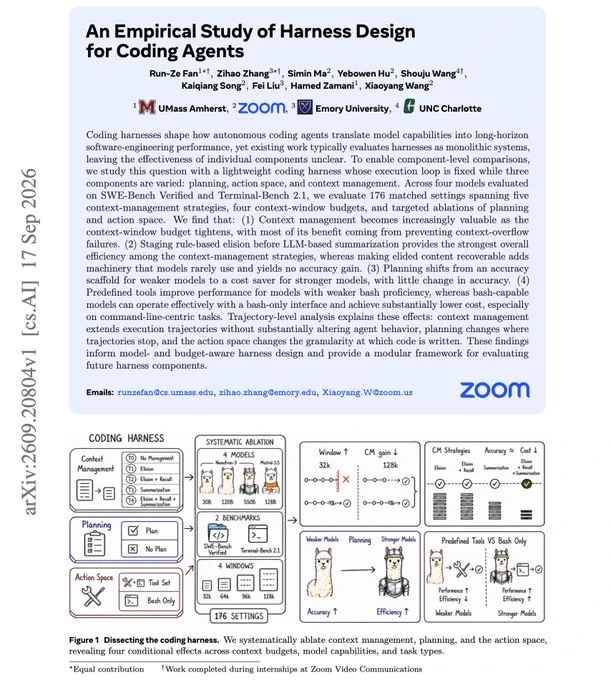
Super interesting work from Zoom and colleagues.
If you maintain a hand-built coding harness, there are some great insights here.
(bookmark it)
They held the execution loop of a coding harness fixed and varied planning, the action space, and context management one at a time.
They did across 176 matched settings, four models, SWE-Bench Verified and Terminal-Bench 2.1.
Context management pays off more as the context window tightens.
Most of its benefit comes from preventing overflow failures rather than from better reasoning.
Staging rule-based elision before LLM summarization gave the best accuracy to cost ratio of the five strategies tested.
Making elided content recoverable added machinery the models rarely used and produced no accuracy gain.
Planning changed role with model strength.
For the weakest model it raised the success rate. For stronger models accuracy barely moved and the gain showed up as lower cost, because planning shortened post-edit verification.
On the action space, predefined tools helped models with weak bash proficiency, while bash-capable models ran a bash-only interface at substantially lower cost on command-line tasks.
Paper:
Show more