Search results for 91216
91216 community
One keyword maps to one global community path.
People
Not Found
Tweets including 91216

Something unusual is unfolding across Iran as multiple pre-strike warning signs appear at once.
▪️ Isfahan air defenses reportedly moved to heightened alert and dispersal, while aircraft were reported entering western Iranian airspace before turning back.
▪️ Unusual drone, fighter and air-defense activity has been reported across northwestern Iran near Urmia, Jolfa and Hadishahr.
▪️ GPS spoofing and electronic warfare intensified around Tehran, while some municipal buildings were reportedly evacuated.
▪️ Six ballistic-missile launchers and a UAV platform were reportedly moved into a civilian tunnel between Khorramabad and Borujerd.
▪️ Fresh explosions were reported around the Strait of Hormuz, while U.S. F-16 movements toward Jordan were separately tracked.
None of this confirms another major strike is imminent, but this many wartime indicators appearing together suggests the Islamic Republic believes something may be coming or is preparing for another escalation.
Show more

🚨 The Islamic Republic tried to stop Trump from attacking it by offering $500 billion in potential business for American companies.
Hassan Qashqavi, spokesman for the Iranian parliament’s National Security Committee, says the Islamic Republic sent its economic diplomacy team into pre-war negotiations with a massive proposal covering oil and gas, mining, aviation, transportation and infrastructure.
The calculation was simple: Trump is a businessman, so give American companies enough economic interest in Iran that confrontation becomes more costly for the United States.
That exposes an extraordinary hypocrisy. For decades, Iranians were told that confronting the United States justified sanctions, isolation and economic sacrifice. Yet when the Islamic Republic itself faced attack, it was prepared to entice American corporations with hundreds of billions of dollars in opportunities across Iran.
The $500 billion was not cash. It represented proposed projects and potential investment, but the strategy behind it is what matters. Islamic Republic officials believed American commercial interests might protect them where missiles, proxies and military deterrence could not.
“Death to America” was imposed on Iranians for decades. When the Islamic Republic itself was in danger, it went looking for a $500 billion deal with Trump.
Show more

🚨 The Islamic Republic is now texting Iranians to come learn how to fight because its existing military and Basij structures are no longer enough to project strength.
The new “Janfada” mobilization is moving from propaganda into training, with the Islamic Republic announcing plans for 1,000 so-called national resistance battalions and mass-texting people about military and relief training.
This comes after state propaganda claimed an astonishing 30 million+ people had volunteered to sacrifice themselves for the country. But registration could reportedly be done with little more than a phone number, while independent scrutiny challenged the enormous official numbers.
And now comes the contradiction: if tens of millions genuinely volunteered and the Islamic Republic already possesses the IRGC, Artesh and a nationwide Basij organization, why does it need another militia structure and mass SMS recruitment campaign?
Because this is as much about projecting strength as possessing it.
After months of war, military losses, economic pressure and internal unrest, the Islamic Republic needs cheap manpower, neighborhood-level control and images of supposed popular mobilization. Mixing “military” training with “relief” training also dramatically broadens who can be counted as participating.
The 1,000 battalions are particularly revealing. Even several hundred fighters per battalion would produce a force measured in the hundreds of thousands, nowhere remotely close to the claimed 30 million-plus “Janfada.”
The Islamic Republic is trying to manufacture the image of a nation mobilized behind it precisely when its vulnerability is becoming harder to conceal.
Strong states demonstrate strength through functioning institutions, credible deterrence and genuine public support. Faltering states inflate loyalty numbers, create new militias, militarize neighborhoods and text the population asking for bodies.
The Islamic Republic wants the world to see millions ready to die for it.
What it is actually showing is how desperately it needs people to believe that.
Show more

🚨 There has been a surge in attacks targeting pro-regime forces and religious authorities in southeastern Iran.
The killing of pro-regime Sunni cleric Yousef Gorgij comes amid heightened armed activity across the region, with security forces and figures aligned with the Islamic Republic increasingly coming under attack.
Southeastern Iran, particularly Balochistan, is becoming an increasingly dangerous pressure point for the Islamic Republic.
Show more
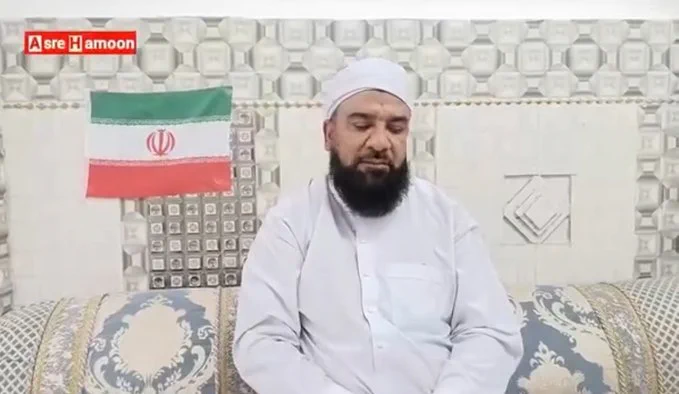
🚨 The Islamic Republic’s police chief just threatened Iranians with another massacre on state TV: “Our finger is on the trigger.”
Ahmadreza Radan called protesters “homeland-sellers” and “enemies,” warning they would be dealt with “firmly.” He then put the police alongside the IRGC, Army and Basij, declaring that all have their fingers on the trigger.
This is a direct threat to repeat the January bloodshed as Iranians suffer under a worsening economic crisis, political repression and suffocating social restrictions. The Islamic Republic has criminalized dissent and protest, threatening Iranians who take to the streets with bullets, imprisonment and death.
This is not an isolated threat. It is consistent with what senior Islamic Republic officials have repeatedly said since the January bloodshed.
IRGC commander Mohammad Pakpour said the IRGC had its “finger on the trigger.” Judiciary chief Gholamhossein Mohseni-Ejei demanded no leniency toward “rioters,” while Mohsen Rezaei later declared that the armed forces’ “hands are still on the trigger.” Radan himself previously warned that anyone taking to the streets “at the enemy’s request” would be treated as the enemy.
Radan was already national police commander when security forces used live ammunition against protesters in January. Now the same commander is publicly announcing that the doctrine remains: label protesters traitors and enemies, then threaten them with battlefield force.
January showed what “finger on the trigger” can mean. Now multiple senior officials are warning Iranians that the same apparatus remains ready to do it again.
Show more

🚨 The Islamic Republic now admits its forces were not in Syria to protect holy shrines. They were there to protect Bashar al-Assad as his forces and allies committed war crimes in a war that killed more than half a million people.
For years, the Islamic Republic sold its intervention under the banner of the “Defenders of the Shrine,” using religion to mobilize Iranians and foreign Shia fighters for Assad’s war.
Iranians, Afghans from Fatemiyoun, Pakistanis from Zainabiyoun, Iraqi militias and Hezbollah fighters were sent into Syria under this religious narrative, while Iranians who challenged it could face accusations of insulting the Ahl al-Bayt.
Now, after Assad’s fall, a Shia cleric featured in the circulating clip says Zainab’s actual body is not buried at the Syrian site and describes it instead as a symbolic shrine.
That strikes directly at one of the most powerful narratives the Islamic Republic used to justify years of bloodshed and intervention.
The real strategic objective was keeping Assad in power, preserving the Islamic Republic’s corridor to Hezbollah and maintaining its military and political foothold in Syria and the eastern Mediterranean.
The religious framing helped sell that geopolitical project to Shia communities across the region.
More than 500,000 people were killed during the Syrian civil war, with some monitoring organizations placing the overall death toll above 600,000. The Islamic Republic poured IRGC personnel, weapons, money and tens of thousands of foreign and terroristic Shia fighters into Syria to keep Assad in power and sustain the war.
They called it defending the shrines.
It was about defending Assad and the Islamic Republic’s regional empire.
Show more

🚨 American military advisers and IRGC officers are now facing off through opposing sides of the escalating war in Yemen.
CNN reports that more than 100 U.S. military advisers are operating in Saudi Arabia, with one U.S. official putting the number at roughly 200. At the same time, U.S. officials assess that hundreds of IRGC officers are inside Yemen working alongside the Houthis.
This is not yet a direct United States-IRGC ground battle, but the two sides are increasingly embedded in opposing military efforts.
American advisers are working inside a newly established Saudi joint forces command, providing intelligence sharing, geospatial targeting and real-time battlefield tracking technology reportedly comparable to the Pentagon’s Maven system.
But there is a hard limit to that support. Axios reports that President Trump has ruled out the United States directly joining Saudi Arabia’s war against the Houthis. American forces are not flying strike missions, participating in Saudi strikes or refueling Saudi aircraft.
So while American advisers are helping Saudi forces understand and track the battlefield, Saudi Arabia is still expected to fight the war itself.
On the other side, the reported IRGC presence is far more extensive.
U.S. officials believe hundreds of IRGC officers are assisting the Houthis, with one official assessing that they are ultimately working toward the ability to close Bab al-Mandab.
That warning comes as the Houthis have seized Mocha, roughly 75 km north of the strait, and pushed government-aligned forces south toward Dhubab while expanding operations around the nearby islands.
The geography explains why this confrontation matters far beyond Yemen.
The Islamic Republic is already disrupting the Strait of Hormuz. Saudi Arabia has consequently become increasingly dependent on the Red Sea as an alternative route for its oil exports.
Now the Houthis are advancing toward the other end of that route.
Hormuz in the east. Bab al-Mandab in the west.
The Islamic Republic does not need to physically close both waterways. Sustained missile, drone and anti-ship threats can disrupt shipping, increase insurance costs, force rerouting and put enormous pressure on global energy markets.
Saudi Arabia therefore finds itself in an increasingly difficult position. It is absorbing Houthi ballistic missile and drone attacks while its Yemeni partners lose strategic territory, hundreds of IRGC officers are reportedly operating across the border, and American advisers are helping Saudi forces with intelligence and targeting.
But the United States has drawn the line at joining the actual fight.
What began as another chapter of the Yemen war is increasingly becoming another arena in the wider confrontation between the United States and the Islamic Republic, with American and IRGC personnel supporting opposing sides of the battlefield.
For now, they are not directly fighting one another.
But the distance between those two sides is getting increasingly smaller.
Show more

🚨 The Islamic Republic used AI to turn state propaganda into fake grassroots opinion across multiple languages and platforms.
According to Anthropic’s latest threat-intelligence report, Iranian state-aligned operators were caught using Claude as a tool for a sophisticated influence operation designed to hide where Islamic Republic narratives were actually coming from.
This went far beyond generating a few social media posts.
Operators used AI to build fake personas, campaign strategies, targeting databases, amplification schedules and multilingual content in Farsi, Arabic, Urdu, Malay, Spanish and English. The objective was to make state messaging appear to come from ordinary citizens, independent commentators and foreign voices.
Even more brazenly, they reportedly instructed Claude to write in the voice of an IRGC spokesman, then repackage state talking points to resemble independent analysis from major American institutions such as CSIS, Brookings and RAND.
Those institutions are not implicated. Their credibility was effectively part of what the influence operation sought to imitate.
A Mashhad-based operation developed a content factory called “Manjanegh” or “Catapult,” where activists and personas could take security-service material, remove the obvious IRGC fingerprint and distribute it across social media.
The planned ecosystem stretched across X, Instagram, Telegram, TikTok, YouTube and Iranian platforms, combining personas, coordinated hashtags, paid amplification and carefully timed campaigns intended to manufacture the appearance of organic public opinion.
And propaganda was only part of what Anthropic uncovered.
Iran-linked operators also used Claude in work involving analysis of more than 155,000 tweets and the profiling of Iranians, while another effort involved a malicious Firefox extension disguised as a prayer-times tool.
Other Iran-linked accounts used Claude for open-source research involving U.S. Navy ships and personnel, including ship tracking, satellite-imagery research and publicly available information on American personnel.
State-aligned operators even used the AI for organizational planning surrounding the Supreme Leader’s funeral and succession.
There is an important distinction: Anthropic did not document Claude autonomously operating some enormous army of thousands of bots.
What it documented is arguably more calculated: a state influence apparatus using AI to industrialize propaganda, manufacture identities, translate narratives, disguise their origin and coordinate how they spread.
Anthropic says the accounts were identified and shut down.
The next time dozens of supposedly independent accounts suddenly repeat the same Islamic Republic narrative in different languages, remember that manufacturing the appearance of grassroots opinion was reportedly part of the strategy.
Show more

🚨 The Houthis have seized the strategic port of Mocha, bringing the Islamic Republic’s most powerful remaining proxy dangerously closer to the Bab al-Mandab chokepoint.
Over the past 48 hours, Houthi forces have rapidly pushed south along Yemen’s Red Sea coast, taking Hays, Al-Khawkhah, Al-Wazi’iyah, Mawza, the Khalid ibn al-Walid camp and Mocha, while Saudi-backed Yemeni forces retreated toward Dhubab, much closer to the strait.
⚓ Mocha dramatically improves the Houthis’ position on the Red Sea. The port sits roughly 60–75 km north of Bab al-Mandab. Consolidating Mocha gives the Houthis another coastal position and brings them closer to Dhubab and Perim Island, directly overlooking one of the world’s most important shipping arteries.
✈️ Saudi Arabia has enormous airpower, but has so far stopped short of fully committing it to the coastal battle. Saudi aircraft have conducted strikes across Yemen, but air support has been intermittent and poorly integrated with the forces actually trying to hold the Hays–Al-Khawkhah–Mocha line. When Houthi drones, missiles and ground forces applied pressure, the line collapsed.
🎯 Saudi caution is becoming a strategic liability. The Houthis have demonstrated that they can retaliate against Abha, Khamis Mushait, Jazan, Najran, Saudi air bases and energy infrastructure. Saudi Arabia therefore faces an ugly calculation: intensify sustained air operations in Yemen and risk heavier retaliation at home, or remain cautious while the Houthis continue taking strategically valuable territory.
🛢️ The timing makes the loss of Mocha even more dangerous. With the Strait of Hormuz already heavily constrained by the wider conflict with the Islamic Republic, Saudi Arabia has become increasingly dependent on moving crude westward toward its Red Sea infrastructure. That makes the security of Bab al-Mandab even more important.
🚢 The Houthis do not need to physically close the strait to inflict serious economic damage. A position closer to Bab al-Mandab can shorten the distance for drones, missiles, mines and small-boat operations. Even the credible threat of attacks can increase insurance costs, discourage commercial traffic and force vessels around Africa.
⚔️ The collapse also exposes the weakness of Saudi Arabia’s ground strategy. After more than a decade of war and enormous military spending, Saudi-backed forces remain fragmented and heavily dependent on outside air support. The Houthis, by comparison, have a more centralized command structure and have become increasingly effective at integrating infantry with drones and missiles supplied or enabled by the Islamic Republic.
This is becoming especially important for Iran. With Hezbollah severely degraded, Assad gone and the Islamic Republic itself under enormous military and economic pressure, the Houthis are one of the most strategically valuable pieces remaining in its regional network.
And now that proxy is moving toward terrain that could give it greater leverage over the Red Sea precisely when the Persian Gulf route is under severe pressure.
Saudi Arabia has the aircraft, weapons and resources to confront this offensive much more aggressively. But its reluctance to fully commit them is giving the Houthis something airpower was supposed to prevent: strategic territory.
If the Houthis consolidate Mocha and continue toward Dhubab and Bab al-Mandab, Saudi hesitation could turn a battlefield setback into a threat to one of the world’s most important energy and shipping corridors.
Show more

🚨 An Iranian protestor who was being hunted by the Islamic Republic’s repressive forces detonated a grenade, killing himself and two Islamic Republic terror agents.
Mojtaba Babakhani, a participant in Iran’s January uprising who had been living in hiding for months to evade arrest, has died during a confrontation with Islamic Republic security forces in Mehran, Ilam Province.
Babakhani and his brother had reportedly gone into hiding after participating in the December 2025–January 2026 protests and subsequently being pursued by security forces.
Security forces surrounded their hideout and moved in to arrest them. During the confrontation, Babakhani reportedly detonated a grenade, killing himself. Two security personnel were also reported killed and several others wounded, although accounts differ on the casualties.
His brother, Shoja Babakhani, reportedly escaped the initial siege.
Months after the January uprising, the Islamic Republic is still hunting those who took to the streets against it. Mojtaba Babakhani spent his final months in hiding because he participated in those protests, and ultimately died when the security forces hunting him finally closed in.
Show more
