Search results for 9370
9370 community
One keyword maps to one global community path.
People
Not Found
Tweets including 9370

Lol, the market picks a side, and it's easy to tell which one it's chosen right now.
Elon told the world a few days ago during SpaceX $SPCX earnings that AI is going to be compute-short for a long time... the market shrugged it off and goes, "sure sure, Elon exaggerates all the time"
Elon says many small neoclouds won't survive, and the market triples the weight of these claims: "SEE I TOLD YOU, ELON SAID IT, SO IT MUST BE RIGHT"
Show more

Lol had a small getaway weekend with the wife at the city.... And came back to the end of the neocloud market part 2.
Soo the person that wants to turn on over 13GW of compute in a market that is constraints in various things is also trying to scare the market from working with other smaller players.
Hey don't work with that neocloud!! They might burst, but you know who won't burst! SpaceX, so don't make power deals with the smaller players, maybe don't sell chips to them, but you can sell it to me!!
Show more

Wait, did a stock split happen to my portfolio? Weird, I didn't get the extra shares, just the change in stock price.
Have to call my broker about the error.

Soo days like today, I'm like, "Am I really the only crazy one buying right now"

This Is What the Chip Happened to Semiconductor and AI Investors Today!
NVIDIA $NVDA expands the supply chain: At GTC Berlin, NVIDIA outlined partner plans for 2.5× substrate capacity over three years. Amkor $AMKR plans to increase South Korean interposer-wafer capacity by more than 300% by end-2028, while SPIL targets 15× optical-engine manufacturing capacity by mid-2027. NVIDIA also plans twice the testing capacity in 2027 versus 2026, including a $1.1B capacity-reservation advance supporting new U.S. facilities. Its DSX POD containers arrive integrated, cabled, piped and tested. NVIDIA says deployment can fall from six months to as little as 14 days at a prepared site with power, cooling and networking ready; worldwide partner availability is planned for early 2027.
Meta $META pairs ad growth with a bigger AI buildout: Q3 revenue reached $64.60B, up 26%, versus the $63.37B LSEG estimate reported by Reuters. Ad impressions rose 10% and average ad prices increased 14%. Zuckerberg said more than 10M users in the U.S. and Canada had set up Muse agents in about six weeks, with approximately 25% using them on a given day. Transaction fees and additional subscriptions remain planned monetization routes. Full-year capex guidance, including finance-lease principal payments, narrowed to $135–145B from $130–145B. GAAP EPS was $3.83, including a $9.89B legal-agreement charge; removing that charge alone would put EPS at $7.40. Q4 revenue guidance is $73–76B.
Lam Research $LRCX sees a larger equipment market ahead: September-quarter revenue reached $8.22B, up 22% sequentially, with non-GAAP EPS of $2.20 versus the $8.14B and $2.17 consensus reported by EarningsWhispers. Systems revenue rose to $5.73B from $4.25B, while customer support and other revenue was nearly unchanged at $2.49B. December-quarter guidance calls for $8.60B ± $400M in revenue and $2.33 ± $0.15 in non-GAAP EPS. Management’s preliminary wafer-fabrication-equipment outlook exceeds $200B for 2027, versus the mid-$150Bs for 2026. That is an industry-spending forecast, not booked revenue, and supply and cleanroom timing could delay shipments.
Tesla $TSLA grows storage deployments, but energy revenue falls: Tesla deployed 13.7 GWh of energy storage in Q3, up 10% year over year, while energy revenue fell 16% to $2.881B. Its 33.1% energy gross margin benefited from tariff refunds and warranty reimbursements, so that margin should not be treated as a clean ongoing run rate. Across Tesla, revenue was $28.05B and non-GAAP EPS was $0.48, versus $28.34B and $0.45 in Tesla’s pre-release compilation of analyst estimates. Free cash flow reached $1.53B, with operating cash flow of $6.26B and capex of $4.73B. Tesla also plans 400 MW of training compute by year-end for vehicle and humanoid autonomy software.
Micron $MU maps its next memory ramps: Micron’s October 21 technology presentation targets second-half 2027 ramps for 1-delta DRAM and G11 NAND. G11 targets approximately twice G9’s bit density, using more than 400 layers and wafer-on-wafer bonding. The presentation also places 3D DRAM in development on a directional roadmap without a launch date. The 2027 timing belongs to the planned 1-delta and G11 ramps, not a confirmed 3D DRAM launch.
Show more
$META’s first earnings-call question gets to the economics of scaling Muse.
Morgan Stanley’s Brian Nowak asked what constrains user growth and what Meta wants to build in enterprise AI.
Zuckerberg said Muse passed 10M setups in the U.S. and Canada in its first six weeks, but compute intensity is one reason it hasn’t launched globally. Local optimization and connectors also need work.
Serving a potential billion-plus people depends on hitting compute-efficiency targets. Mark expects that work to remain a limiting factor over the next year, alongside building the business around the product.
There’s already a product ladder: Spark powers the free tier, Wonder is available in the paid tier, and Meta is developing a more efficient Wonder version for broader distribution.
For enterprise, the near-term offering is model APIs, Muse Code and business agents. Longer term, Mark wants consumer and business agents interacting directly, including for commerce.
CFO Susan Li added the financial framework: diversified recurring revenue through subscriptions, usage-based APIs, messaging and other services. She expects that opportunity to develop over multiple years, with investment scaling behind demonstrated customer demand and product-market fit.
That answer puts two practical conditions on expansion: cheaper compute and evidence customers want the products. Li didn’t provide a new enterprise revenue target or capex figure.
Show more

This is bullish for semiconductor equipment demand. $LRCX now sees preliminary 2027 wafer-fab equipment spending ABOVE $200B, compared with the mid-$150B range in 2026. $ASML $AMAT $TSM
CEO Tim Archer expects DRAM to lead percentage growth, followed by leading-edge foundry/logic, then NAND. That puts both AI memory and advanced chip manufacturing behind the spending expansion. $MU
Lam also expects calendar 2026 systems revenue growth well above 40%, including the midpoint of its December-quarter guidance.
The constraint isn’t simply whether customers want more capacity. Management says cleanroom availability and component supply will continue limiting how quickly the industry can meet demand into 2027.
For equipment investors, that’s an important distinction: a strong spending outlook can coexist with bottlenecks that affect delivery timing.
My takeaway: the quarterly stock reaction and the longer-term equipment opportunity are two different conversations. Lam’s preliminary outlook points to a much larger equipment market, although it doesn’t guarantee equal growth for every supplie
Show more

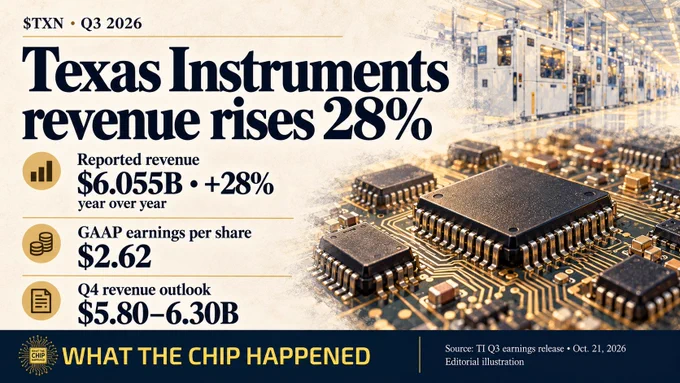
Texas Instruments $TXN reported $6.06B in Q3 revenue, up 28% year over year and 11% sequentially, ahead of the $5.94B FactSet estimate reported by IBD.
Analog revenue grew 32% to $4.91B, while embedded processing increased 21% to $858M. CEO Haviv Ilan described “continued broad growth in industrial, automotive and data center.”
The live call adds a useful detail: management says data-center revenue grew approximately 95% year over year and 20% sequentially. Industrial grew more than 40% annually, while automotive grew in the mid-teens.
GAAP EPS was $2.62. Q4 guidance is $5.80–6.30B revenue and $2.45–2.79 EPS. The $6.05B revenue midpoint is above the $5.76B FactSet estimate reported by IBD, but roughly flat with Q3.
So this isn’t only an AI data-center story. TI is reporting growth across analog, embedded, industrial and automotive, with data centers growing particularly quickly.
Show more
$TSLA missed revenue expectations slightly, beat adjusted EPS, and delivered a much bigger cash-flow surprise.
Against Tesla’s October 19 company-compiled analyst averages:
Revenue: $28.046B vs $28.341B expected.
Non-GAAP EPS: $0.48 vs $0.45.
GAAP EPS: $0.22 vs $0.23.
Gross margin: 19.6% vs 17.9%.
Free cash flow: positive $1.531B vs negative $4.506B.
The cash-flow difference needs context. Capex was $4.732B versus $7.771B expected, while operating cash flow was $6.263B versus $3.267B. Both lower spending and stronger operating cash generation contributed.
Automotive gross margin excluding regulatory credits improved to 18.1% from 16.3% sequentially. Tesla also says Cybercabs entered the Austin Robotaxi fleet, Semi volume production began in Nevada, and Optimus production began in Fremont.
Show more
