Search results for ME_I_FLUTE
ME_I_FLUTE community
One keyword maps to one global community path.
People
Not Found
Tweets including ME_I_FLUTE

why do i get so flustered when someone calls me a good girl... like sir i'm just trying to exist
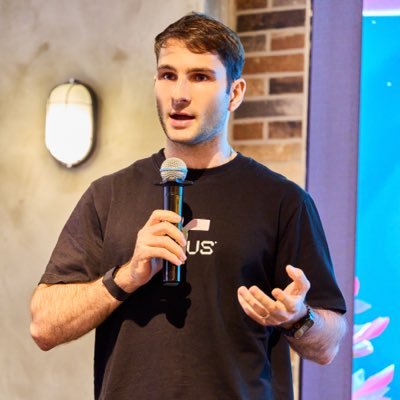
In my first investor meetings, I was the quiet one in the room.
I didn't bring commanding energy, nor rehearsed one-liners. Just someone trying to be straight about what I was building and why.
What I didn't expect was that this would actually work.
What showed was the ability to grasp complex topics fast and explain them back clearly. When a hard question came in, I didn't get flustered but I broke it down and answered it straight.
Over a few meetings, I think they started to see something else too: that I was an operator. Someone who would organize, execute, and not leave loose ends.
But the thing that closed it was commitment. I showed I would go the extra mile because I was performing conviction and because I genuinely would.
They could feel the difference.
I've since read a lot about what makes a great fundraiser.
The charisma, the timing, the nervous system regulation when the room is ready to write a check. All real. But there's another path nobody talks about enough.
Investors don't just back ideas. They back people they believe will figure it out.
And "will figure it out" doesn't always look like confidence. Sometimes it looks like depth.
The person who does the homework, follows through on the small things, shows up the same whether there's a deal on the table or not.
I wasn't the loudest founder in the room. But I think they felt like no obstacle between now and the outcome they wanted would stop me from grinding through it.
That's its own kind of conviction. Quieter than most people describe it. But the investors who've worked with me longest recognized it the moment they saw it.
You don't have to change who you are to raise. You have to make the thing that's true about you impossible to miss.
Show more

I was feeling the @flueai FOMO, so I finally built something!
It's a little automation that emails me a daily digest of GitHub activity for repos I'm watching.
Check it out, fork it, and make your own thing.
Show more


I've been working with Char, my (human!) assistant from @oceanstalent for 6 months.
I think the best assistants today need to know how to work with AI agents.
Char uses Claude Code and Codex to help me run podcast post-production, draft show notes, and make clips. He's made copies of my AI skills and tailored them for his own workflows over time.
If you want to hire vetted, AI-fluent operators who can help you run your business, check out Oceans at
#sponsored#
Show more


A turtle “claw fluttering”, a mating ritual where a male rapidly waves his front claws near the female’s face to attract her.
Who says romance is dead. Instead of butterfly kisses, they should be called turtle kisses. "Girl, my man, he fluttered me so good yesterday, I couldn't see straight for an hour!"
Show more


Gavin Baker says Grok Bot feels like another ChatGPT moment because it turns hours of Claude Code work into seconds:
"You see these 23-year-old kids and just the way they use AI, they're just fluent and native in it. I just feel like maybe in a way that no matter how hard I try, I will never be, and I'm trying really hard."
"We got Claude Code. I built some stuff, did some cool stuff, and in, I don't know, 3 minutes of creating Grok Bots, I had much better versions of everything I created."
"I love having a podcast summarizer... It takes 10 seconds in Grok Bot. It's amazing, and it's so good."
"A Substack summarizer, an X summarizer, an X sentiment tracker for topics and stocks... All of those would have taken me hours working with Claude Code, and they each took 7 to 12 seconds with Grok Bot. And it's better."
"To me, Grok Bot does feel like another ChatGPT moment."
@GavinSBaker @DavidGeorge83
Show more

Gavin Baker says Grok Bot feels like another ChatGPT moment because it turns hours of Claude Code work into seconds:
"You see these 23-year-old kids and just the way they use AI, they're just fluent and native in it. I just feel like maybe in a way that no matter how hard I try, I will never be, and I'm trying really hard."
"We got Claude Code. I built some stuff, did some cool stuff, and in, I don't know, 3 minutes of creating Grok Bots, I had much better versions of everything I created."
"I love having a podcast summarizer... It takes 10 seconds in Grok Bot. It's amazing, and it's so good."
"A Substack summarizer, an X summarizer, an X sentiment tracker for topics and stocks... All of those would have taken me hours working with Claude Code, and they each took 7 to 12 seconds with Grok Bot. And it's better."
"To me, Grok Bot does feel like another ChatGPT moment."
@GavinSBaker @DavidGeorge83
Show more

Gavin Baker and a16z's David George on the state of the AI boom:
The future doesn't have to be winner-take-all. Labs, open-source, applications, and the clouds can all capture value.
Demand for intelligence is still dramatically underestimated. Today's power users number in the millions and will grow to hundreds of millions. Gavin and David argue a compute shortage is a more real risk than an AI bubble, and building through it is an opportunity to reindustrialize America.
In this episode, they get into why compute investments pay back so fast, what the data center backlash gets wrong, the case for putting compute in orbit, why enterprises will run several models at once, and how Nvidia ended up at the center of the entire supply chain.
00:00 Intro
01:06 The bear case Gavin couldn't find
05:50 Why a lab would cut its own revenue 75%
08:05 What LPs get wrong about a crash
10:50 Microsoft slowed its capex and regrets it
14:33 The engineers spending 100x the median
17:35 Why 23-year-olds use AI better than Gavin
21:45 How much copper 500M AI users need
23:00 Stop promising to cure cancer
26:00 America's richest county is full of data centers
30:48 Who gets priced out of compute
33:05 The age of Elon and Jensen
34:25 Orbital data centers
44:40 Asteroid mining
48:12 Why Microsoft doesn't need a frontier model
54:02 Who becomes the abstraction layer
55:40 Everyone wanted a deity, Cursor wanted a product
1:00:25 Never take shots at Jensen
1:07:40 What happens when the chip doesn't work
1:12:10 What chip deals reveal about customer demand
YouTube:
@GavinSBaker @DavidGeorge83
Show more


Today’s #China# news had many layers. @realDonaldTrump in Beijing; Xi hosting a high-stakes summit; @elonmusk making faces...
But for me, there was another very human moment.
I spotted a familiar face on TV: Cheng Lei.
We used to do TV crossovers back in the CCTV days, when I was at @Reuters which had a partnership with CCTV for financial news. (That kind of partnership is almost unimaginable today.)
And Cheng Lei was one of the most recognizable English-language business anchors in China. Sharp, professional, fluent across cultures. A face of China’s opening to the world.
Then one day - she was arrested as a spy! In 2020, Cheng Lei was detained in China. She was accused of supplying state secrets overseas and spent more than three years in custody before being released in 2023.
By her own account, the ordeal was not only legal or political. It was deeply human: isolation, uncertainty, separation from her children, and the mental pressure of being caught inside something much larger than herself.
She lost 1,154 days. And today, there she was again — on Australian television, analyzing Trump’s China visit.
That image gave me déjà vu — and goosebumps.
Because U.S.-China relations are not only about tariffs, semiconductors, Taiwan, AI, supply chains, or state banquets.
They are also about people.
Journalists. Translators. Entrepreneurs. Students. Families. Immigrants. People who once believed they could move between worlds, explain one side to the other, and build bridges through language, trust, and shared curiosity.
Some of those bridges are now broken. Some became dangerous and some people paid a very real price.
Cheng Lei’s story is a reminder of how quickly the world can change — and how personal geopolitics can become.
The silver lining is - after years of silence, she can return to the screen with her own voice.
That is resilience.
Watching her today, I felt both a sense of sadness and admiration.
Sadness for the world we lost. Admiration for a woman who survived, came home, rebuilt her life, and returned to journalism on her own terms.
In the middle of another Trump-Xi summit, maybe this is the angle worth remembering:
Great power politics is never abstract.
Behind every diplomatic reset, every strategic rivalry, every headline about “China” and “America,” there are human lives being reshaped.
And sometimes, the most powerful story is not only the leaders on the stage. It is the familiar face who made it back to the screen. 🫶
Show more


Germany is in panic over Chinese companies taking over its markets at home, abroad and in China. Having spent quite some time in China in the 2010s, I can’t help but thinking back to the arrogance and quite frankly racism of German expat businesses people. Chinese engineers with Ivy League degrees speaking fluent English and German looked down upon by German engineers with a degree from some German university, unimpressive English and less than two sentences of Chinese. The Germans didn’t see it coming because they couldn’t imagine Chinese people becoming better at what they are doing than themselves. An industry insider told me at the time how keen Chinese entrepreneurs were to collaborate with German car companies on EV development. But all the Germans worried about was they are going to steal our IP. Well, here we are.
Show more