Search results for TheHouse』
TheHouse』 community
One keyword maps to one global community path.
People
Not Found
Tweets including TheHouse』

The members of the House Freedom Caucus are always fighting the Swamp to advance President Trump's MAGA America First Agenda.


The House just voted 215–208 to end an undeclared war. Mark Levin's response was to call a principled, decorated constitutionalist a "moron."
So let's settle who actually read Article I.
Madison. Lincoln. The actual text. And the one place the war power can still be enforced.
Show more


The House of the Dragon Season 3 trailer gave us dragons, battles, and some incredible visuals, but a few moments felt strangely familiar.
Are these intentional callbacks, visual parallels, or something else entirely?
Show more


The president’s focus on the House Democratic leader is part of his battle plan for November.


The biggest crypto regulation bill in 15 years just passed and $10 TRILLION is about to get injected on chain
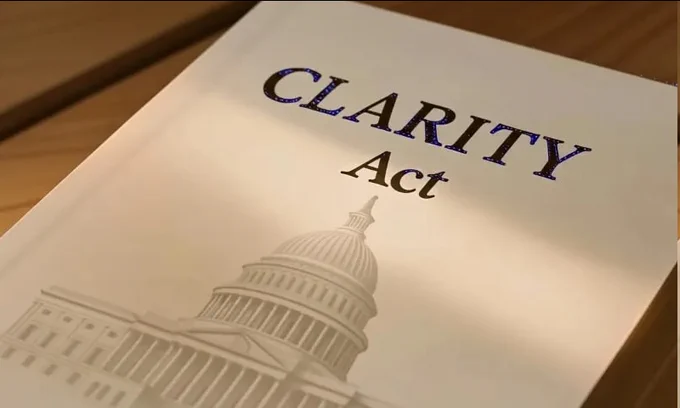
Yesterday, May 14, 2026, the US Senate Banking Committee advanced the Digital Asset Market Clarity Act
The bill already passed the House in July 2025 by a cross party vote of 294 to 134
Treasury Secretary Scott Bessent has signaled a spring 2026 signing timeline and Polymarket currently prices the odds of passing it in 2026 at 67%
This is the first comprehensive piece of US digital asset market structure legislation in 15 years and its scope reaches well beyond crypto
The CLARITY Act splits regulatory power between the SEC and CFTC for the first time
Digital commodities fall under CFTC oversight in spot markets while investment contracts and tokenized securities remain under SEC authority
The bill automatically classifies any token with an approved or pending ETF as of January 1, 2026 as a commodity, fast tracking BTC, ETH, XRP, SOL, LTC, HBAR, DOGE and LINK
This single change ends a regulatory pattern that has shaped the industry since 2018, going after companies through lawsuits instead of clear rules
Grayscale and a16z both note that until 2025, the SEC had active investigations or lawsuits against Coinbase, Ripple, Binance, Robinhood, Consensys, Uniswap and OpenSea
All those active lawsuits kept the biggest investors out of crypto
US listed Bitcoin and Ethereum ETFs made $115 billion in net inflows from launch through 2025 and Ethereum based funds alone gathered roughly $12 billion
Standard Chartered's Geoffrey Kendrick projects tokenized real world assets to expand from $35 billion today to $2 trillion by 2028, which is a 56x increase
This is the missing piece that converts those projections into deployable capital
Grayscale's 2026 outlook expects the legislation to bring deeper integration between public blockchains and traditional finance
They also forecast new Bitcoin all time highs in the first half of 2026 on the strength of regulatory clarity alone
The bill also restructures the entire stablecoin business model
Earning yield just for holding stablecoins is now banned, while rewards from active use like staking, liquidity provision and governance are still allowed
The market has already priced this
Circle, the issuer of USDC, lost 20% in a single trading session on the March draft and Coinbase fell 9% the same day
Tether, which never passed reserve income to USDT holders, was completely unaffected
With USDT sitting at $184 billion in market cap compared to USDC at $78 billion, the gap is likely to widen under the new framework
For traditional finance, the stablecoin reset is the real prize
The American Bankers Association estimates yield generating stablecoins could pull $500 billion out of US bank deposits by 2028
This compromise is designed to protect bank balance sheets while letting stablecoins remain functional payment instruments
Section 309 of the bill provides explicit legal exclusion for non custodial DeFi protocols from broker, dealer and exchange registration requirements
Section 203 confirms that staking rewards don't count as the offer or sale of a security
This is the most lobbied piece of the entire bill and getting it included is why Coinbase went from fighting it to backing it in January 2026
Hyperliquid, Aave, Uniswap, Ethena and Compound all fall directly under this legal protection
The biggest impact is on traditional finance
Bloomberg Intelligence analyst James Seyffart projects the RWA market to grow from $15 billion today to over $100 billion within three to five years if the bill becomes law
DTCC, which clears $3 trillion in US securities annually, plans to launch tokenized real world asset trading in July 2026
JP Morgan tokenized a private equity fund in October 2025 and Franklin Templeton partnered with Binance in September
Reports say Walmart and Amazon are exploring their own corporate stablecoins
All this infrastructure is being built and the CLARITY Act gives compliance teams the legal foundation they've been waiting for before their firms can actually invest
The bill still needs 60 votes in the full Senate, which requires 7 Democrats to switch sides
Seeking Alpha currently estimates 50/50 odds for it to pass in 2026 but three problems still haven't been resolved
The ethics rule that bans government officials from launching their own tokens directly targets the Trump family's WLFI, state securities regulators argue the bill weakens the SEC too much and the CFTC rulemaking could take until late 2026 or 2027
If it doesn't pass before the November 2026 midterms, the final legislation would likely get pushed into 2027 or later
The CLARITY Act is not a price catalyst on its own, it's an infrastructure shift
Once the legal framework is in place, every institution that's been waiting to enter regulated digital asset markets finally has a clear path in
For one single asset, the Bitcoin ETF alone brought $115 billion in 18 months
This bill extends the same framework to altcoin ETFs, staking products, tokenized securities and the entire $10 trillion RWA opportunity
The next six weeks will determine whether 2026 becomes the year US digital asset infrastructure rebuilds or whether the industry waits another 18 months for the next attempt
Show more

The USA’s number one grifter teams up with the least qualified member of the House and giant Wall Street firms to strip the dream of home ownership from a generation of young Americans.
Sad, pathetic, and a disgrace!
Show more


The Senate unanimously passed the Maverick Act to bring the F-14 Tomcat back to American skies. They have all the parts to build one, just have to make it legal. Sen. Sheehy lead the charge on this, now it’s on the House. @HouseGOP, don’t blow this.
Show more

NEW: The F-14 Tomcat may fly again over the United States for the first time in nearly 20 years.
The Senate has unanimously passed the "Maverick Act," which would transfer 3 retired F-14Ds from an Arizona boneyard to the U.S. Space & Rocket Center museum in Huntsville, Alabama.
The Navy would reportedly supply enough spare parts to get one of them airborne again.
The bill was introduced by former Navy SEAL Sen. Tim Sheehy, and is being championed by NASA Administrator Jared Isaacman.
It now heads to the House for final passage, possibly in time for America’s 250th birthday. The last Navy F-14 was retired in September 2006.
Video: @aaronrheins
Show more


The UK government is considering new rules on social media for children under 16.
Some people in the House of Lords want a strict ban, saying it should start in 12 months, but the government wants more time and could take up to 3 years.
Australia introduced a ban for under-16s in December 2025, but it has not worked well. Surveys show more than 60% of teens aged 12 to 15 still use the main platforms.
A full ban would require age checks and ID verification for everyone online, and we know how many data breaches occur these days.
As I always said parental controls are a better way, the tools let parents set time limits, block certain apps or features and control children's activities.
Show more


The Clarity Act (to be passed by the House of Representatives in 2025, with the Senate still pushing forward) further categorizes digital assets into three types: Digital Commodities (such as Bitcoin and Ethereum), which are essentially tied to the functions of the blockchain system and are regulated by the CFTC; Investment Contract Assets (similar to securities), regulated by the SEC; and Permitted Payment Stablecoins, regulated by banks.
This act will separate the previously attempted unified definition of attributes: stablecoins will primarily handle application-level payment/settlement functions (subject to strict reserve and redemption rules), while retaining the value store function as a crucial element of Bitcoin's value maintenance role, assuming the attributes of speculative assets and commodities, rather than everyday currency functions.
Show more

The champs are in the house 🏆
Michigan men's basketball pulled up to Magic-Pistons 🔥
