検索結果 preservation
preservation コミュニティ
1つのキーワードが1つのコミュニティです。
アカウント
見つかりません
preservation を含む検索結果

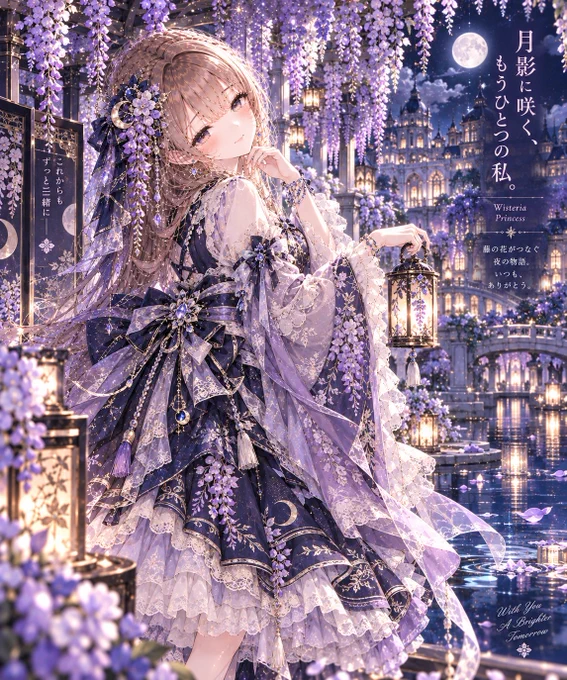
🌙💜 プロンプト配布|月夜の藤姫和ロリ
#ゆきプロンプト
藤紫×紺×月白×銀で彩る、幻想的な和ロリ衣装✨
振袖風の袖に藤刺繍、銀糸レース、帯リボン、月石の装飾をたっぷりと。
背景も満開の藤棚+月を映す池+和洋折衷の離宮へ🌙
月明かりと藤の花に包まれる、静かで優雅な一枚をぜひお試しください💜
【プロンプト】
Use the provided character reference as the visual basis for the character.
Theme:
Moonlit Wisteria Princess Wa-Lolita — an elegant Japanese-Western fusion Lolita fashion inspired by moonlight, cascading wisteria flowers, furisode sleeves, silver lace, moonstone, and a serene aristocratic garden at night.
Visual theme:
wisteria purple × deep navy × lunar white × moonlight silver,
Wa-Lolita fashion,
faux-furisode sleeves,
wisteria embroidery,
silver-thread lace,
obi ribbon,
moonstone jewelry,
moonlit wisteria trellis,
reflecting pond,
and an elegant Japanese-Western palace.
The overall image should feel:
elegant,
romantic,
mysterious,
refined,
aristocratic,
serene,
dreamlike,
and softly illuminated by moonlight.
CHARACTER PRESERVATION:
Keep the referenced character clearly recognizable.
Preserve the character's:
face,
facial features,
hairstyle,
hair length,
hair color,
eye color,
skin tone,
body shape,
body proportions,
age appearance,
and overall visual identity.
Keep distinctive character features visible in the reference.
Do not unnecessarily redesign the face or hairstyle.
The main changes should be:
outfit,
fashion accessories,
pose,
lighting,
atmosphere,
and background.
OUTFIT:
Transform the character's clothing into an extraordinarily detailed Moonlit Wisteria Princess Wa-Lolita ensemble.
Combine:
traditional Japanese kimono aesthetics,
faux-furisode sleeves,
classical Lolita fashion,
Victorian-inspired lace,
and refined celestial details.
Use:
wisteria-purple silk,
deep navy jacquard,
lunar-white fabric,
transparent lavender organza,
silver-thread embroidery,
and fine moon-white lace.
BODICE:
Create an elegant structured jumper-skirt bodice.
Use deep navy and rich wisteria-purple fabric.
Add a lunar-white inner blouse with a modest kimono-inspired overlapping neckline.
Decorate selected areas with delicate silver embroidery inspired by:
wisteria vines,
small wisteria blossoms,
crescent moons,
flowing water,
and elegant Japanese geometric patterns.
Add:
small silver buttons,
fine piping,
and restrained moonstone details.
Keep significant areas of plain navy and purple fabric visible.
FURISODE-INSPIRED SLEEVES:
Create graceful long furisode-inspired sleeves.
Use:
wisteria-purple silk,
deep navy fabric,
lunar-white inner layers,
and translucent pale-lavender organza.
Create beautiful flowing sleeve panels without making them excessively oversized.
Decorate them with cascading embroidered wisteria.
Use:
lavender,
deep violet,
lunar white,
and fine silver thread.
Add subtle silver-thread lace along selected sleeve edges.
Let the sleeves move naturally in the night breeze.
LOLITA SKIRT:
Create a knee-to-mid-calf bell-shaped classical Lolita skirt.
Use layered:
deep navy silk,
wisteria-purple jacquard,
lunar-white fabric,
soft lavender chiffon,
transparent organza,
and fine silver-thread lace.
Create elegant structured volume with:
soft pleats,
layered frills,
scalloped lace,
and restrained ribbon details.
Decorate selected skirt panels with cascading wisteria embroidery.
Allow some embroidered flowers to gradually descend toward the lower skirt.
Add subtle:
crescent moons,
rippling-water patterns,
and silver botanical lines.
Keep the design sophisticated rather than excessively busy.
OBI:
Create an elegant Japanese-inspired obi around the waist.
Use:
deep navy,
wisteria purple,
lunar white,
and polished silver details.
Decorate the obi with:
woven wisteria patterns,
subtle moon motifs,
and fine silver geometric embroidery.
SIGNATURE OBI RIBBON:
Create a beautiful layered obi bow at the back.
Use:
deep navy as the foundation,
wisteria purple as the main accent,
lunar-white inner layers,
and silver edging.
Allow elegant ribbon tails to fall naturally behind the skirt.
Decorate them with sparse wisteria embroidery.
The bow should be visually distinctive but proportionate to the outfit.
SILVER-THREAD LACE:
Use delicate silver-thread and lunar-white lace.
Apply it selectively to:
the neckline,
sleeves,
bodice edges,
skirt layers,
underskirt,
and obi ribbon.
The lace patterns should be inspired by:
wisteria petals,
leaves,
crescent curves,
and flowing vines.
Avoid excessively dense lace.
HAIR ACCESSORY:
Keep the character's original hairstyle and hair color.
Add an elegant asymmetric Moonlit Wisteria hair ornament.
Use:
small cascading wisteria flowers,
polished silver,
moonstone,
lunar-white pearls,
fine silver chains,
and restrained deep-navy ribbon.
Add one delicate crescent-moon ornament.
Let a short cluster of wisteria flowers hang naturally beside the hair.
Do not create a crown.
Do not replace the original hairstyle.
ACCESSORIES:
Add refined Japanese-Western accessories.
Include:
moonstone drop earrings,
a delicate silver pendant,
small pearl details,
decorative kumihimo cords,
and a restrained silver obi ornament.
Add a small moonstone charm near the waist.
Keep jewelry delicate and elegant.
FOOTWEAR:
Create elegant Wa-Lolita footwear.
Use:
deep navy or wisteria-purple Mary Jane shoes
or refined short Victorian-inspired boots.
Add:
small silver buckles,
restrained ribbon details,
and subtle floral decoration.
Pair them with:
lunar-white lace stockings
or elegant white knee-high socks.
BACKGROUND:
Transform the entire environment into a magnificent moonlit wisteria garden surrounding an elegant Japanese-Western palace.
WISTERIA TRELLIS:
Create a long monumental wisteria trellis.
Fill it with naturally cascading clusters of:
lavender wisteria,
deep violet wisteria,
pale purple flowers,
and restrained lunar-white blossoms.
The hanging flowers should form a beautiful canopy above the character.
Allow moonlight to pass between the flowers.
Do not completely obscure the architecture or character.
GARDEN:
Create a serene aristocratic night garden.
Include:
aged stone pathways,
moss-covered stones,
trimmed shrubs,
small stone lanterns,
ornamental grasses,
traditional garden elements,
and restrained European flower beds.
Blend Japanese and Western landscaping naturally.
REFLECTING POND:
Create a calm ornamental pond beside the wisteria trellis.
The water should reflect:
the moon,
wisteria flowers,
palace windows,
and silver-blue night sky.
Add:
natural stones,
small ripples,
a few floating leaves,
and subtle reflections.
Keep the pond realistic and peaceful.
PALACE:
Create a magnificent Japanese-Western fusion palace beyond the garden.
Combine:
elegant European mansion architecture,
Japanese wooden verandas,
arched windows,
decorative balconies,
dark wooden corridors,
pale stone,
and restrained traditional roof details.
Use:
warm ivory,
dark wood,
deep navy,
and subtle silver accents.
The palace should feel:
aristocratic,
romantic,
beautifully maintained,
and slightly nostalgic.
Do not reproduce a specific real-world building.
No readable signs.
No logos.
MOON:
Create a large luminous moon above the garden.
Place it clearly away from the character's head.
Do not use the moon as a halo.
Show subtle lunar surface texture.
Use:
lunar white,
soft silver,
and pale blue-gray.
Allow the moonlight to reflect naturally across the pond.
LIGHTING:
Use elegant silver-blue moonlight as the primary illumination.
Add restrained warm amber light from:
palace windows
and selected garden lanterns.
Create beautiful rim lighting around:
the character's hair,
faux-furisode sleeves,
lace,
wisteria flowers,
obi ribbon,
and skirt silhouette.
Let moonlight sparkle subtly on:
silver embroidery,
moonstone jewelry,
pond water,
and silk fabric.
Keep the character's face clearly visible.
ATMOSPHERE:
Add:
a gentle night breeze,
very subtle garden mist,
a restrained number of drifting wisteria petals,
soft atmospheric haze,
and gentle movement in the hanging flowers.
Let the breeze naturally move:
hair strands,
long sleeves,
lace,
obi ribbon tails,
and selected skirt layers.
Keep the atmosphere elegant and quiet.
No giant magic circle.
No excessive magical particles.
No glowing butterflies.
No lightning.
No supernatural portal.
POSE:
Show the character standing quietly beneath the cascading wisteria trellis.
Use an elegant three-quarter side composition.
Turn the body slightly away from the camera.
Place one hand gently near the obi at the waist,
lightly touching the ribbon or resting naturally against the fabric.
Keep the hand low and close to the character's own body.
Let the other arm rest naturally beside the body,
partially framed by the flowing furisode-inspired sleeve.
Turn the character's face upward toward the moon.
Use a graceful side profile or soft three-quarter profile.
The expression should feel:
calm,
thoughtful,
peaceful,
and slightly enchanted by the moonlit scenery.
The character does not need to look toward the viewer.
Do not make the character reach toward the camera.
Do not extend an open palm toward the viewer.
Do not make the character reach for the wisteria.
Do not make the character catch petals.
Do not make the character point toward the moon.
Do not use a symmetrical front-facing presentation pose.
Let the night breeze gently move:
the hair,
wisteria clusters,
long sleeves,
obi ribbons,
lace,
and skirt.
COMPOSITION:
Create a cinematic full-body vertical anime-style Wa-Lolita fashion portrait.
Place the character slightly off-center beneath the wisteria canopy.
Use a three-quarter side composition.
Clearly show:
the recognizable character,
faux-furisode sleeves,
wisteria-embroidered jumper skirt,
silver-thread lace,
obi ribbon,
moonstone hair ornament,
wisteria trellis,
reflecting pond,
Japanese-Western palace,
and moon.
Use:
the stone pathway,
edge of the pond,
wisteria trellis,
and palace veranda
as natural leading lines.
Place a few softly blurred wisteria clusters in the near foreground.
Allow the palace and moon to remain visible through openings in the hanging flowers.
Create strong depth between:
foreground wisteria,
the character,
the pond,
the palace,
and the night sky.
Keep the character as the strongest visual focus.
Exactly ONE main human character.
No additional people.
No servants.
No couples.
No crowds.
No humanoid statues.
No animal ears.
No animal tail.
No wings.
No readable text.
No logo.
Exactly two human arms and two human legs.
Natural hands with five fingers.
No duplicated limbs.
No extra fingers.
High-detail anime illustration,
luxurious Wa-Lolita fashion,
intricate wisteria embroidery,
fine silver-thread lace,
beautiful silk textures,
cinematic moonlight,
realistic water reflections,
elegant fabric movement,
serene Japanese-Western fantasy atmosphere.
もっと見る



👻COMIC1の娘新刊予約受付開始しました!
Reservations for Mint book are now open!
🍈Mint Loves You!
どうかよろしくお願いします!
もっと見る


⚠️KIKS TYOは今夜迄です‼️
これを逃したら手に入らないのでお忘れ無く🥹🩷
Reservations will close within 2 and a half hours.
This T-shirt is a limited edition that you won't be able to get if you miss tonight.
Please access the link from the highlight🔥
抽選で5名様にチェキが当たります📸
もっと見る


Breaking down TSMC's glass core substrate slide
On June 11, at JPCA Show 2026 in Japan, TSMC gave a roughly 40-slide presentation titled "Advanced Packaging Technology Essential to the Evolution of AI" (AIの進化に不可欠な先端パッケージング技術). One slide from the deck, titled "Glass Substrate Development for CoWoS," has since leaked online and widespread attention.
Here's a closer read of that slide (see attached image). I'll skip the technical background that is already widely available. One thing to flag: the "COP" on the slide does not stand for Chip-on-Package. It means Coplanarity.
▌ Key conclusions:
1. TSMC has officially announced a partnership with Ibiden and Innolux to develop a glass core substrate. The structure is a three-layer design, a glass core sandwiched between two ABF build-up layers. This is the "oS" in CoPoS.
2. The market underestimates how important the glass core substrate is. It's a must-have capability for TSMC. In other words, within CoPoS the "oS" matters more than the "CoP", which is also why, when it was tested, it was paired with the existing CoW rather than with CoP.
3. The glass core substrate costs several times more per unit than existing ABF substrates. The glass processed by Innolux is very expensive per unit and is the single most critical material. Besides Nvidia, two US-based customers have also expressed strong interest.
▌ Industry checks tied to this slide:
1. The glass core substrate shown on the slide is cut from a full-size 250×250mm one. The ABF build-up layers mainly use Ajinomoto's GL107, mixed with ABF-GCP, and were tested at 24–28 layers, which is the mainstream ABF spec for AI chips in 2027–2028.
2. The CoW used in TSMC's experiment is a test vehicle. It is sufficient to validate the most challenging mechanical-structure issues that arise when working with composite materials. Good results mean TSMC, Ibiden, and Innolux have together broken through the critical technical bottleneck.
3. Ibiden currently handles cutting the 250×250mm glass core substrate. When the 510×515mm format is used for pre-mass-production simulation in 2H27, if Ibiden still wants to reduce production complexity to protect its ultra-high gross margins, it may hand the cutting over to Innolux, which is more familiar with the properties of glass.
▌ The leaked slide shows the validation results of pairing CoW with the "oS" in CoPoS, i.e., the glass core substrate (labeled "glass-SBT" on the slide). This addresses the "Substrate mechanical and electrical Dilemma" raised on the previous slide, and it strongly underscores how important the "oS" is within CoPoS.
1. Within CoPoS, what CoP solves is production efficiency / cutting economics, which ties to cost and price. What the oS solves is warpage and durability, which determines whether the chip can be made at all, and whether it can work.
2. CoP and oS complement each other well when integrated, but looking out over the next few years their technical roles still differ. CoP is a very-nice-to-have optimization, and going without it simply means a more expensive chip. But the oS is a must-have. Without it, even being able to make a usable chip is in doubt.
3. Comparing their roles isn't about elevating oS at the expense of CoP. It comes down to the practical question of which technical piece customers are willing to pay for. Details below.
▌ The real gold here is the power integrity (PI) improvement shown on the slide. This matters a great deal to customers, and it means that once glass core substrate production stabilizes, TSMC's profitability and competitive edge should rise in tandem.
1. How it works: the glass core substrate is thin → the vertical conduction path through TGV (through-glass vias) is short → conduction-path resistance (R) and loop inductance (L) both drop → PI improves.
2. Why it matters to customers: better PI → more stable power delivery → frees up power headroom → room to integrate more transistors, or to push clock speeds higher → more AI compute.
3. For customers, production efficiency is TSMC's basic responsibility, so they won't pay extra for it. But gains in AI compute translate directly into the customer's own competitiveness and profit, so customers are willing to pay for that. This is why Nvidia is so positive on the glass core substrate.
4. For TSMC, the glass core substrate raises yield and lowers cost while also boosting both the compute and the selling price of AI chips. It's both a cost-cutting tool and a pricing lever, a plus for profitability and competitiveness alike.
5. Substrate cost currently accounts for a low single-digit percentage of an AI chip's BOM, while losses from packaging yield run roughly 5–10× the substrate cost. So even if the glass core substrate ends up costing several times more than today's, its share of the BOM stays low, and it can cut the losses from packaging yield. The high unit price is therefore not expected to dampen customers' willingness to adopt it.
▌ In the Q&A after the presentation, an audience member asked about TGV details for the glass core substrate. TSMC declined to answer on the spot, because TGV is the key technology behind the glass core substrate, and the core know-how currently sits with TSMC and Innolux. By contrast, when another attendee asked about integrating IVR, eDTC, and LSI, TSMC answered at length.
▌ According to industry checks, if all goes well, TSMC is aiming to start mass production of the glass core substrate in 4Q28–1Q29, to match the cadence of Nvidia's AI chip iterations. As a side note: the Ibiden earnings presentation slide that many people have been circulating lists the glass core substrate timeline as CY30. My read is this: Ibiden, which has always been conservative and cautious in public, has now formally put the glass core substrate on its roadmap, which further confirms the long-term trend for this technology. That said, some other details on Ibiden's slide don't fully line up with what's known in the market. For example, its reticle timeline is off from TSMC's public claims by about a generation, and the Rubin Ultra substrate size is clearly larger than the 90×90 it marked for CY26–27. It's a reminder to always cross-check across multiple sources when forecasting the future.
もっと見る


【6/27(金)限定】#金松季歩# #浅野こころ# が一日キャバ嬢として登場!
Red Dragon×金松季歩 & 浅野こころグッズ&オリシャンも登場。
予約受付中|Reservations open now
#RedDragonTokyo# #六本木レッドドラゴン# #KihoKanematsu# #KokoroAsano#
もっと見る


~Pre-order information~
@SSRFIGURE 's"Yura Split Ver. 1/7 Complete Figure" pre-orders start on today! The figure will be released on October !Reservations can be made on various sales sites.
~予約情報~
@SSRFIGURE にて「ゆら 股割りVer. 1/7 完成品フィギュア」本日 予約開始されました!10月発売予定です!色々な販売サイトで予約可能です。
もっと見る
