Search results for 𝛑
𝛑 community
One keyword maps to one global community path.
People
Not Found
Tweets including 𝛑

π in depth: a visual guide to its many mathematical forms.
The decimal expansion truncated to 50 places, the Leibniz series, the Wallis product, the geometry of the unit circle (circumference 2π, area π), three classic integral definitions, a nested radical expression, and continued-fraction representations - all presented together.
Show more


Apple-π
Benchmarking Thinking with Video Towards Law-Grounded Physical Intelligence
paper:


We trained π0.5 for 8 hours on 4× H100, streaming a 10.7 TB dataset straight from the Hub.
Time spent waiting for data: 0.52% of step time.
No full download first.
Just add --dataset.streaming=true
How it works 👇
Show more

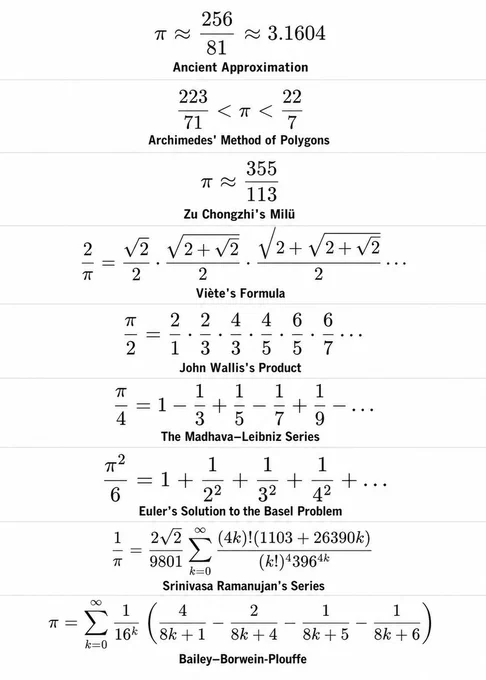
A visual history of π approximations
From ancient civilizations to modern mathematics, this infographic showcases key milestones in our quest to understand π. See how approximations evolved; starting with simple fractions and polygon methods by Archimedes, through brilliant contributions like Zu Chongzhi’s fraction, infinite products, series, and fast-converging formulas developed over centuries.
Show more

A famous formula for π:
π/4 = 1 − 1/3 + 1/5 − 1/7 + …
This comes from a trigonometry formula:
arctan(x) = x − x³/3 + x⁵/5 − x⁷/7 + …
Putting x = 1 gives the series for π/4.
This result was discovered independently by: Gottfried Wilhelm Leibniz (1673), James Gregory (1671), Nilakantha Somayaji (around 1500, in Tantrasangraha).
Show more

Add the odd reciprocals with alternating signs and a circle appears:
π/4 = 1 − 1/3 + 1/5 − 1/7 + ⋯
The reason is arctan x = x − x³/3 + x⁵/5 − ⋯, evaluated at x = 1, where the angle is 45°.
It converges painfully slowly. At N = 10 the error is 0.0227; at N = 1000 it is still 0.00025. Each extra digit costs ten times the work.
Leibniz published it in 1674. Madhava of Sangamagrama had found it in Kerala some 250 years earlier.
Show more


THE MEN OF GAZA SH0T HER FROM BEHIND AND THEN BUπNED HER ALIVE
Shani Gabay graduated from law school with honors and was just 25 years old when she attended the Nova Music Festival on October 7th.
When the men of Gaza arrived at the site, she began running away, but the men of Gaza sh0t her as she was fleeing and hit her in the leg.
As she could no longer walk, 4 women who were there, Noam Shalom, Karin Journo, Lior Atun and Moriah Or Swissa all helped carry her to a nearby ambulance.
Once Shany had reached the ambulance, the men of Gaza attacked the ambulance with heavy gunfire, hand grenades and rocket-propelled grenades. 18 of the 20 people hiding in and under the ambulance were buπned alive, including Shany.
How do any of the pro Hamas crowd justify this barbaric behavior? And Muslim people don't like dogs. Dogs have more compassion than they could ever hope to have. Monsters.
Show more


ephemera
/ɪˈfɛmərə/ ih-FEM-er-uh
from the Ancient Greek ephḗmerosἐπί (epí, upon) + ἡμέρα (hēméra, day) — lasting only a day
things of brief existence; objects made to be used once and discarded — tickets, posters, letters, menus, moments — that somehow endure as evidence of the fleeting.
Show more

The earliest records of mankind’s awareness of π are to be found among the Babylonians and Egyptians. Some four thousand years ago, they knew about π as the ratio of the circumference of a circle to its diameter.
The Babylonians gave the value of π as 25⁄8, while the Egyptians used (4⁄3)⁴, which works out to be 256⁄81. It is amazing that the Babylonian value is only 0.5% off the correct value of π, while the Egyptian estimate is 0.6% off.
Today, students in elementary schools routinely use the estimate of 22⁄7 for π, which despite its simplicity is only 0.04% off its correct value. This estimate is attributed to the great Greek mathematician and physicist Archimedes (287–212 BC). Yes, he is the one who ran naked in the streets and shouted “Eureka” after discovering the principle of displacement of water.
A more accurate approximation of π, but still a simple ratio, is 355⁄113. This gives π accurate to six decimal places.
π is also essential for calculating many properties of curved figures and objects:
Area of a circle = πR² (R is the radius)
Surface area of a sphere = 4πR²
Volume of a sphere = (4⁄3)πR³
Surface area of a hollow cylinder = 2πRH (H is the height of the cylinder)
Volume of a cylinder = πR²H
This simple number, π, has proven to be an extremely important universal constant that finds applications in many branches of mathematics, science, and technology, beginning with the simple circle and sphere.
At the other extreme of complexity, π also appears in one of Albert Einstein’s field equations for his theory of general relativity (1916), which describes mathematically how gravity arises from the curvature of space-time:
Rₐᵦ − ½Rgₐᵦ = (8πG⁄c⁴)Tₐᵦ
Show more


These six books will change how you see π — and you won't be able to unsee it.
