Search results for Bitcoin📷
Bitcoin📷 community
One keyword maps to one global community path.
People
Not Found
Tweets including Bitcoin📷

Videos to Learn How Bitcoin and Open Blockchains Might Change Our Lives (no ads): (1) A crowd fav about #Bitcoin📷# & why it matters (20 min) 1,000,000+ views: Intro to Bitcoin and Open Blockchains:
📷
Show more

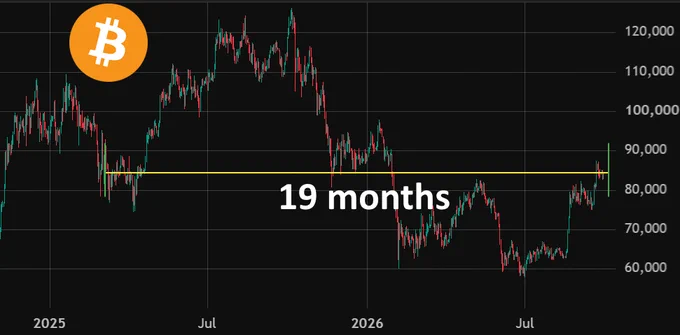
Bitcoin is back to where it was 19 months ago...

Bitcoin ($BTC) could attract more capital as global liquidity continues expanding, with the combined money supply of the Federal Reserve, European Central Bank, Bank of Japan and People’s Bank of China reaching a record $103.66 trillion.
Market research platform Bull Theory said the four central banks added more than $1 trillion to combined M2 money supply in August and roughly $5.6 trillion so far in 2026.
M2 broadly measures cash, checking deposits, savings and other highly liquid financial assets. Rising M2 generally means more liquidity is available across the financial system.
Bull Theory argues that expanding money supply can push more capital into assets such as stocks, gold and Bitcoin.
Bitcoin advocates including Anthony Pompliano and Arthur Hayes have long argued that monetary expansion is an important driver of Bitcoin’s long-term value.
Historical data has often shown a positive relationship between Bitcoin and global liquidity, although that correlation weakened during the 2025-2026 bear market as Bitcoin fell despite continued growth in money supply.
Bitcoin recently climbed to around $87,000, its highest level in nearly eight months, even as investors dealt with higher interest rates and rising Treasury yields.
VanEck digital assets research chief Matthew Sigel said Bitcoin often reacts to liquidity growth with a lag. With M2 having accelerated for several quarters, the bullish argument is that the impact of expanding global liquidity may still be working its way into crypto markets.
Show more


Bitcoin Outflows From Binance Hit a Three-Year High
More than 13,800 bitcoin:native left Binance on Sept. 22, according to CryptoQuant data. This marked the exchange’s largest single-day Bitcoin outflow since 2023.
Binance’s reserves also fell from about 705,000 BTC to 685,000 BTC. The 20,000 BTC decline happened over just four days.
CryptoQuant analyst Darkfost linked the withdrawals to renewed accumulation and possible FOMO.
Source: CryptoQuant
Show more


𝗕𝗶𝘁𝗰𝗼𝗶𝗻 𝗘𝗧𝗙 𝗙𝗹𝗼𝘄 (𝗨𝗦$ 𝗺𝗶𝗹𝗹𝗶𝗼𝗻) – 2026-09-28
TOTAL NET FLOW: 31
IBIT: 54.8
FBTC: -10.9
BITB: 0
ARKB: 0
BTCO: 0
EZBC: 0
BRRR: 0
HODL: 0
BTCW: 0
MSBT: 0
GBTC: -23.2
BTC: 10.3
Show more

Bitcoin ETF Daily Flow - US$
Blackrock (IBIT): 54.8 million

Bitcoin ETF Daily Flow - US$
VanEck (HODL): 0 million

Bitcoin ETF Daily Flow - US$
Invesco (BTCO): 0 million

Bitcoin ETF Daily Flow - US$
Fidelity (FBTC): -10.9 million

Bitcoin ETF Daily Flow - US$
WisdomTree (BTCW): 0 million
