Search results for TriEagles
TriEagles community
One keyword maps to one global community path.
People
Not Found
Tweets including TriEagles

New BrownDust2 Figures Incoming! 🎉
Morpeah, Teresse, Loen, Nebris, Eclipse, and Luvencia figures are officially in the works! 💃
Stay tuned for more details coming soon~! 🙌
#BrownDust2# #Figure# #HobbySakura# #Lovely# #Hanabee# #TriEagles#
Show more


Triangles are a deep state conspiracy! Prove me wrong! 😤


Puff Pastry Triangles being rolled up with slices of ham and cheese, forming savory croissant-like appetizers....
© lucas_paixao_Lamounier


$BTC and $ETH were not in triangles which would've been the most fun but pretty rare.. so ill put my hand up on that.
They are however both still in completely normal retracement zones for their respecitive wave 4s pullbacks.
Clarity Act was a dud as usual.
Rate hikes are pretty much priced in imo.
So maybe another 24 hours of unwarranted fear?
Then it'll be time to head up imo.
Show more

The Spiral of Theodorus is a geometric masterpiece formed by contiguous right triangles.
Starting with an isosceles triangle (side = 1), each subsequent hypotenuse becomes the base for the next triangle.
Through the Pythagorean theorem, a² + b² = c², it visualizes the square roots of integers from √1 to √17 in a perfect mechanical sequence.
Show more

Visualizing K-Means Clustering in action.
Watch how the centroids (triangles) start at random, carve out their initial territories (Voronoi cells), and iteratively shift to the actual mathematical center of the data.
Show more

This is one of the most famous puzzles in history: Fermat's Last Theorem.
While (a^2 + b^2 = c^2) works perfectly for right triangles, Pierre de Fermat claimed in 1637 that no three positive integers can satisfy (x^n + y^n = z^n) if (n) is greater than 2.
It remained unproven for 358 years until Andrew Wiles cracked it in 1994 using elliptic curves.
Show more

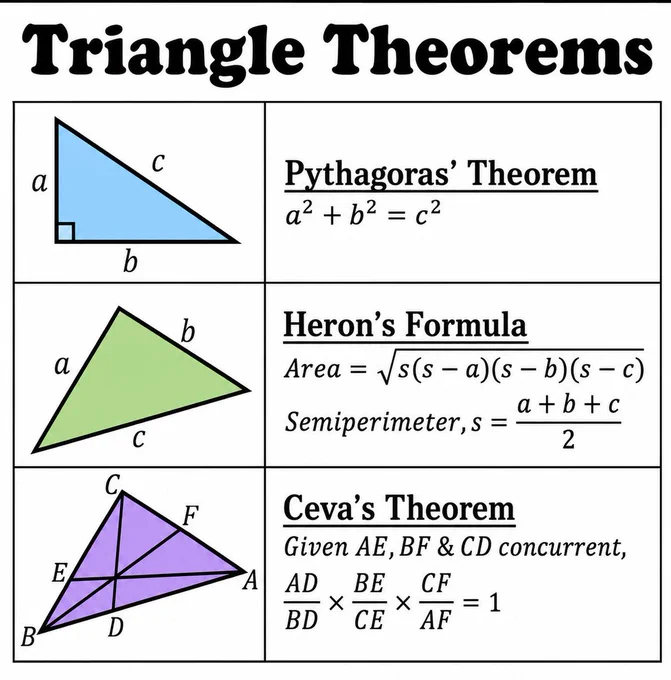
Unlock the power of geometry with these three fundamental theorems:
> Pythagoras’ Theorem: The gold standard for right-angled triangles. Solve for any side using a² + b² = c².
> Heron’s Formula: Find the area of any triangle using only its side lengths: no height required!
Area = √[s(s−a)(s−b)(s−c)], where s = (a + b + c)/2 is the semi-perimeter.
> Ceva’s Theorem: A deeper dive into triangle geometry. Three cevians AD, BE, and CF are concurrent if
(BD/DC) × (CE/EA) × (AF/FB) = 1.
Show more

In 1995 Nvidia $NVDA was 6 months from dead.
They’d bet on the wrong graphics method, Microsoft made triangles the standard with DirectX, and the Sega contract they were building for fell apart.
Shoichiro Irimajiri at Sega put $5 million in anyway. Huang has said outright that without it Nvidia wouldn’t exist.
That money bought them 6 months. They used it to build the RIVA 128, which shipped in 1997 and sold a million units in 4 months.
Nvidia IPO’d in 1999 at $12 a share, valued at $300 million. Sega sold the whole stake for $15 million.
Tripled their money. Perfectly sensible decision at the time, and Sega needed the cash because the Dreamcast was failing.
Huang’s estimate is that stake would be worth about $1 trillion now.
The two of them were back together in a Tokyo arcade in July, 30 years on. Huang thanked Irimajiri in person.
Worth remembering Sega didn’t do anything stupid here. They 3x’d an investment in a company that had nearly died. Almost anyone would have taken it.
That’s the part people miss about these stories. The mistake is never obvious at the time…
Show more

Third teaser: Vertigo! (Two more to go in the queue!)
A procedurally generated steel coaster, ridden from the front. 285k triangles, zero assets, plain JS. No engine, no assets, no build step, no CDN 👀
Show more
