
Mark
@MRRydon
Cofounder @AethirCloud | Building global GPU infrastructure for AI | Here for AI, GPUs, inference economics, power and the money behind the compute
参加 December 2016
2.3K フォロー中 335.6K ファン
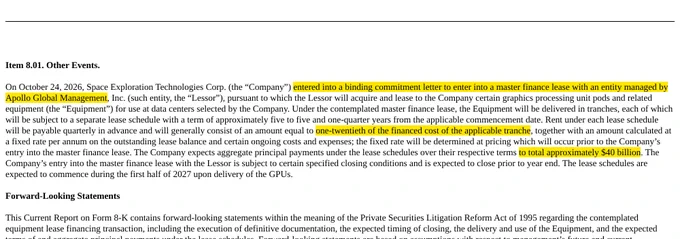
A lot of people ask me how a GPU finance lease works. SpaceX just signed the biggest GPU financing ever, about $40B with Apollo, so here it is step by step from SpaceX's own 8-K.
Step 1: the lender buys the GPUs. An Apollo-managed entity will buy NVIDIA Vera Rubin GPU pods and lease them to SpaceX for data centers SpaceX picks. SpaceX pays back the full cost over the lease, so it's really buying them on credit.
Step 2: the GPUs arrive in tranches. Each tranche gets its own lease of about 5 to 5.25 years, starting when it's delivered. The first are expected in the first half of 2027.
Step 3: SpaceX pays rent every quarter, in advance. Each payment is one-twentieth of that tranche's cost, plus fixed-rate interest on what's still owed. Twenty quarters is five years, so each tranche is fully paid off by the end of its lease. Across all tranches that's about $40B of principal, roughly $2B a quarter once everything is running.
Step 4: the money comes from the biggest pools of capital out there. Apollo leads, Goldman Sachs structured it, and BlackRock, Goldman Sachs Asset Management and KKR-advised accounts are anchors.
So why lease when you could pay cash? SpaceX's CFO says it's seeing payback periods of less than a year on its AI infrastructure. If a GPU pays for itself inside a year, spreading the cost over five keeps cash free to build faster.
And it's already spreading. The same day, Bank of America, Blackstone, Citi and Morgan Stanley put together a $63B vehicle that will buy Broadcom's custom AI chips and lease them to Anthropic.
The part I find most interesting is what the lenders signed up for. They're comfortable being paid back over five years, which says a lot about how long they expect these chips to keep earning. What is clear is that the biggest credit investors now treat AI compute as financeable infrastructure, and I think that's what keeps the buildout funded.
もっと見る