
Michael Kutsche
@michaelkutsche
Production Designer/ Painter/ Animator /// Sotheby's | PROOF Grails | SuperRare 💎| Feature film Character Designer |
参加 March 2010
8K フォロー中 11.9K ファン
🤔Some thoughts on AI and how it challenges our beliefs as artists:
I don’t think we can look at this purely from a technical or mathematical perspective, unless we see human beings as little more than machines and have no empathy for what actually moves the people around us.
The real question isn’t whether AI will technically be able to make films, paintings or music. It’s whether we still WANT humans to make them.
Art is ultimately an expression of human existence, drawn from the experience of actually being alive. An AI may eventually simulate that convincingly, with or without consciousness, but simulation is still simulation. It can imitate love without ever having loved, grief without grieving, desire without wanting anything.
And I think audiences understand this instinctively. We don’t read books, watch films or visit exhibitions merely to consume “content.” Part of the experience is knowing that another person stood behind the work, someone who can feel as we do, who cares about the medium, the culture around it and the audience receiving it.
It’s an exchange between human beings, not just one-way consumption.
And the same is true for artists. We don’t write, paint, compose or make films purely for money or to satisfy an algorithm. We make something because we want another person to EXPERIENCE IT.
That’s why people care so much about what is still human-made: the story, the designs, the decisions, the performances, as opposed to what has simply been automated away.
“AI slop” isn’t only an aesthetic category. It also describes the potentially destructive logic behind replacing the artist altogether.
That’s why I keep arguing for AI primarily as a tool, not as some technological cure-all that, in the name of optimization, gradually replaces everything we actually valued in the first place.
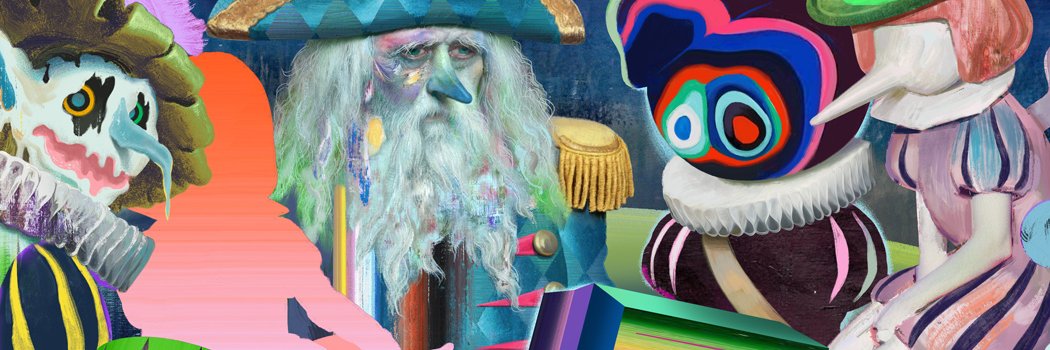
(🖼️: 𝘎𝘰𝘰𝘥𝘣𝘺𝘦 𝘏𝘰𝘳𝘴𝘦𝘴, digital, 2023)
もっと見る









