
Ming
@tslaming
参加 August 2011
0 フォロー中 0 ファン
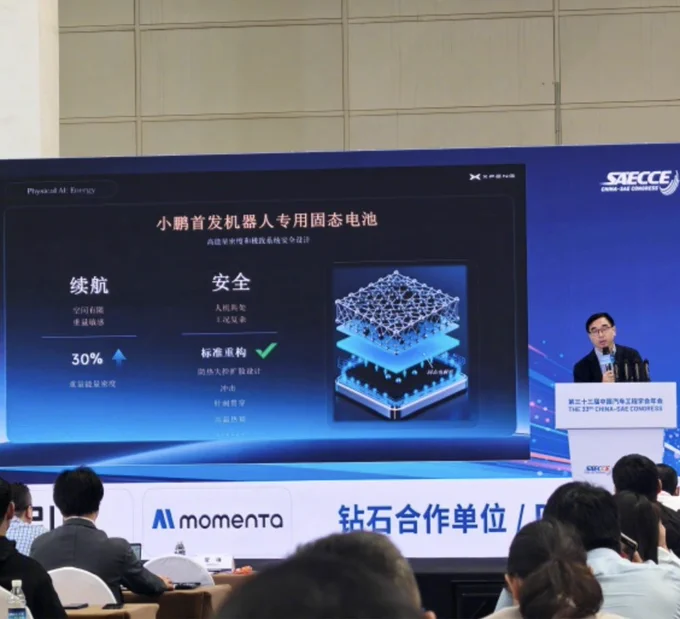
HUMANOID ROBOT NEWS 🚨 According to reports from the October 28 SAECCE conference in Suzhou, XPeng Vice President Gu Jie said the company had unveiled a solid-state battery designed specifically for robots 🤖
It prioritizes high energy density in a robot’s limited internal space, resistance to impacts and nail penetration, and protection against thermal runaway spreading from one cell to another.
In an all-solid-state battery, a solid material replaces the liquid electrolyte that carries ions between the electrodes. Semi-solid batteries use both solid and liquid electrolytes, and that distinction matters here.
For humanoid robots, these are fundamental engineering challenges.
Every kilogram of battery is another kilogram the robot has to support, balance, and move. Higher energy density lets designers store more energy at the same weight, or cut weight while keeping the same capacity. Energy per liter matters just as much, because space inside a humanoid’s body is tight. A more compact battery leaves more room for actuators, electronics, and cooling.
Those gains only count at the level of the finished machine. Protective structures, cooling, electronics, and the compression hardware some solid-state cells need to keep their layers pressed together all add weight and take up space. The battery also has to deliver bursts of power for walking, lifting, and catching balance, manage heat, recharge efficiently, and hold its capacity through repeated use. Higher energy density solves only part of the problem.
Safety takes on new importance when the battery walks into a room full of people. A humanoid can fall, hit equipment, or get damaged while working nearby.
Gu also reportedly said XPeng had “reworked its battery standards.” The report offers no specifics, but that could mean testing batteries around a robot’s real working life: falls, repeated bumps, and close contact with people. A pack designed to contain a single failing cell could keep a local failure from turning into a larger emergency. Solid-state chemistry alone doesn’t guarantee that, so pack design still matters.
XPeng’s timeline adds important context. When the company announced an all-solid-state battery for its next-generation IRON in November 2025, it reported that the pack withstood one hour at 250°C without thermal runaway, a 300G impact, and penetration by a 3 mm nail without catching fire. Those results apply to the 2025 design, and the October report doesn’t say whether it’s the same pack.
XPeng announced the opening of its robot production line in September 2026. Its latest schedule calls for scaled production in late 2026, with initial deliveries in the first half of 2027.
But which battery will actually go into production?
In September, Jipian Lab reported that XPeng had tried unsuccessfully to source all-solid-state cells from BYD, Gotion, CALB, and EVE. It then selected a high-energy semi-solid cell in a pouch format, rather than the cylindrical format common in robot batteries. The reported problem was finding production-ready all-solid-state cells.
Jipian also quoted a researcher who described the industry’s all-solid-state cells as largely laboratory samples, with almost none ready for outside testing. XPeng has not publicly confirmed the reported switch.
The Chinese wording makes this especially interesting. The October report uses 固态, or “solid-state.” China’s draft national standard for EV batteries separates batteries into three categories: liquid, mixed solid-liquid, and solid-state. It also accepts “semi-solid” as another name for mixed solid-liquid, and “all-solid-state” as another name for solid-state.
Under that draft’s terminology, “solid-state” means all-solid-state. Everyday industry usage is looser. Was Gu referring to an all-solid-state battery, or the semi-solid cell Jipian reported? The remark alone doesn’t answer that question.
The connection to Tesla Optimus is now concrete. In its October 21 Q3 update, Tesla said it had begun building Optimus on its high-volume production lines in Fremont, describing the robots coming off those lines as its first production-quality units.
XPeng and Tesla announced major humanoid production milestones within weeks of each other.
Both programs now face the same practical test: how much useful work can the complete machine do between charges, safely and reliably?
A better battery could turn more of a humanoid’s intelligence into productive hours.
もっと見る