
Richard Albert
@RichardAlbert
📍 Professor of World Constitutions @UTAustin 📜 Advisor to Governments and Parliaments 🌏 Former President of @ICON__S 🎓 Alum @Yale @Harvard @UniofOxford
가입 April 2009
155 팔로잉 중 25.9K 팬
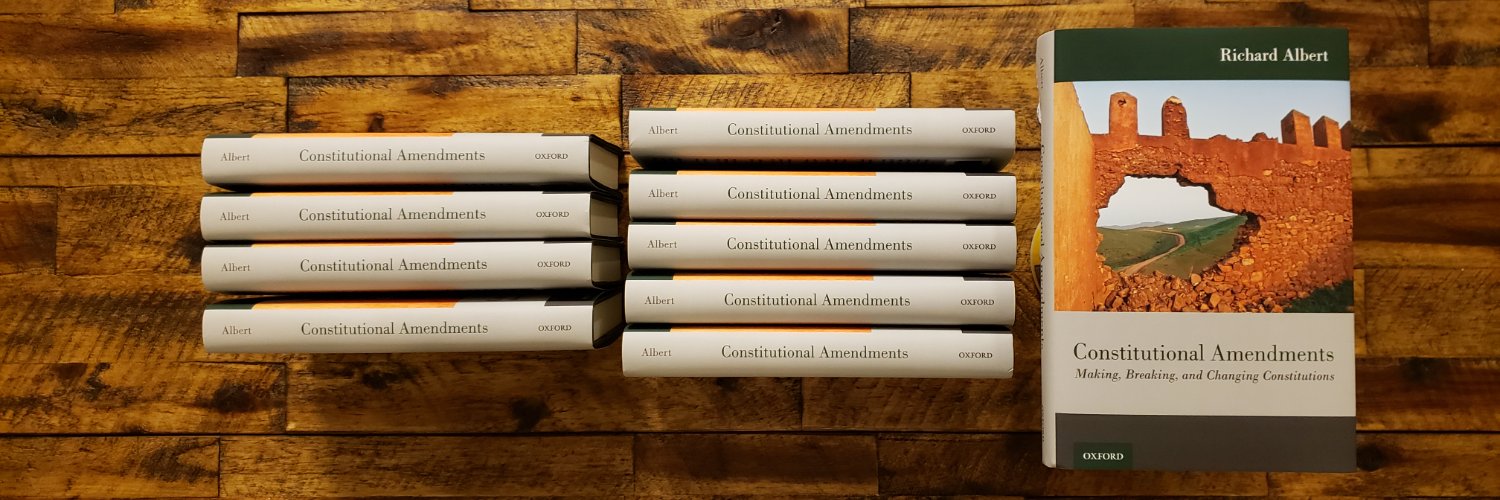
🤩 Class today in my course on Constitutional Amendments in the U.S. and the World here at the University of Texas at Austin.
📜 Our topic is how to design a constitutional amendment procedure.
📑 Some key readings include:
1. Xenophon Contiades & Alkmene Fotiadou, Models of Constitutional Change, in Engineering Constitutional Change: A Comparative Perspective on Europe, Canada and the USA (Xenophon Contiades ed., 2013)
2. Jon Elster, Ulysses Unbound: Studies in Rationality, Precommitment, and Constraints (2000)
3. Jan-Erik Lane, Constitutions and Political Theory (2d ed. 2011)
4. Arend Lijphart, Patterns of Democracy (2d ed. 2010)
5. Donald S. Lutz, Principles of Constitutional Design (2006)
6. Dawn Oliver & Carlo Fusaro, Changing Constitutions: Comparative Analysis, in How Constitutions Change: A Comparative Study (Dawn Oliver & Carlo Fusaro eds., 2011)
7. Bjørn Erik Rasch & Roger D. Congleton, Amendment Procedures and Constitutional Stability, in Democratic Constitutional Design and Public Policy (Roger D. Congleton & Birgitta Swedenborg eds., 2006).
8. Edward Schneier, Crafting Constitutional Democracies: The Politics of Institutional Design (2006)
더 보기










