Finn Stockinger
@FinnStockinger
Analyst. Investor.
Early where the market is late.
加入 December 2025
692 正在关注 17.6K 粉丝
$MU Customers are paying to secure memory years ahead.
What immediately grabs your attention is the incredible numbers in Q4.
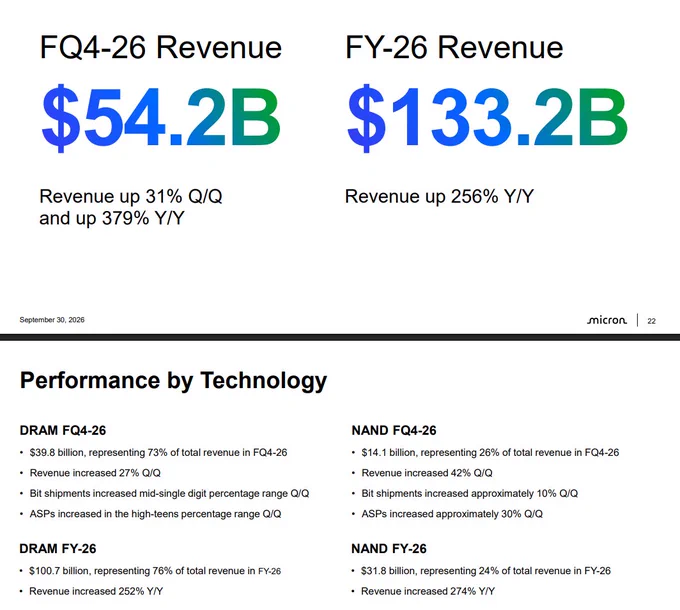
Revenue reached $54.2B, up 31% QoQ and 379% YoY. Non-GAAP gross margin hit 87%, EPS came in at $33.42, and adjusted free cash flow reached $33.2B.
For Q1 FY27, Micron guides to $61.5B in revenue and $38.15 in non-GAAP EPS at the midpoint.
It's massive numbers.
Management expects revenue to grow sequentially every quarter in FY27, with Q1 marking the year’s lowest gross margin.
TBH most of this growth is coming from pricing.
DRAM bit shipments rose by mid-single digits sequentially, while prices increased by high teens.
NAND shipments rose roughly 10%, while prices climbed around 30%.
That matters when judging how much of this performance can last.
The contracts give us something more concrete to work with.
Micron has signed 26 multi-year take-or-pay agreements, estimated to represent over 35% of revenue through 2030. Customer financial commitments total $32B, mostly cash deposits. Some agreements now extend into 2031.
Remaining performance obligations are approximately $150B, calculated using committed volumes and minimum contractual pricing where a pricing framework exists. Management says even those floor prices should deliver margins meaningfully above previous cycle peaks.
HBM is another important piece. Agreements are complete for the vast majority of Micron’s 2027 HBM bit supply, with significant annual price increases narrowing its gross-margin gap with conventional DRAM. Micron is also working with NVIDIA on NVHBM, a custom HBM4E implementation for next-generation GPUs and NVLink Fusion platforms.
But I wouldn’t overlook storage. Quarterly data center SSD revenue was nearly $10B, more than 10 times the year-ago level. Micron identifies KV-cache offload and HDD replacement as expanding opportunities.
The question I’m left with is how quickly supply can catch up.
Micron expects tighter conditions in 2027 and 2028 and says it cannot yet identify when DRAM supply and demand will balance. Planned capex is approximately $25B in the first half of FY27, with spending higher in the second half. Much of the additional construction spending targets cleanroom availability in late 2028 and beyond.
Pricing explains much of today’s earnings, while the customer commitments strengthen the case for durability. Customers are putting substantial cash behind their future memory needs. I’d watch those contracts and the capacity timeline just as closely as the next quarter’s growth.
显示更多