
Ihtesham Ali
@ihtesham2005
investor, writer, educator, and a dragon ball fan 🐉
加入 October 2025
375 正在关注 35.8K 粉丝
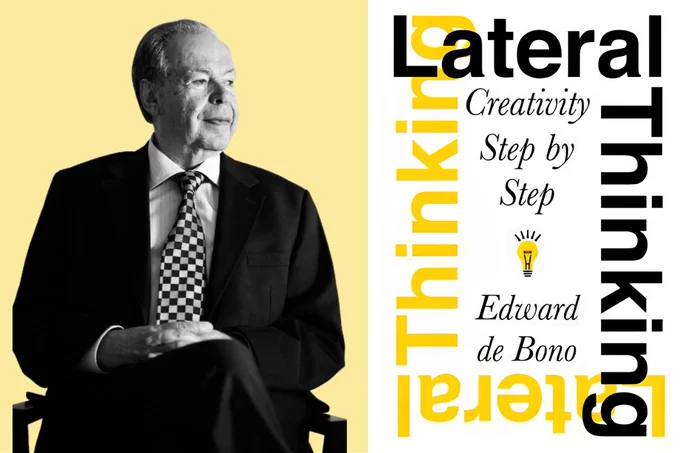
A doctor from Malta with degrees from Oxford, Cambridge, and Harvard coined a phrase in 1967 that ended up in the Oxford English Dictionary and became the most widely used thinking framework in corporate history.
His name was Edward de Bono. The phrase was "lateral thinking."
De Bono grew up in Malta and finished his undergraduate degree at 15. His nickname at school was Genius. He qualified as a doctor at 21, won a Rhodes Scholarship to Oxford, completed a PhD at Cambridge, and held faculty appointments at Oxford, Cambridge, London, and Harvard simultaneously.
His father told him he had a great career in medicine and should not throw it away by writing books.
He wrote 85 of them.
The idea that made everything started with a simple observation about how the brain actually works.
Your mind is a pattern-recognition machine.
Every time you encounter a problem, your brain scans its memory for the most familiar framework it has ever used on something similar and routes your thinking straight down that groove. This is efficient. It is also the reason most people keep solving new problems the wrong way.
The groove deepens every time you use it. The more experienced you become at anything, the more aggressively your brain routes you toward the same familiar paths. De Bono called this vertical thinking. You dig the same hole deeper. More logic, more analysis, more effort, all inside a frame you never question.
The harder you work, the deeper into the wrong hole you go.
The problem was not intelligence. No amount of better logic can correct an error that happened in perception before the logic even started. If the frame is wrong, the reasoning is wrong. Every time. A genius applying perfect logic to the wrong frame still gets the wrong answer.
Lateral thinking was his answer.
Not brainstorming. Not creativity in the vague sense people throw around at workshops. A specific set of deliberate techniques designed to force the brain off its established grooves and approach a problem from a direction it would never reach by digging straight down.
His most useful technique was provocation. He gave it the symbol Po.
A provocation is a deliberately absurd or impossible statement used not because it is true but because it breaks the pattern and forces the mind to construct new pathways around it.
The classic example: a factory is polluting a river. Vertical thinking produces filters, regulations, process changes. The lateral provocation is: the factory is downstream of itself. Physically impossible. But sitting with that impossibility produces a real insight. What if the factory had to use the water at the exact point where its own discharge ends up? The incentive structure changes completely. Zero-discharge solutions become visible that conventional thinking would never reach because they lie outside the groove.
The DuPont result is the number that ends every argument.
One employee applied a single lateral thinking technique to their Kevlar manufacturing process. Eliminated nine steps. Saved the company $30 million a year. One person. One different way of looking at the same problem.
IBM used it. McKinsey used it. Shell used it. NASA used it. Prudential used it to restructure the entire concept of life insurance, creating policies that let people access their benefits while still alive. The president of Prudential said publicly that de Bono's framework made the innovation possible.
Channel 4 television in England trained its staff for two days and said they generated more new ideas in those two days than in the previous six months combined.
De Bono spent the second half of his life furious about one thing.
Schools were still not teaching thinking.
They taught content. They taught facts. They taught students what to think rather than how to think. His frustration with this never softened. He said repeatedly that we spend enormous resources teaching children information and almost nothing teaching them what to do with it. The entire educational system was training vertical thinkers at industrial scale and then wondering why genuine innovation was so rare.
He tried to fix it. His CoRT program brought thinking skills into classrooms across 20 countries. His Six Thinking Hats method was used to train juries in several US states to examine evidence more objectively. In Australia, marine biologists credited it with transforming meetings that had been paralyzed by ego and argument for years.
In 2005 he was shortlisted for the Nobel Prize in Economics.
He died in 2021 at 88.
His most famous line contains the whole thing in one sentence.
"You cannot dig a hole in a different place by digging the same hole deeper."
Every person who has ever worked harder on the wrong approach without changing the approach has lived inside that sentence. Every company that poured resources into optimizing something that should have been abandoned. Every person who applied more logic to a frame that was wrong from the start.
De Bono was not arguing against logic. He was arguing that logic only works once you are standing in the right place.
Most people never question where they started digging.
That was the only problem his entire career was trying to solve.
显示更多