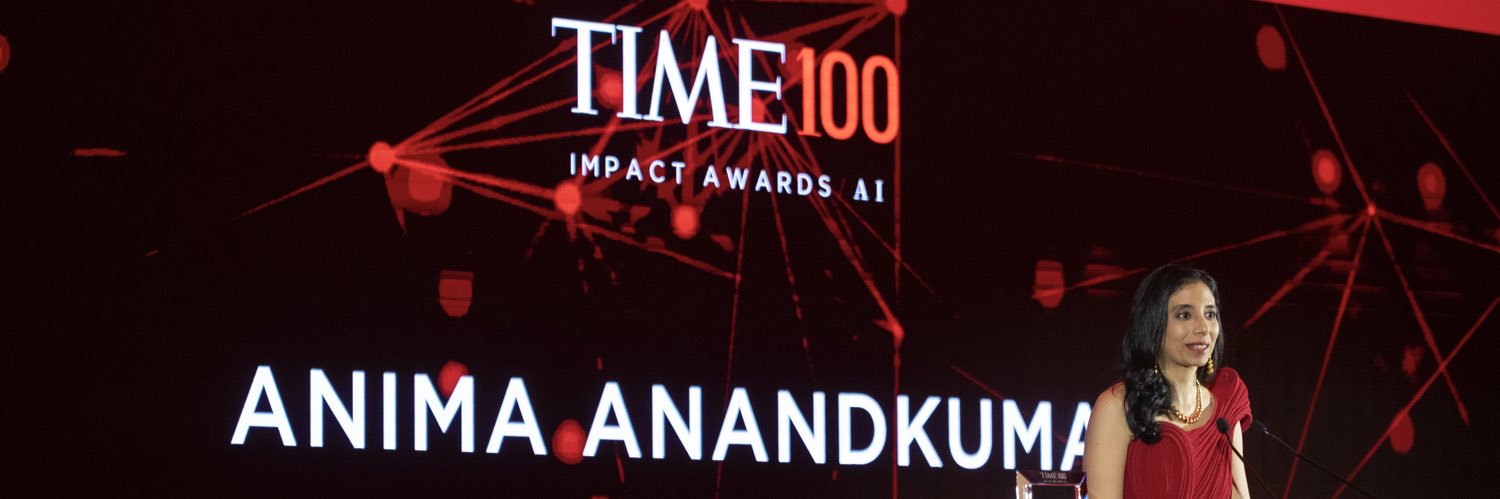

Prof. Anima Anandkumar
@AnimaAnandkumar
AI+Science, Co-Founder @accelerated_u, Bren Professor @caltech, Time100, Fmr Sr Director of #AI# research @nvidia Fmr Principal Scientist @awscloud
加入 May 2021
2.5K 正在關注 46.2K 粉絲
Solving Inverse PDEs with 1% Paired Data: Introducing Decoupled Diffusion Inverse Solver
We propose a data-efficient and physics-aware diffusion framework for solving inverse problems on function spaces.
In scientific machine learning, solving inverse problems requires costly and limited data acquisition from physical systems. Existing joint-embedding diffusion models require massive paired training data, as they represent the underlying physics implicitly through statistical correlations. In this work, we identify that under data scarcity, the observation-induced guidance signal vanishes during posterior sampling, making reconstruction impossible.
Our Solution: We propose a decoupled design against joint-embedding: an unconditional diffusion learns the coefficient prior, while a neural operator explicitly models the forward PDE for guidance. This enables (1) superior data efficiency (2) effective physics-informed learning and sampling.
Performance: Achieves state-of-the-art results on Navier-Stokes, Helmholtz, and Poisson benchmarks, improving spectral error by 54% on average.
Data Efficiency: DDIS maintains high accuracy even when limited to just 1% of paired training data, outperforming joint models by 40% in L2 error.
Robustness: Theoretical guarantees that avoid the guidance attenuation identified in joint-embedding methods.
Check out the paper for the full theoretical analysis and experiments!
Thomas Lin , @jiacheny7, Alex Chiang, Julius Berner,
#MachineLearning# #DiffusionModels# #InverseProblems# #PDE# #NeuralOperators# @Caltech #AI4Science#
顯示更多








