Search results for AIadoption
AIadoption community
One keyword maps to one global community path.
People
Not Found
Tweets including AIadoption

Galini is a forward-deployed AI team for mid-market companies that are struggling to realize measurable value from #AI#.
They pick 1–2 high-#ROI# workflows and work side-by-side with your teams to scope, design, and build the solution in your environment over 8 weeks with affordable price, so your team builds the capability alongside them. Founders are ex-McKinsey and ex-Bridgewater (SRE), on the path to Anthropic Partner Network.
#AIadoption#
Show more

The businesses getting the most out of AI right now aren't tech companies.
They’re plumbers, agency owners, dentists, Etsy sellers.
New data from @OpenAI (cc @RonnieChatterji) makes the pattern clear: tech startups account for about 5% of ~active~ U.S. users doing entrepreneurial work with ChatGPT.
The other 95% are spread across services, retail, healthcare, and trades.
AI adoption for entrepreneurship isn’t concentrated in tech. It’s happening inside everyday businesses, folding into routine work that used to be slower or outsourced or entirely overlooked.
Show more

Three more things are still blocking mainstream #AI# adoption:
1. Reliability
AI systems are impressive in demos, but inconsistent in the real world. They hallucinate, misinterpret context, and occasionally fail at basic tasks.
That’s fine for experimentation. Not fine when you’re handling real operations.
Until outcomes are predictable, businesses will hesitate to fully rely on them.
2. Evolving regulations and change management
The rules are still being written. Governments are actively shaping policies, and companies don’t want to bet big on something that might be restricted tomorrow.
Adopting AI isn’t a plug-and-play upgrade, it reshapes workflows, roles, and accountability. Most organizations aren’t ready for that level of change yet.
3. Integration complexity
AI doesn’t live in isolation, it needs to connect with existing systems, data pipelines, #privacy# and #security# layers.
These hurdles explain why AI feels everywhere in conversation, but still not fully embedded in everyday business operations.
Also there is an AI native vs #Saas# AI competition as well. It will take sometime.
Show more
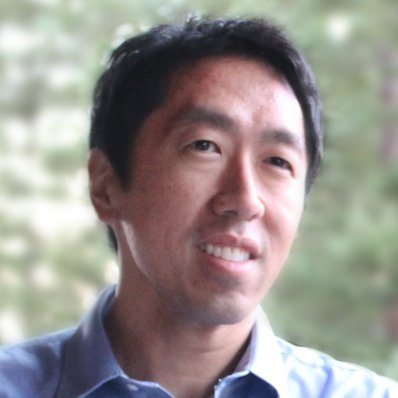
I recently spoke at the Sundance Film Festival on a panel about AI. Sundance is an annual gathering of filmmakers and movie buffs that serves as the premier showcase for independent films in the United States. Knowing that many people in Hollywood are extremely uncomfortable about AI, I decided to immerse myself for a day in this community to learn about their anxieties and build bridges.
I’m grateful to Daniel Dae Kim @danieldaekim, an actor/producer/director I’ve come to respect deeply for his artistic and social work, for organizing the panel, which also included Daniel, Dan Kwan, Jonathan Wang, and Janet Yang. I found myself surrounded by award-winning filmmakers and definitely felt like the odd person out!
First, Hollywood has many reasons to be uncomfortable with AI. People from the entertainment industry come from a very different culture than many who work in tech, and this drives deep differences in what we focus on and what we value. A significant subset of Hollywood is concerned that:
- AI companies are taking their work to learn from it without consent and compensation. Whereas the software industry is used to open source and the open internet, Hollywood focuses much more on intellectual property, which underlies the core economic engines of the entertainment industry.
- Powerful unions like SAG-AFTRA (Screen Actors Guild-American Federation of Television and Radio Artists) are deeply concerned about protecting the jobs of their members. When AI technology (or any other force) threatens the livelihoods of their members — like voice actors — they will fight mightily against potential job losses.
- This wave of technological change feels forced on them more than previous waves, where they felt more free to adopt or reject the technology. For example, celebrities felt like it was up to them whether to use social media. In contrast, negative messaging from some AI leaders who present the technology as unstoppable, perhaps even a dangerous force that will wipe out many jobs, has not encouraged enthusiastic adoption.
Having said that, Hollywood is under no illusions that AI will change entertainment, and that if Hollywood does not adapt, perhaps some other place will become the new center for entertainment. The entertainment industry is no stranger to technology change. Radio, TV, computer graphics special effects, video streaming, and social media transformed the industry. But the path to navigating AI’s transformation is still unclear, and organizations like the new Creators Coalition on AI are trying to stake out positions. Unfortunately, Hollywood’s negative sentiment toward AI also means it will produce a lot more Terminator-like movies that portray AI as more dangerous than helpful, and this hurts beneficial AI adoption as well.
The interests of AI and Hollywood are not always aligned. (Every time I speak in a group like this as the “AI representative,” I can count on being asked very hard questions.) Most of us in tech would prefer a more open internet and more permissive use of creative works. But there is also much common ground, for example in wanting guardrails against deepfakes and a smooth transition for those whose jobs are displaced, perhaps via upskilling.
Storytelling is hard. I’m optimistic that AI tools like Veo, Sora, Runway, Kling, Ray, Hailuo, and many others can make video creation easier for millions of people. I hope Hollywood and AI developers will find more opportunities to collaborate, find more common ground, and also steer our projects toward outcomes that are win-win for as many parties as possible.
[Original text: ]
Show more


FIGMA $FIG JUST REPORTED A Q1 BEAT AND RAISED FULL-YEAR GUIDANCE. AI ADOPTION IS DRIVING UPSIDE.
But the CFO publicly named Claude Design as a competitive threat they cannot dismiss.
The numbers and the AI quote, in full:
Q1 results:
- Revenue: $333.4M vs $313.2M est 🟢
- Adj EPS: $0.10 vs $0.06 est 🟢
- Net Dollar Retention Rate: 139% as of 3/31/2026
Q2 guidance:
- Revenue: $348M to $350M vs $327M est 🟢
Full-year 2026 guidance raised:
- New: $1.42B to $1.43B
- Prior: $1.36B to $1.37B
- Adjusted operating income: $125M to $135M
The AI angle:
- 75%+ of Org and Enterprise users who exceeded AI credit limits continued using credits in April
- Figma began enforcing credit limits in March, selling add-ons to users who exceeded plan credits
- That conversion is the proof point for AI monetization working
CFO Praveer Melwani on competition, per Reuters:
"When you talk about a Claude design... you can't dismiss them, their ability to train first party models and couple those with their own products is something that we definitely are paying attention to."
Anthropic unveiled Claude Design last month, which lets users explore designs, interactive prototypes, and presentations.
Show more


The image captures a key shift: people are now the most effective marketing channel. In the AI era, this becomes even more powerful. Individuals, amplified by AI tools, can create, distribute, and monetize content at scale—turning personal influence into a core driver of brand growth.
At the same time, semiconductor companies sit at the center of this cycle. As AI demand explodes, chipmakers are being priced not on current earnings, but on future compute demand, pushing valuations to extreme levels.
This creates a closed loop: people drive attention, AI scales it, and semiconductors monetize it. However, the risk is clear—if AI adoption slows or monetization disappoints, the “picks and shovels” trade in semiconductors could unwind just as quickly.
Show more


Alphabet is closing the gap.
While $NVDA still leads the market cap race at $5.33T, $GOOG has surged to $4.69T, fueled by rapid AI adoption across its services.
AI is redefining the value of the world’s biggest companies.
Show more


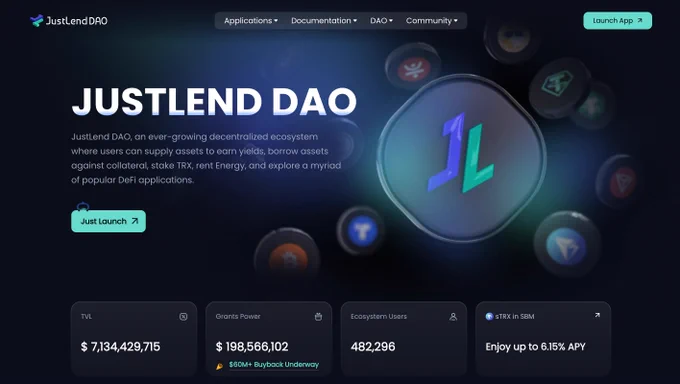
#JustLendDAO# Adoption Snapshot 📸
Grants Power: $198M+
482K+ users
More users. More strategies. More on-chain activity.
DeFi grows when participation grows.
👇Check:
Show more

“Institutional adoption isn’t a forecast. It’s already happening.” — Catherine Chen, Head of Binance VIP & Institutional, at @ParisBlockWeek
The numbers back it up. Tokenized Treasuries grew from $750M to $8.4B in two years.
That is where Binance Institutional is focused: building the infrastructure and providing the services that institutions need to participate with confidence.
Show more


ETF adoption opened one door.
The next challenge is building the systems that make BTC more useful beyond passive exposure.