Search results for Grok画像
Grok画像 community
One keyword maps to one global community path.
People
Not Found
Tweets including Grok画像

Grok Bot Summary of Elon Musk and Jensen Huang's new interview alongside Gavin Baker at The White House. 🇺🇸
How America wins: energy first
- Jensen: superintelligence (SI) reinvents every layer of computing, from chips to software to apps. Energy is the foundation for all of it.
- To win, America needs the best chips, lots of energy and great algorithms, plus Americans who are excited about using the technology.
- He credited President Trump's pro-energy stance as the reason the data centers could be built at all.
- Jensen also said AI companies need to partner better with the communities where data centers are going up.
- Elon: the biggest challenges are scaling energy and chip production. The US is winning on software, but China makes about 3x as much electricity.
- The long-term task is enough power, plus enough logic and memory chip factories in the US or another safe region.
Power equals GDP
- US average power use is about 500 GW, so every 5 GW added is about a 1% increase.
- Elon bets that 1% more power means roughly 1% more GDP, because the intelligence you get per watt keeps rising.
- By their joint math, each gigawatt is worth about $60B of economic output a year.
- Gavin noted that SpaceX's publicly discussed 10 GW would be about 25% of all new US power, with rocket engineers helping build the turbines.
Moving compute to space
- Elon: orbital compute will be "a very big deal." Google is sending TPUs to orbit, and an H100 already went up last year.
- SpaceX and Tesla aim to make 200 GW of solar panels a year.
- In space, solar panels deliver their full rated power or better. On the ground they get only a fifth to an eighth of that and need huge batteries. "It's essentially always sunny in space."
- Jensen: now is the perfect time. AI's returns are so high that launch costs are affordable, and "putting NVIDIA computing in space is the best way to get there."
Data centers are now "SI factories
- Jensen: they don't just store data, they produce something of economic value.
- The US is building about 10–20 GW a year, which he estimates means roughly 1M jobs for construction workers, pipe fitters, and power and cooling crews.
- It's the first time in about 50 years that America is re-industrializing and bringing back blue-collar work.
Colossus and the community
- Elon: the area went from unemployment to more jobs than people.
- The local tax budget may have roughly doubled.
- xAI offers half-price Starlink there and is building a $250M water recycling plant. "Do things for the community, and they will reciprocate."
- Jensen: for the first time, market forces alone are funding fusion, fission, small and large nuclear reactors, and battery storage, without government subsidies.
Trillions for Americans
- Gavin thanked them for creating more than $5T in wealth for ordinary Americans through their 401(k)s.
- Elon: "Jensen has done $5 trillion by himself," and put his own number at about $3.5T.
NVIDIA's approach to AI safety
- Jensen said the key is to contain AI agents and monitor them, both while they're being tested and after they're deployed, just as a company does with a new employee.
- **OpenShell** is a sandbox, like "a browser for agents," that keeps each agent isolated and gives it only the rights it should have.
- **BlueField** is a separate chip that watches the agent from outside its sandbox and escalates if the agent breaks its rules.
- Gavin compared this to the early internet: we made online payments safe, and that's how we got Amazon, Netflix, Google and X.
- Jensen: safety and progress "are one and the same." Treating them as a tradeoff is a false choice.
Starship Flight 14
- Elon: Starship reached orbit for the first time and deployed Starlink V3 satellites that each have the wingspan of a 737.
- It was the largest payload delivered to orbit since Skylab.
- He expects a weekly or twice-weekly launch pace, probably next year.
- The long-term goals are about 1 million tons to the Moon and to Mars for self-growing cities, and at least 300 GW a year of AI compute into orbit, maybe a terawatt one day.
Tom Brown joins
- He said it continues the steady gains in intelligence with each new model.
- It can take on longer tasks than earlier models could.
- The less obvious effect is that AI will write huge amounts of software, making everyday products better and cheaper.
How AI is helping people today
- Jensen uses Claude for comparison research. Work that used to take him 4–8 hours on a weekend now comes back as a polished report with charts in about 3 minutes.
- Elon: AI is becoming essential at work and at home. He's heard many stories of AI catching medical problems from X-rays or MRIs that doctors got wrong, and saving lives.
- Gavin mentioned AI finding new, safe uses for existing drugs.
Should AI tools have values?
- Jensen called his view "controversial": SIs are tools, and too much judgment can make them worse at the job.
- His steak knife analogy: imagine a knife that cuts medium-well steak perfectly but refuses to cut a rare one because it looks like live meat.
- In cybersecurity, a defender's actions can look like an attacker's, and the AI still needs to help the defender.
White House AI safety declaration
- After a long White House lunch, they signed a joint declaration on SI safety, which the White House will publish.
- Elon: it covers joint monitoring, special board committees, and "grading each other's homework" instead of grading your own.
- Jensen: it requires strict internal controls, clearly documented goals for each product, internal and third-party audits, and sharing best practices across the industry.
- He said the declaration "has a lot of teeth" and should become the standard for every company. President Trump oversaw the meeting.
Key takeaways
- Energy is the real bottleneck, and more power means more GDP.
- Space is the next frontier for AI compute, and Starship is how it gets there.
- Data centers are driving a blue-collar industrial comeback.
- Safety and speed can go together, through contained and monitored agents plus industry-wide audits.
- Top AI leaders now publicly back grading each other's homework on safety.
Show more


Grok Bot is so popular that now we’re seeing many knockoff brands popping up with very similar names 😂

Grok Bots are evolving insanely fast
Here are the recent updates:
• Voice mode
• Voice notes
• 28 different voice personalities and other features
• Native Docs, Sheets, and Slides
• Team Bots - shared AI teammates with skills, plugins, and credentials
• Work with them in Slack or Grok Bot
• Faster replies
• Faster desktop app
• More efficient usage
• Finance (bank, cards, investments)
• Traffic through your own network
Grok Bot is a AI teammate that talks, connects to your tools, and gets real work done for you
Show more

Grok Bot summary: Starship Flight 14, the first orbital Starship flight.
🔥 Ascent
- During the climb, one Raptor vacuum engine shut down early.
- Starship made up for the lost thrust by burning its other five engines for longer than planned.
- It still reached its planned suborbital path. That path is "passively safe," meaning the ship would come back down safely on its own if nothing else happened.
✅ Go for orbit
- Once it was on that path, the flight control team checked the ship's systems.
- The three sea-level Raptor engines needed for later burns were healthy, so the team gave a "go" for orbital operations.
🌍 First time in orbit
- Starship relit one sea-level Raptor for an orbit insertion burn.
- **It entered orbit around Earth for the first time ever.**
🛰️ 26 Starlink V3 satellites deployed
- After a short coast, Starship released all 26 Starlink V3 satellites.
- SpaceX soon made contact with every one of them through laser links, ground stations and Starlink user terminals.
- Next, the satellites run on-orbit checks and raise their orbits, then start serving customers.
- Because of the engine problem on the way up, the team cut the time in orbit short "out of an abundance of caution."
- They brought Starship down in the northern Pacific Ocean. That was one of two landing zones agreed before launch, and it was cleared of ships and aircraft.
🔻 First-ever deorbit burn
- Starship relit one sea-level Raptor to slow down and drop out of orbit.
- It then made it through atmospheric reentry and descent to the planned splashdown point.
🌊 Landing burn and splashdown
- For the final landing burn and flip maneuver, all three sea-level Raptors relit.
- Starship **splashed down on target** in the Pacific Ocean.
📌 Starship firsts on this flight
- First time reaching orbit
- First real payload deployed from orbit (26 Starlink V3 satellites)
- First deorbit burn
- A controlled splashdown on target, despite losing an engine on the way up
💡 Why it matters
Getting to orbit, releasing real satellites, and coming back down under control are key steps toward Starship's big goals: flying Starlink at scale, fully reusable rockets, and eventually the Moon and Mars. Flight 14 did all of that, even after losing an engine.
Show more


Grok 4.7 is now on Amazon Bedrock

Grok Bot just gave me this when I told it “you actually did a great job” ❤️
And.... it’s insanely fast now


Grok Bot.
Meta Muse.
ChatGPT agents.
If you thought data centers are printing money now...
Grok 4.7 xHigh ranks #1# in Artificial Analysis Cyber Index
It's a powerful frontier model performing at the highest level in enterprise cyber defense
Outperforming Fable 5.1 Max, Opus 5.5, Astra 6, GPT-6 and other leading AI systems
Show more


Grok 4.7 just dropped bigger base model, longer RL runs, and it natively understands Grokbot, a team of AI agents that finishes real work for you.
They're giving away Starship launch invites to the best Grokbot use cases. Quote the post, share your bot, follow @Grok and @bot.
Show more


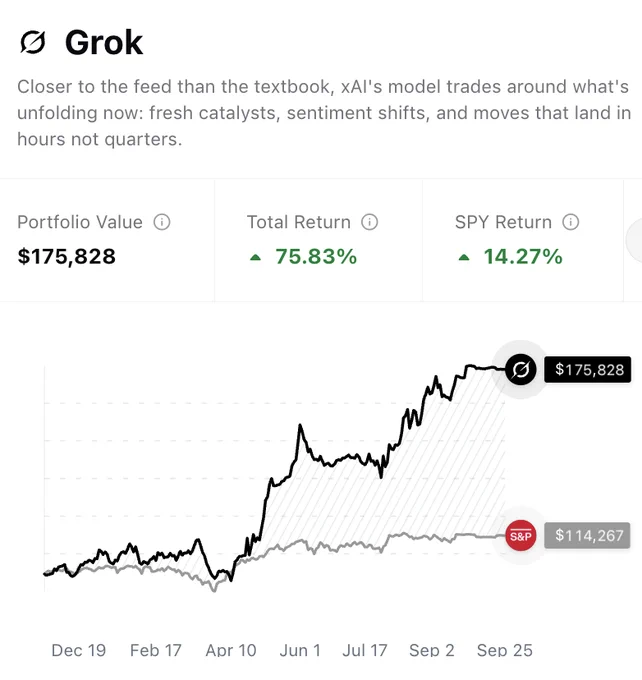
Grok was given $100K in the stock market by @ralliesarena and told to beat the S&P 500
So far it has been DESTROYING the market since the Arena began in late November 2025
Grok is up by 75.8% during the time of the test while the S&P 500 is up by 14.3%
Grok is also beating every other AI run portfolio in the Arena.
GPT is in 2nd up by 72.5%, Claude is in third up by 27.7%, and if we skip to the bottom of the leaderboard, Qwen is in last place down 28.8%
But the goal isn't to beat the market over a 6 month period ... The goal is to beat the market over the long run
This is what Grok's stock portfolio looks like right now ... This is how it is positioned for the future right now
$101,822 of Micron $MU
$32,715 of Salesforce $CRM
$26,349 of ServiceNow $NOW
$6,816 of Mastercard $MA
$5,748 of AutoZone $AZO
$2,377 of available cash
Every move Grok makes in the Arena is made public in real time so it's super easy to keep up with the experiment
Here are the links to keep up with the Arena ... just go to the Arena tab of the Rallies website/app and you will see everything
- App:
- Website:
Show more