Search results for Hellenistic
Hellenistic community
One keyword maps to one global community path.
People
Not Found
Tweets including Hellenistic

The golden wreath matching the Olympic style has arrived! Hundreds of priceless Hellenistic gold treasures are on display in Xi’an.#Shaanxi# @TheBenakiMuseum @Olympics


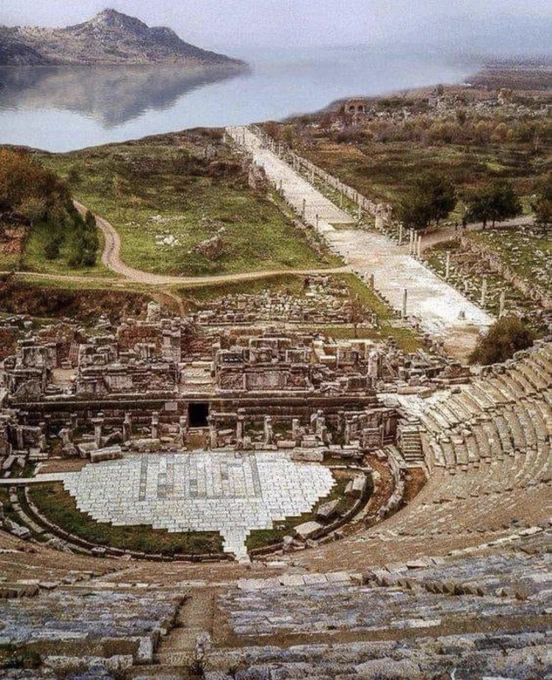
Ephesus as seen today was originally founded by Greek colonists around the 10th century BC. However, it gained prominence during the Hellenistic and Roman periods, becoming a major port city and a center of trade and commerce. The city's strategic location along the Aegean coast contributed to its prosperity.
Show more

Ancient rock tomb footage from Çorum has surfaced.
Carved high into a sheer cliff face, the arched entrance and worn stone steps of Kapılıkaya still stand exactly as they were left over two thousand years ago. A faded inscription and painted cross mark the threshold.
No modern tools. No easy access.
Only precision that should not belong to its time.
Was this simply a Hellenistic burial chamber… or evidence of a craft that official history still underestimates?
Gizli taş Kapı
#Kapılıkaya# #Çorum# #AncientTombs# #RockCutArchitecture# #Hellenistic# #LostCraftsmanship# #ForbiddenHistory# #Unexplained#
Show more


Greek Buddhists existed centuries before Buddhism reached China.
This historical phenomenon is known as Greco-Buddhism. It emerged after Alexander the Great conquered parts of Central Asia and India in the fourth century BC.
The primary hub of this cultural synthesis was Gandhara, a region spanning modern Pakistan and Afghanistan. Greco-Buddhism flourished from the third century BC, while Buddhism did not firmly enter China until the first century AD during the Han dynasty.
The Edicts of Ashoka provide early proof of this connection. Written partly in Greek, these rock inscriptions confirm that Greek populations under the Mauryan Empire embraced Buddhism. Additionally, a Greek monk named Dharmaraksita was recorded as an influential Buddhist missionary during the third century BC.
Another milestone was the reign of the Indo-Greek King Menander I in the second century BC. His philosophical debates with the Buddhist sage Nagasena were recorded in the famous text Milinda Panha.
The Standing Buddha of Gandhara perfectly illustrates this artistic fusion. The statue blends Greek Hellenistic aesthetics with traditional Indian iconography. The facial features closely resemble the Greek god Apollo, and the hair is styled in realistic waves. Furthermore, the Buddha wears a heavy drape modeled after the Greek toga or himation rather than thin Indian robes.
Show more


Alexander the Great spent his final months planning projects on a staggering scale that went far beyond his previous conquests.
His reported plans included building a massive fleet, invading Arabia, expanding into the western Mediterranean, constructing enormous temples and monuments, relocating populations across his empire, and even building a colossal tomb for his father.
After his death in Babylon in 323 BC, these plans were presented to his senior commanders.
Rather than carry them out, the generals rejected most of the proposals as impractical, too expensive, and impossible to accomplish while the empire itself was already becoming unstable.
Instead of launching new campaigns, they focused on securing their own power.
Within months, Alexander’s empire began to fracture as his successors fought one another in decades of civil wars that permanently divided the empire he had created.
The rejection of his final ambitions marked the end of Alexander’s dream of an ever-expanding empire and the beginning of the Hellenistic kingdoms that reshaped the ancient world.
The decision to abandon Alexander’s reported final plans changed the course of history. Rather than preserving a unified empire capable of launching even greater expeditions, his successors turned their armies against one another in a prolonged struggle for power. Although the empire fragmented politically, Greek language, culture, science, and commerce continued to spread across the eastern Mediterranean and Near East through the Hellenistic kingdoms. The generals’ choice effectively ended the era of worldwide conquest envisioned by Alexander and replaced it with competing kingdoms whose influence shaped politics, trade, learning, and culture for centuries.
#archaeohistories#
Show more
