Search results for MOONSHOTAI
MOONSHOTAI community
One keyword maps to one global community path.
People
Not Found
Tweets including MOONSHOTAI

A project shaped by experimentation, trust and a genuinely wonderful collaboration.
Thank you to the Kimi team for believing in the process and being such a pleasure to create with!
#KIMI# #KIMIK3# #MOONSHOTAI# #K3# #BTS#
Show more


A glimpse into the making of the K3 film.
An exploration of materials, motion and form.
Brought to life by Studio Archive.
#KimiK3# #KimiAI# #MoonshotAI#


ZERO Market Flash #003#
China's Second AI Shockwave: Is the Market Misreading It Again?
Why Cheaper AI May Mean More Infrastructure—Not Less
In January 2025, DeepSeek triggered one of the biggest debates in AI investing. The market quickly concluded that if powerful models could be trained with fewer GPUs, future demand for AI infrastructure must decline. NVIDIA lost nearly 17% in a single day, and AI-related stocks sold off across the board.
More than a year later, history appears to be repeating itself.
Kimi K3 has once again demonstrated that Chinese companies can build highly competitive large language models at significantly lower cost. The market immediately returned to the same question: If AI keeps getting cheaper, will we need fewer GPUs?
Ironically, Kimi itself may have provided the opposite answer.
Shortly after launch, the company suspended new subscriptions—not because the model had reached its limits, but because user demand had pushed GPU capacity close to its deployment limit.
That may be the most important signal from Kimi's release.
The first bottleneck wasn't model capability. It was deployment capacity.
For the past several years, AI competition has largely been defined by training. Whoever trained larger models with more GPUs was assumed to have the strongest competitive advantage. Under that framework, lower training costs naturally imply lower infrastructure demand.
But that assumption depends on one premise: that AI's value is created primarily during training.
The more important question is: What happens if cheaper AI leads to dramatically more adoption?
A foundation model may be trained once. It may perform billions of inference requests afterward.
Over the long run, infrastructure consumption is driven less by training than by continuous deployment.
Lower cost reduces the price of each interaction. Growing adoption increases the number of interactions. If usage grows faster than cost declines, total infrastructure demand can continue to expand.
That is why Kimi's GPU capacity announcement may matter more than the model itself. The market focused on lower training costs. Reality exposed growing deployment demand.
This also gives new context to SK Group Chairman Chey Tae-won's observation that the memory industry may gradually shift from a Price-driven cycle to a Volume-driven one.
If AI deployment continues to expand, future industry growth may depend less on rising prices and more on rising deployment volumes.
Kimi's capacity constraints do not prove that transition has already happened. They do suggest that AI competition is beginning to extend beyond training and into deployment.
One year ago, DeepSeek forced investors to rethink training costs. Today, Kimi may be forcing investors to rethink deployment demand.
Training creates models. Deployment creates industries.
—
This article reflects personal research and opinions only and should not be considered investment advice. Please conduct your own research before making investment decisions.
ZERO
Good is not good enough for conviction.
Only the best deserves concentration.
Scientist · Doctor · A9 Investor
Search Tags
#AI# #ArtificialIntelligence# #GenerativeAI# #LLM# #KimiK3# #MoonshotAI# #DeepSeek# #Inference# #Deployment# #Training# #AIAgents# #GPU# #NVIDIA# #Memory# #HBM# #Semiconductors# #AIInfrastructure# #SKHynix# #Micron# #SNDK# #TechInvesting# #ZERO#
Show more


Moonshot AI CEO Yang Zhilin surprised some of his Carnegie Mellon professors by choosing to return to China. Now, his Beijing-based startup’s latest private funding round values it at $50 billion. 🔗
Show more


MOONSHOT AI TARGETS $2B ANNUALIZED REVENUE BY YEAR-END
China’s Moonshot AI told investors its annual recurring revenue topped $1B in August, up from just $300M in June, with growth accelerating after the July launch of its Kimi K3 model.
The company now expects its annualized sales rate to reach $2B by year-end as subscriptions, hosted models and enterprise adoption grow.
Moonshot is also raising capital at a roughly $50B valuation ahead of a potential Hong Kong IPO as soon as this year.
Kimi K3 has 2.8T parameters, while Moonshot is expanding into enterprise deployments and is in talks with Microsoft, Amazon and Google over potential cloud distribution and revenue-sharing agreements.
Show more

Moonshot AI CEO Yang Zhilin surprised some of his Carnegie Mellon professors by choosing to return to China. Now, his Beijing-based startup’s latest private funding round values it at $50 billion.
Show more

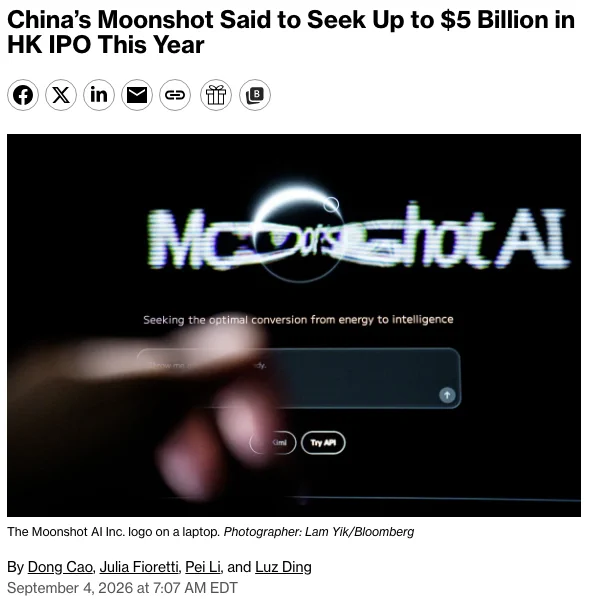
MOONSHOT AI SEEKS UP TO $5B IN HONG KONG IPO
Chinese AI startup Moonshot is considering raising $3B-$5B in a Hong Kong IPO as soon as this year, Bloomberg reports.
The company has already filed confidentially and added Bank of America as overall coordinator alongside CICC, Deutsche Bank and Goldman Sachs.
Moonshot was recently valued at $35B after a $3.5B funding round and is also seeking pre-IPO capital at a $50B pre-money valuation.
The Alibaba- and Tencent-backed startup launched its Kimi K3 model in July.
Show more
MOONSHOT AI FILES CONFIDENTIALLY FOR HONG KONG IPO
Chinese AI startup Moonshot, developer of the Kimi model, has confidentially filed for a Hong Kong IPO and is targeting roughly $3B in proceeds, per Reuters.
The company is being valued at about $50B in an ongoing funding round.
Moonshot also shifted from an offshore structure to an onshore China domicile ahead of the filing and is working with Goldman Sachs, CICC and Deutsche Bank on the listing.
Show more


Moonshot AI has raised about $2 billion in its latest funding round, signaling growing investor appetite for Chinese startups rivaling Silicon Valley’s leaders


BREAKING: Moonshot AI has confidentially filed for a Hong Kong IPO, seeking to raise about $3,000,000,000.00.