Search results for STARSHIP_PLANET_2017
STARSHIP_PLANET_2017 community
One keyword maps to one global community path.
People
Not Found
Tweets including STARSHIP_PLANET_2017

Starship is built to deliver millions of tonnes to Mars. We’re now offering Starship services to the red planet, recently signing our first agreement with the Italian Space Agency
Show more


Elon Musk's ecosystem of companies 🚀
• SpaceX — making life multiplanetary
• Starlink — connecting the planet from space
• Starship — building the future of space travel
• Tesla — accelerating sustainable energy
• xAI — advancing artificial intelligence
• Neuralink — creating brain-computer interfaces
• The Boring Company — reinventing transportation infrastructure
Few entrepreneurs have built companies across so many industries at the same time.
From Earth to Mars, from AI to energy, the ambition is hard to ignore.
Show more


NEXT STOP: MARS
Did you witness SpaceX’s historic Starship launch and catch? Absolute history in the making!
Here are some mind-blowing facts about Starship:
• Biggest Rocket Ever Built:
Standing 120 meters tall (394 ft), Starship is the largest and most powerful rocket ever created - built to reach the Moon, Mars, and beyond.
• Fully Reusable:
Unlike traditional rockets that burn up or sink after launch, Starship is designed for full reusability, slashing the cost of space travel and paving the way for frequent interplanetary missions.
• Massive Payload Capacity:
Capable of carrying 100+ tons to Low Earth Orbit (LEO), Starship can deploy mega-constellations, deliver lunar cargo, or even carry entire Mars mission modules in one flight.
• Built for Mars Missions:
Designed to ferry up to 100 passengers, Starship is humanity’s vessel for multi-planetary life - turning Elon Musk’s vision into reality, one launch at a time.
The dream of living on another planet just took its biggest step forward. Thank you @elonmusk
Show more


Elon Musk emphasizes that the complexity of developing a reusable orbital rocket is incredibly high. That's why "many smart people have tried it before, and no one has succeeded… most have kinda just been given up halfway through."
“We live on a planet where the gravity is actually very strong... That means that you have to have ‘A pluses’ across the board, incredibly efficient engines, incredibly efficient structure, you do need scale, that’s why Starship is so gigantic... But if full and rapid reusability can be achieved, it reduces the cost of access to orbit by a factor of 100 or more...
The difference between humanity being a multiplanet species or a single-planet species… It’s really that big of a deal.”
Video: @SpaceX
Show more


WATCH: Elon Musk on Starship's fundamental breakthrough, live with JPMorgan CEO Jamie Dimon.
Starship will be the first orbital rocket that is fully reusable, Musk says. Every other form of transport is reused as a matter of course. Planes, cars, ships, bikes, even horses.
A plane ticket would cost a fortune if you threw the aircraft away after one flight. That is exactly how rockets have worked until now. Full reusability is what changes the economics of spaceflight.
Show more


2034 Earth–Venus–Mars opportunity looks promising. 10–15 on-orbit refueling operations may be needed to make a crewed ship full. Most can be done at an altitude of 180–200 km, made possible by Starship’s size. The final refueling may be performed at a higher altitude of ~2000 km, just below the Van Allen belt.
Earth departure on 2034-08-21 from 2000 km orbit. A Trans-Venus Injection burn of ~3.7 km/s will place the ship on an Earth–Venus–Earth free-return trajectory. Venus flyby is expected on 2034-12-19, 120 days after departure. Two weeks before the encounter, if the mission proceeds as planned, a 25-m/s maneuver will shift the trajectory from Earth-return to Mars-bound. If not, the ship will free return to Earth in September 2035.
The Venus gravity assist will send the ship into another Earth free-return trajectory, with Mars flyby around 2035-06-02. One week before reaching Mars, a system health check will determine whether to commit to Mars Orbit Insertion. If it’s GO, a small 10-m/s manuever will put the ship to less than 100 km altitude periapsis. Otherwise, a Mars flyby will lead to an Earth return in May 2036.
The ship will enter the Martian atmosphere at about 9.4 km/s, performing an aerobrake to slow to 4.88 km/s and capture into a 100x140000 km, 7-day period high elliptical orbit. At apoapsis, a 50-m/s plane change will align the inclination with Mars’ equator, followed by additional aerobraking to remove about 650 m/s of velocity, placing the spacecraft in a 120x6128 km orbit. A 550-m/s burn at 6128 km altitude will then adjust the trajectory into Phobos orbit.
The ship will stay at Phobos for about 7 days. The Mars–Phobos L1 point is only about two miles above Phobos’ surface, and Mars would dominate nearly half the sky, appearing about 80 times larger than the Moon from Earth.
The ship will depart for Deimos afterward. Two burns totaling roughly 750 m/s will transfer the ship from Phobos to Deimos. And the ship will stay at Deimos for 7 days more.
From Deimos, the ship will raise its apoapsis to form a 20000x140000 km altitude, 7-day orbit, requiring about 420 m/s of delta-v. At apogee, a 50-m/s burn will adjust inclination and lower periapsis to ~500 km for final Trans-Earth Injection. If time and propellant allow, the orbit can be aligned to a polar inclination for Mars ice-cap observations before departure.
A Trans-Earth Injection burn at 500 km altitude, requiring 1.5–1.6 km/s of delta-v in early July 2035. If departure on the first days in July, Earth arrival is expected in December 2035. If missed that window, a March 2036 arrival may look more feasible.
Nominal mission duration: 490 days, with 30 days in Mars orbit and 14 days at Phobos and Deimos.
Two planets, two moons for 3.7+0.025+0.010+0.05+0.42+0.55+0.75+1.55=7.06 km/s Δv
Show more


Starship Was Engineered Backward From One Objective:
Moving millions of tons to Mars at the lowest possible cost per ton to build a self-sustaining civilization.
Five first-principles decisions make it possible:
- Produce propellant on Mars. Methane and oxygen made from local CO2 and water ice via Sabatier. No Earth return fuel required.
- Use 301 stainless steel. 67× cheaper than carbon fiber and survives both cryogenic propellants and 1,700°C reentry without heavy shielding.
- Refuel in orbit. Tankers reset the rocket equation, enabling 100–150 ton payloads to Mars.
- Belly-flop reentry. Maximize drag area so the atmosphere does most of the braking.
- Full reusability. Both stages fly again rapidly. Marginal cost collapses to propellant only.
This is the minimum architecture that makes multi-planetary life feasible.
Show more


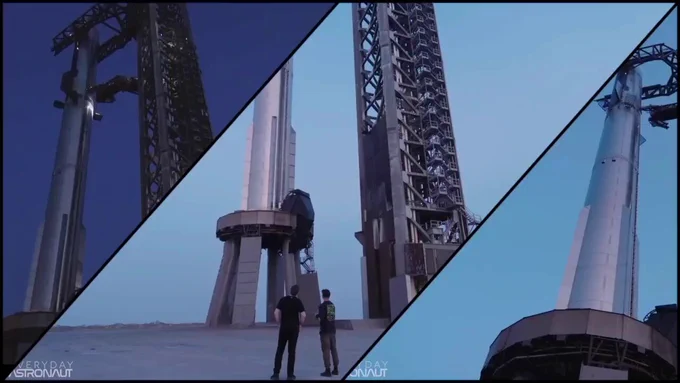
Starship is the largest flying object ever built.
This is the factory where it happens — and Elon Musk giving an inside tour of SpaceX’s Starbase factory


Starship roaring into the sky, pushing humanity closer to becoming a multi-planetary species 🚀


Starship The largest flying object ever made