Search results for SystemDesign
SystemDesign community
One keyword maps to one global community path.
People
Not Found
Tweets including SystemDesign

Where does an ad-serving stack break as formats keep multiplying?
Uber Ads started with Sponsored Listings, then grew to Sponsored Items, display, banners, and video. Retrieval, scoring, and bidding logic forked per surface, and with a shared codebase, deployments became coupled. A bad change on one surface could force a rollback of an unrelated one.
The turning point was to rebuild ads around capabilities rather than per-surface features. A supply layer normalizes each surface's request into an AdSpec, a marketplace layer picks an auction or a preferred-deal strategy, and demand providers bid. Surface-specific context is split into extensions, and only the providers that need them use them.
Traffic is then split into environment-based fleets running the same codebase. Deployments and rollbacks are independent, and if a provider fails, the auction completes with the remaining candidates.
"Build capabilities, not features" and "push complexity to the edges" carry over to any multi-surface platform.
Note: this is a blog post, and it reports no quantitative results.
Title: Designing a Generalized Ads Marketplace Platform
#SystemDesign# #AdTech#
Show more


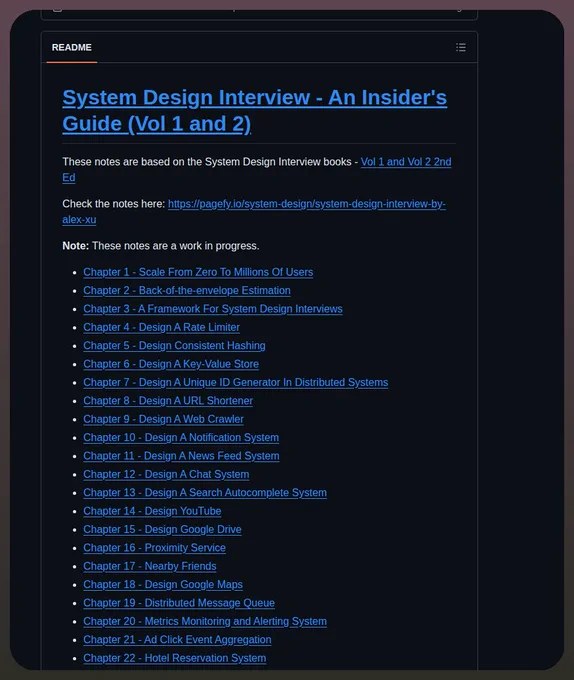
Breaks down system design interviews into 28 chapters on scaling, rate limiting, and distributed systems.

Me in 2012 instead of learning:
DSA
System Design
AI / ML
Generative AI
LLMs
AI Agents
RAG
Vector Databases
Embeddings
Fine-tuning
Prompt Engineering
MCP
AI Coding Agents
Python
Java
C
C++
Go
Rust
JavaScript
TypeScript
HTML
CSS
React
Next.js
Vue
Angular
Node.js
Express.js
NestJS
Spring Boot
Django
FastAPI
REST APIs
GraphQL
WebSockets
SQL
PostgreSQL
MySQL
MongoDB
Redis
Elasticsearch
Kafka
RabbitMQ
Docker
Kubernetes
Terraform
AWS
Azure
GCP
Linux
Git
GitHub
CI/CD
DevOps
Microservices
Serverless
Cloud
Cybersecurity
Data Engineering
Data Science
MLOps
Data Analytics
Blockchain
Web3
Smart Contracts
Solidity
Edge Computing
Distributed Systems
Observability
Prometheus
Grafana
OpenTelemetry
Supabase
Firebase
Vercel
Cloudflare
PostgreSQL + pgvector
LangChain
LlamaIndex
PyTorch
TensorFlow
Hugging Face
Ollama
OpenAI APIs
Claude APIs
Gemini APIs
Model Context Protocol
AI Infrastructure
GPU Computing
CUDA
Show more

TL;DR: CaMeL stops prompt injection through system design, not model smarts. It solves 77% of AgentDojo tasks with provable security.
Title: Defeating Prompt Injections by Design
URL:
Key points
・🧠 The Privileged LLM only writes the plan and never sees untrusted data
・🔒 The Quarantined LLM only parses untrusted data into structure and has no tools
・🏷️ Every value carries a capability for its provenance and allowed readers
・📜 Python security policies check each tool call before it runs
・📊 Zero successful attacks on Claude 3.5 Sonnet, vs. 8 for the next-best defense
・⚖️ Utility goes from 84% to 77%, with about 2.8x the tokens
・🕳️ Side channels such as exceptions and timing remain open problems
Building a secure system around an untrusted model looks key for production agents.
#PromptInjection# #AIAgents#
Show more
$NVDA LAUNCHES OPEN AGENT SAFETY PLATFORM
Nvidia is introducing OpenShell software and the Sentry reference system design to let companies set enforceable limits on what AI agents can access and do, with security controls operating outside the agents themselves.
OpenShell, the open-source software layer, controls access to files, tools and external services, protects credentials and records permission decisions. It works with existing agents such as Claude Code, Codex and Hermes without requiring developers to rewrite them.
Sentry adds a separate hardware watchdog running on Nvidia’s BlueField-4 processors. Nvidia says it continuously monitors agent activity from outside the agent’s environment and can quarantine agents attempting to cross their boundaries within milliseconds.
The approach is designed for agents that work for hours or days, write code and interact with business systems. Instead of relying only on the model to follow instructions, the infrastructure limits which actions it can actually carry out.
Anthropic has collaborated with Nvidia to add protections to Claude Managed Agents, while SpaceXAI is using the platform for Cursor coding agents and Grok models. Salesforce has integrated OpenShell with Slack, and SAP is embedding it into Joule Studio.
Nvidia says more than 100 organizations are working with the technologies, including Microsoft, CrowdStrike, Cisco, Palo Alto Networks, Palantir and ServiceNow. The effort also extends to robotics, banks and energy infrastructure.
Jensen Huang: “Safety and security require full-stack engineering.”
OpenShell is broadly available, with platform software accessible through Nvidia’s developer resources and GitHub. Sentry is presented as a BlueField-4-based reference system design.
Show more


Temporary power is more than a generator.
Site survey, system design, logistics, installation, commissioning, monitoring and fuel management all matter.
MEMS manages the requirement from planning through to project close-out.
Show more


🚀 Over one trillion tokens per day, powered by Mooncake and SGLang.
@ApproachingAI shares the system architecture and engineering lessons behind its token factory, running leading trillion-parameter models with SGLang HiCache + Mooncake Store.
A deep dive into:
🏗️ Production architecture and system design trade-offs
⚡ Performance optimizations for trillion-token-scale workloads
🛡️ Failure isolation, fault tolerance, and recovery
Real production lessons on scaling KV cache reuse while meeting strict inference SLOs.
Read more:
Show more


Today I had in-depth conversations with optical, packaging, and system design engineers at Intel, NVIDIA, Marvell, Micron, Broadcom, and Ayar Labs.
My takeaway is that optics is just getting started. Don’t put a ceiling on how big it can get.
Investing is still hard. Conversations like these strengthen my conviction to keep going.
Show more

Independent researchers bring a different perspective to protocol security, challenging assumptions, roles and system design from outside the team.
@lonelysloth_sec spent 157 days reviewing Centrifuge across V3.1, V3.2 and V3.3.
Show more


AI workloads don't run on compute alone.
AMD CTO Mark Papermaster (@MPaper2000) explains why increasingly demanding foundation models require CPUs, GPUs and networking to work together and how a holistic system design can help deliver the performance AI needs.
Show more
