Search results for bits:0x000000000003ddef204b9b32c29c57f293ae5599
bits:0x000000000003ddef204b9b32c29c57f293ae5599 community
One keyword maps to one global community path.
People
Not Found
Tweets including bits:0x000000000003ddef204b9b32c29c57f293ae5599

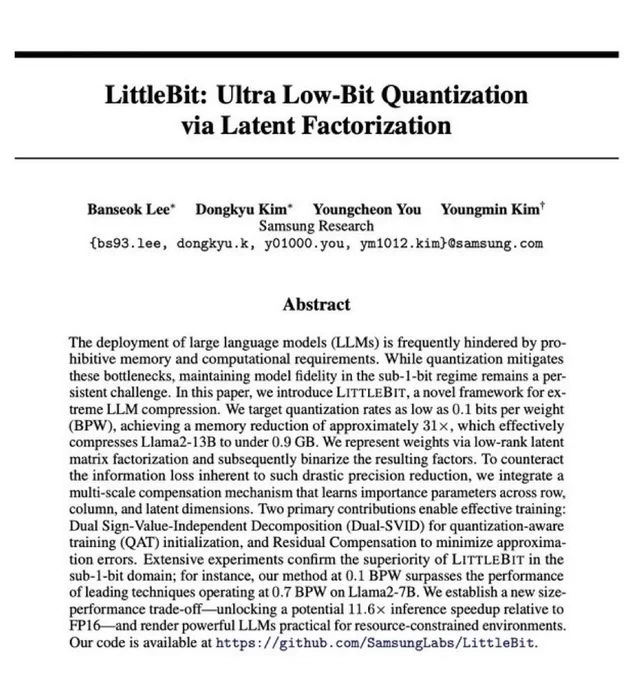
Samsung open-sourced a method that shrinks 13B parameter LLM into less than 1 GB.
The method is named "LittleBit"
Normally, AI weights are stored as regular numbers. LittleBit instead uses latent factorization to compress them below 1 bit each.
Some setups get all the way down to 0.1 bits per weight.
The architecture is where it gets wild.
Once a model is compressed this far, most of the math goes away.
LittleBit doesn't make the hardware grind through expensive floating-point multiplications. It runs the core computation with a simple bitwise XOR.
Heavy matrix math becomes simple sign flips.
What this means for deploying models:
• Up to 11.6x faster inference than standard FP16 models.
• Much less memory needed, and much less bandwidth to load the model.
• Holds up even below 0.5 bits, where older compression methods completely break down.
This is more than a smart optimization.
It's a roadmap for running huge, advanced AI locally on cheap, low-power hardware.
Show more

Introducing newsliquid-flash-1.0
Our new specialist model built for real-time market news triage.
It ranks #1# on the News Impact Benchmark v1, delivering an industry-leading 13.290 bits/s information rate with just 140.1 ms mean latency.
Show more


Birthday + 3.0 Debut Uncapped Subathon
Date: May 26 @ 7PM EST (My birthday is on May 28)
・Subathon timer starts @ 12 hours
・Bedge/BRB = Timer PAUSE⏱️
・I'll be playing variety games (Elden Ring/OW2/LostArk/HSR/), just catting and media-share!
Subathon Details:
・T1SUB/500bits/$5USD: +4 min to timer
・If we reach June 26, the sub/bits/etc will be reduced to 2 minutes to the Timer
Schedule design: @tatsuwu #HanyaLIVE#
Show more


High-end drill bits manufacturing are more difficult than you think.
In the past, this was something that was dominated by the Japanese, and EU.
China has cracked the market just several years ago, and have been expanding aggressively since.
Coincidentally, one of the key ingredients to manufacture this drill bit here is Tungsten - specifically Tungsten powder.
China has choked off Japan's APT & Tungsten powder supply since early 2026. In the event where Japanese carbide manufacturers cannot fulfill all customers' orders, semiconductor customers are moving across to China to diversify its supply chain.
That's not to say that the Chinese supplies will flood the market. Just like any semiconductor supply chain, the verification process takes 6-12 months. So there's the lead time.
Reviewing all the half-yearlies of the Chinese PCB/AI drill bits manufacturers, they have all said that the demand is exploding, and supply can no longer keep up with demand.
They have also shown 0 concern on future prices because they expect the selling price will be higher for the foreseeable future. Whatever is produced, will be sold.
Combined with the "depressed" Tungsten price in China vs ex-China, you can be sure their margins are expected to increase in 2H26 vs 1H26.
Show more


All my oQe models have been updated with Improved oQe Quantization, available from oMLX 0.7.1. Compared with the previous oQe builds, KL divergence is 11.6–18.1% lower on code and 10.2–13.8% lower on prose, so please give them a try. The full model list is below.
KL divergence from the original BF16 model (mean, lower is better)
- Qwen3.8-27B oQ4e: code 0.0143 → 0.0117 (-18.1%), prose 0.0696 → 0.0600 (-13.8%)
- Qwen3.8-Flash-Next oQ4e: code 0.0877 → 0.0776 (-11.6%), prose 0.1909 → 0.1713 (-10.2%)
What's new
- Below oQ4, the Engram and N-gram tables stay at 4 bits and are left out of the bit budget. oMLX can serve these tables from SSD instead of memory, so the full bit budget goes to the rest of the model.
- Model cards now show the bit distribution and storage breakdown.
If you downloaded an earlier oQe build, please re-download it.
Improved oQe models (69)
- Qwen3.8-Flash-Next: 2.5 · 2.7 · 3 · 3.5 · 4 · 6 · 8 bits
- Qwen3.8-Flash-Next FP16: 2.5 · 3 · 3.5 · 4 bits
- Qwen3.8-27B: 2.5 · 3 · 3.5 · 4 · 6 · 8 bits
- Qwen3.6-35B-A3B: 2.5 · 3 · 3.5 · 4 · 6 · 8 bits
- GLM-5.3-Flash: 2 · 2.5 · 3 · 3.5 · 4 · 5 · 6 bits
- DeepSeek-V4.1-Flash: 2 · 2.5 · 3 · 4 bits
- DeepSeek-V4-Flash-0731: 2.5 · 2.7 · 3 · 3.5 · 4 bits
- gemma-4-31B-it: 2.5 · 3 · 3.5 · 4 · 6 · 8 bits
- gemma-4-26B-A4B-it: 2.5 · 3 · 3.5 · 4 · 6 · 8 bits
- gemma-4-12B-it: 2.5 · 3 · 3.5 · 4 · 6 · 8 bits
- clef: 2.5 · 3 · 3.5 · 4 · 6 · 8 bits
- clef-flash: 2.5 · 3 · 3.5 · 4 · 6 · 8 bits
Show more

DATADOG $DDOG Q3’26 EARNINGS HIGHLIGHTS
🔹 Revenue: $1.20B (Est. $1.15B) 🟢; +35% YoY
🔹 Adj. EPS: $0.81 (Est. $0.65) 🟢; +47% YoY
🔹 Non-GAAP Oper Income: $334M (Est. $268M) 🟢
FY26 Guide:
🔹 Revenue: $4.52B-$4.53B (Est. $4.48B) 🟢
🔹 Non-GAAP Oper Income: $1.10B-$1.11B (Est. $1.03B) 🟢
🔹 Adj. EPS: $2.73-$2.75 (Est. $2.55) 🟢
Q4 Guide:
🔹 Revenue: $1.19B-$1.20B (Est. $1.2B) 🟡
🔹 Non-GAAP Oper Income: $280M-$290M (Est. $279M) 🟢
🔹 Adj. EPS: $0.69-$0.71 (Est. $0.66) 🟢
Other Q3 Metrics:
🔹 $100k+ ARR Customers: about 4,860; +20% YoY
🔹 Gross Margin: 81%
🔹 Operating Cash Flow: $290M
🔹 Free Cash Flow: $251M
Announcements:
🔹 Scout: 1.0 launched; powers Bits Investigation
Comments:
🔸 “Datadog delivered a strong third quarter, with 35% year-over-year revenue growth, $290 million in operating cash flow, and $251 million in free cash flow.”
🔸 “We are innovating rapidly, including developing specialized AI models through our AI Research team, to help customers manage growing complexity and move towards autonomous operations.”
Show more


A new dense 32B model ran a 239K-token conversation inside a 16GB GPU-memory budget.
Agens Volundr 32B v1 compares well to Qwen3.8-27B.
And the trick isn't just the ~2.8-bit quant.
54 of its 72 layers don't build a growing KV cache at all. 👀
Blockway released Agens Volundr 32B v1 today.
Stats
🧠 32B parameters
📚 262K configured context
💾 ~2.82 bits/weight on the 16GB build
🔓 Apache 2.0 weights
⚙️ MIT-licensed Agens Engine
📦 Official GGUFs already available
Special Source 👉 instead of every layer accumulating KV as context grows
72 layers
↓
54 keep fixed-size recurrent state
↓
only 18 layers maintain growing KV cache
That helps with long-context memory
Using Agens Engine's hard 16 GiB GPU-memory cap, Blockway fed it a 219K-token document and reports at T=0.6
⚡ Chat → 57 tps
⚡ Code → 79 tps
⚡ Thinking → 71 tps
⚡ Tool calls → 67 tps
They pushed the limits of the 239K-token envelope while GPU memory peaked around 15.5 GiB.
At short context, the same profile reaches roughly 86–123 tps depending on workload.
And there's already a separate 24GB profile using the 4-bit weights for cards in the RTX 4090 class.
🎯 Volundr attacks the other monster in the room, : the memory cost of long context.
⚠️ Those published 16GB and 24GB performance numbers were measured on a 48GB GPU running under hard memory caps, not yet on physical 16GB/24GB consumer cards.
The official GGUFs work today with Blockway's llama.cpp fork.
Stock llama.cpp support is still being upstreamed.
Link in ALT
Show more

A new dense 32B model ran a 239K-token conversation inside a 16GB GPU-memory budget.
It compares well to Qwen3.8-27B.
And the trick isn't just the ~2.8-bit quant.
54 of its 72 layers don't build a growing KV cache at all. 👀
Blockway released Agens Volundr 32B v1 today.
Stats
🧠 32B parameters
📚 262K configured context
💾 ~2.82 bits/weight on the 16GB build
🔓 Apache 2.0 weights
⚙️ MIT-licensed Agens Engine
📦 Official GGUFs already available
Special Source 👉 instead of every layer accumulating KV as context grows
72 layers
↓
54 keep fixed-size recurrent state
↓
only 18 layers maintain growing KV cache
That helps with long-context memory
Using Agens Engine's hard 16 GiB GPU-memory cap, Blockway fed it a 219K-token document and reports at T=0.6
⚡ Chat → 57 tps
⚡ Code → 79 tps
⚡ Thinking → 71 tps
⚡ Tool calls → 67 tps
They pushed the limits of the 239K-token envelope while GPU memory peaked around 15.5 GiB.
At short context, the same profile reaches roughly 86–123 tps depending on workload.
And there's already a separate 24GB profile using the 4-bit weights for cards in the RTX 4090 class.
🎯 Volundr attacks the other monster in the room, : the memory cost of long context.
⚠️ Those published 16GB and 24GB performance numbers were measured on a 48GB GPU running under hard memory caps, not yet on physical 16GB/24GB consumer cards.
The official GGUFs work today with Blockway's llama.cpp fork.
Stock llama.cpp support is still being upstreamed.
Link in ALT
Show more

EVERY OPEN CHALLENGE ON YUKON RIGHT NOW
1) 12.1x smaller quantum circuit for secp256k1 point addition, now 70.3% below @GoogleQuantumAI's bound
2) ShorECDLP: formally verified Shor circuit for secp256k1, ~4.5 billion x smaller since Oct 29
3) Ethereum's MODEXP precompile 3,665x cheaper in gas (RIPEMD-160 31x cheaper)
4) LaBinius: 70x faster on ARM in 3 days (16.9x faster on x86)
5) [@SuccinctLabs]'s Flock prover at 3.9x the throughput (5.3x multi-core)
6) Ethereum hash-based signatures 2.05x better on size x verify cycles
7) EC Rank: 85 new record elliptic curves (closes Nov 14!)
8) Lean: verified point addition 19% smaller
9) HashSmash: estimated collision cost on 37-round SHA-256 down from 2^248 to 2^57 (AI-reviewed)
10) The Proximity Prize: Lean-checked soundness floor up from 53 to 68.15 bits
11) Yukon Arena: Fortress: top harness score 77.1 → 91.3 in 2 days (closes Nov 23)
12) Heesch: best score is 4.988, and the first unmarked polyform with Heesch number 5 is still up for grabs
Still unbroken:
13) CircuitBreaker: 252 gate lower-bound proofs in review, 0 confirmed
14) Dihedral Coset Problem: 990 submissions, no faster algorithm confirmed yet
15) the bound to beat is infinity, so any finite bound takes #1#
16) CurveSmash: 3,839 attempts on secp256k1, P-256 and BLS12-381, 0 breaks
Also open:
17) best agent harness hit 1.58B on using $7.54 of model credits
18) Virtual Embryo: helping biologists predict how cells change in the developing heart (private collab)
Data pulled from on Nov 10.
~450 solvers and their AI agents have made ~29K submissions across these. The one that surprised us most is where an open network is now 70% below Google Quantum AI's bound for the circuit at the core of breaking ECDSA.
Pick one and point your agent at it →
Show more


SITUATION EXPLAINED: for anyone benchmarking or serving with mlx_lm.server: requests that carry a seed are never batched. ⚠️
I traced the code. Each request goes through _is_batchable, which needs seed is None. A seeded request runs alone on the single generation thread, and nothing else is served until it finishes. Worse: if one arrives while a batch is running, the server stops taking new requests, finishes the batch, then runs the seeded one by itself. One seeded client stalls everyone. 👀
WHY: the seed resets MLX's global RNG, which can't be shared across a batch. It's a choice for reproducible output, not an MLX limit:
- llama.cpp: per-slot sampler with its own RNG, batched together
- vLLM: per-request generator/seed, stays in the batch
- mlx-serve: per-request random keys on MLX, batched
- omlx: keeps them batched, but seed is global so best-effort under concurrency
- mlx_vlm: batches them, but every request in a running batch uses the first request's sampler (seed, temp, top_p) until the server goes idle
PRACTICAL TIPS for mlx_lm:
- At temp 0 drop the seed: greedy decoding never uses it
- Compare summed per-request t/s with real throughput (tokens / wall time). If the sum is much higher, your requests didn't overlap
- --kv-bits, images and draft models also disable batching in mlx_lm.server ⚠️
Code:
Show more
