Search results for embodied
embodied community
One keyword maps to one global community path.
People
Not Found
Tweets including embodied

Embodied AI Enters Deployment Year One, and @AGIBOT_US put A3, X2, and G2 in front of the North American automation crowd 🤖
A3 and X2 showed the service side: performance, reception, guided tours, and real work already moving into restaurants and exhibition halls.
G2 showed the industrial side: teleoperated wire-harness routing, connector mating, precise grasping, visual perception, dual-arm coordination, and Jenga stacking.
That was more than a booth interaction.
Teleoperation is one of the ways robots learn.
The factory follow-up was the stronger signal: G2 completed a 6-day tablet-inspection livestream on LONGCHEER’s real production line.
99.99% task success rate.
2 mm precision fluctuation.
17,625 units produced.
64,828 robot operations completed.
Cycle time stayed at 22 seconds per operation.
The livestream ran for 64 hours from June 23 to June 28, 2026.
By the end of it, the robots had already been running on that line for 105 days, from March 16 to June 28.
This is the shift we actually want to see: humanoid robots moving from demos into real factory work.
#AGIBOT# #Automate2026# #EmbodiedAI#
Show more


Embodied intelligence can’t afford bad data.
Perle Labs is building AI data infrastructure designed for this reality:
→ Human-verified, expert-validated work
→ On-chain auditability
→ Sovereign and enterprise-grade design
Built to benefit everyone.
Show more


Will Embodied AI Be AI’s Next Breakout?
At this week’s World Humanoid Robot Games, organizers released a dataset containing more than 2,500 hours of real-world robot operation data.
It reflects a broader shift: embodied AI is moving beyond stage demos and toward data accumulated through physical interaction.
Zhihu contributor 任广杰, Assistant Vice President at @LejuRobotics_ , believes embodied AI will become AI’s next breakout field.
But it will not resemble ChatGPT’s overnight rise. The real signal will be a steady increase in the hours robots can work reliably in real environments.
1️⃣ Physical AI plays by different rules
The previous AI waves, including computer vision and NLP, operated largely in information space. When a model makes a mistake, the task can usually be retried.
Robots operate in the physical world. Changes in lighting, friction, payload, or object position can damage equipment or halt a production line.
That creates two requirements AI has rarely had to meet at scale:
🔹 Real-time, closed-loop control
🔹 Consistently high success rates in uncontrolled environments
A successful demo is not enough. The system must continue working when conditions change.
2️⃣ Three inflection points have arrived
🔹 Robot bodies are becoming reliable enough
Integrated actuators now combine motors, reducers, encoders, and drivers. This has sharply reduced joint failure rates.
At Leju, robot mean time between failures has increased from hours to thousands of hours.
Below that threshold, the economics do not work. Maintenance and downtime can erase the value of replacing human labor.
🔹 Robots now have both a “brain” and a “cerebellum”
Traditional industrial robots execute fixed instructions. A change in task usually requires new programming and teaching.
Large models give robots task-level understanding. A robot can inspect randomly placed components, then plan the order and pose for grasping them.
Meanwhile, lower-level control systems handle balance, locomotion, and physical disturbances.
The “brain” decides what to do. The “cerebellum” keeps the movement stable. The body must survive repeated execution.
🔹 The data flywheel is starting to turn
Embodied AI is beginning to follow the path of autonomous driving.
Real robots generate operational data. That data improves the models, which then return to the physical world and generate more useful experience.
This closed loop is essential because many problems only appear during deployment.
3️⃣ The real gap lies between the lab and the factory
Leju began developing humanoid robots in 2016. One of the clearest changes in the current cycle is that factories are now willing to open real production stations for testing.
Three years ago, that was much harder.
A 95% grasping success rate may look impressive in a laboratory. A factory may require 99% availability under changing lighting, reflective surfaces, deformed containers, and shifting object positions.
Customers therefore ask very practical questions:
🔹 How long can the robot operate without failure?
🔹 Can it recover from an exception by itself?
🔹 Can it keep pace with the production line?
Answering them requires the body, controller, model, data loop, and deployment engineering to work as one system.
4️⃣ The first commercial wave is already taking shape
The earliest deployments appear in structured environments with clear task boundaries and measurable value.
Leju’s full-size Kuavo 5 robots are already used for reception and guided tours in exhibition halls, banks, and stores, as well as for park inspection. The company says these projects now cover 23 Chinese provinces and hundreds of customer cases.
In manufacturing, Leju explored more than 70 factories and hundreds of potential tasks over the past year. Dozens passed proof-of-concept acceptance.
Its wheeled Kuavo 5-W has entered small-batch deployment for tasks such as loading small automotive components and depalletizing cartons.
The important change is that some customers are beginning to pay for repeatable workflows, not merely demonstration projects.
5️⃣ Home robotics remains the endgame
Homes may eventually become the largest market, but they are also the hardest environment.
They are highly unstructured. Task boundaries are almost unlimited, and consumers are extremely sensitive to cost.
Two conditions must be met:
✅ Embodied models must generalize well enough for real household use.
✅ The total cost of the robot must fall below the cost of human labor.
Until both happen, industrial and commercial settings will remain the more realistic path to scale.
6️⃣ Watch effective working hours, not flashy demos
The best measure of an embodied AI system is how long it can create value without human intervention.
Three questions matter:
🔹 Can it do the job?
This depends on whether the task can be decomposed and whether the environment is sufficiently structured.
🔹 Can it do the job reliably?
The key metrics are continuous operating time and autonomous recovery from failures.
🔹 Is it economically worthwhile?
The customer must be able to calculate the full lifecycle cost. Once the economics become clear, repeat purchases can begin.
Embodied AI is already moving from exhibition piece to production tool.
Its breakout will not be defined by one viral robot. It will be defined by thousands of machines quietly accumulating useful working hours in factories, stores, and eventually homes.
🔗 Full analysis:
#EmbodiedAI# #HumanoidRobots# #Robotics# #PhysicalAI# #ArtificialIntelligence# #ChinaTech#
Show more


Recursive Embodied Self-Improvement.
A future where humanoid robots operate factories, design improved actuators/hands/bodies, manufacture those components, assemble the next generation of robots, evaluate them, and then let those improved robots repeat the process.
Show more


OVC embodied AI companies are taking over WRC 2026!
From robots that cook and wash dishes to machines that run, flip, fight, and inspect industrial sites – the valley is bringing next-gen robotics to Beijing!
Show more

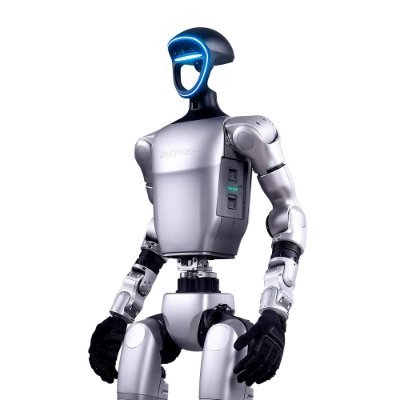
Unitree Embodied AI Model Manufactures Robots in Factory🤩
Based on Unitree’s UnifoLM-X1-0 embodied AI model, this is an actual deployment at Unitree’s own robot factory.


A lot of embodied AI still feels like AI modules bolted onto a robot.
TARS is taking a different architectural bet with AI World Engine (AWE) 3.5, TARS’ embodied-native foundation model for physical AI.
Its "Born as One" approach puts action, perception, geometry, and touch into one model from the beginning rather than stitching those capabilities together later.
The same model-driven system is designed to generalize across different tasks, objects, environments and robot bodies.
The training recipe then implements and validates a full closed-loop methodology for embodied-native foundation models through pre-training and post-training.
During pre-training, 2 priors give the model a base understanding of action patterns, spatial structure and understanding of physical laws before it is adapted to a robot, while post-training uses the AI World Engine to roll possible future states forward inside the model, predict what different actions may lead to and use those predictions to choose better actions.
TARS describes the full loop as 5 connected parts: embodied-native architecture, dual-prior pre-training, World Engine-driven post-training, scaling validation and continuous data feedback.
TARS positions AWE 3.5 as one of the most powerful embodied-native foundation models for general-purpose physical AI, with several minutes of long-horizon closed-loop reasoning and roughly 2x task execution efficiency versus PI0.5.
@TARSRobotics #AWE35# #TARS# #tarsrobotics#
🧵 1.
Show more

🤖 #Hubei#'s first embodied intelligence talent training base has opened at the Hubei Humanoid #Robot# Innovation Center in #OVC#.
The province is home to 10+ academicians in embodied intelligence and 140+ humanoid robot firms. #OVCIndustry# #OVCTalent#
Show more


From AI agents to embodied intelligence, Tencent unveiled a full-stack approach at #WAIC2026# spanning models, platforms and applications—alongside the global launch of @TencentCloud's enterprise-grade Agent Development Platform, ADP 4.0.
Show more


Showcasing Industrial Embodied AI in Action
At the exhibition, Lumos showcased how embodied AI is moving from research to real-world deployment through:
🤖 Industrial mobile manipulation solutions
📊 End-to-end data infrastructure for embodied AI
🦾 A complete embodied AI robot portfolio
🏆 AI Innovation Product Award recognition
By connecting data, models, and robotic infrastructure, we're accelerating the large-scale deployment of embodied AI in industrial environments.
Thank you to everyone who visited the Lumos booth. See you at the next event!
#EmbodiedAI# #IndustrialAI# #Robotics# #HumanoidRobot# #Automation#
Show more
