Doctors watched a woman with late-stage Alzheimer's wake up and start telling stories from her own life. She'd barely said a word in five years.
The patient, a Japanese-American woman in her 80s, had been declining for a decade. For the last five years she communicated mostly in single syllables. She couldn't walk well, couldn't dress herself, couldn't control her bladder. Her family had watched her slip further away every year, the way millions of families do.
Then, under medical supervision and with her caregiver's consent, she was given 5 grams of psilocybin mushrooms. A big dose. She sweated heavily and sank into a deep, sleep-like state.
Around 19 hours later, she woke up and started talking.
Full sentences. Memories from her own life, flowing out for nearly four hours straight. In the days that followed she began recognizing family members again. She dressed herself. She walked more independently, held eye contact, smiled, even cracked jokes. Her bladder control came back. A second, smaller session a month later brought more of the same: humor, emotion, connection.
Now, the honest part. This is one patient. One case report, published in Frontiers in Neuroscience by researchers in Brazil. No brain scans, no standardized cognitive tests, no placebo. The disease itself wasn't reversed, and the gains were temporary. High-dose psilocybin also carries real risks, especially for frail elderly patients, so nobody should try this at home.
But here's why scientists are paying attention anyway. Alzheimer's this advanced was assumed to be a one-way street. This case hints that some of the brain's circuits may still be in there, quiet but not gone, waiting for something to switch the lights back on.
She was never really gone. We just couldn't reach her.
Source: Frontiers in Neuroscience case report by Brazilian neuroscientists, covered by ScienceAlert, The Conversation, and Vice.
Show more

Japan just turned thin air into fuel.
No oil rigs. No drilling. No pipelines stretching across oceans.
Just water, CO₂, and a process that flips combustion on its head.
ENEOS Corporation, Japan's biggest oil refiner, pulled it off at their Yokohama lab.
They built a demo plant that sucks carbon dioxide straight from the atmosphere, splits hydrogen out of water using renewable energy, then fuses them through Fischer-Tropsch synthesis into liquid hydrocarbons.
The result? Real, usable synthetic petroleum.
The kicker: this fuel is "drop-in ready." That means it works in the cars you already drive, the planes already in the sky, the pipelines already in the ground. Zero modifications.
They didn't just brew it in a beaker either. They ran actual vehicles on it. It works.
Think about what that unlocks. Countries with no oil reserves could manufacture their own fuel using nothing but sunlight, wind, and the air around them.
The geopolitical chessboard would flip overnight.
Sectors that electrification can't easily touch, like aviation and heavy shipping, suddenly have a clean fuel path.
There's a catch, though. The process is hungry. The same electricity it takes to brew one liter of synthetic fuel could push an EV about 200 km down the road. ENEOS quietly shelved the project in 2025 because the economics didn't math out yet.
But the science? Proven. The blueprint exists. Someone, somewhere, will crack the cost problem.
And the day they do, the oil map of the planet gets redrawn.
Source: ENEOS Corporation / TheTownHall(.)News
Show more

An 18-year-old just did what billion-dollar water companies couldn't.
Meet Mia Heller.
A high school junior from Warrenton, Virginia who built a water filter in her garage that strips out 95.5% of microplastics from drinking water.
That's better than most government treatment plants, which sit somewhere between 70% and 90%.
Her secret weapon? Ferrofluid. A magnetized liquid made of oil and powder that latches onto microplastic particles. Then a magnet yanks them out. No membranes. No constant filter replacements. No endless maintenance bills.
The ferrofluid even gets recycled, around 87% of it, in a closed loop.
The spark for all of this wasn't a classroom project. It was a local newspaper article warning that her town's tap water was loaded with PFAS and microplastics, and that nobody was coming to fix it.
So she watched her mom swap out filter after filter and thought, there has to be a smarter way.
She built the prototype herself. Tested it with a homemade turbidity sensor. Then walked into the Regeneron International Science and Engineering Fair and walked out with a special award from the Patent and Trademark Office Society.
Up against nearly 1,700 students from 62 countries.
She's now eyeing a household version that sits under your kitchen sink.
The future of clean water might not come from a lab in Silicon Valley. It might come from a teenager's garage in Virginia.
Source: Smithsonian Magazine
Show more

A tiny bee just did what chemotherapy couldn't.
Scientists in Australia discovered that honeybee venom can wipe out 100% of aggressive breast cancer cells in under 60 minutes.
And the healthy cells around them? Barely touched.
The breakthrough came from Dr. Ciara Duffy and her team at the Harry Perkins Institute of Medical Research, working alongside the University of Western Australia.
They tested venom drawn from 312 honeybees and bumblebees across Australia, Ireland, and England.
The target: triple-negative breast cancer and HER2-enriched breast cancer. Two of the deadliest, most stubborn forms of the disease.
The weapon: melittin. The same tiny peptide that makes a bee sting burn.
At one specific dose, melittin tore through cancer cell membranes completely within an hour. Within just 20 minutes, it shut down the chemical signals cancer cells need to grow and multiply.
Bumblebee venom, which lacks melittin, did nothing. Zero effect, even at high concentrations.
Scientists then recreated melittin synthetically in the lab and got almost identical results, meaning no bees need to be harmed to develop the therapy.
Published in the peer-reviewed journal npj Precision Oncology, the findings are still early-stage. Human trials haven't happened yet.
But one thing is clear. Nature has been hiding answers in plain sight all along, sometimes inside the smallest creatures on Earth.
Source: Harry Perkins Institute of Medical Research / npj Precision Oncology (Dr. Ciara Duffy et al.)
Show more

She was bullied for being "different." Now her IQ is higher than Einstein's.
Meet Adhara Pérez Sánchez. 11 years old. From a low-income neighbourhood in Tláhauc, Mexico City.
And quietly outsmarting two of the greatest minds in history.
Her score? 162. Einstein and Hawking both clocked 160.
Diagnosed with autism at age three after her speech regressed, Adhara spent her early years getting picked on at school for being "different." The same brain her classmates mocked had already memorised the entire periodic table and taught itself algebra. Her mum thought she was just bored.
She wasn't bored. She was operating on another level entirely.
By five, she'd finished elementary school. One year later, she had middle school AND high school in the rearview mirror.
Then depression hit. A therapist sent her to the Center for Attention to Talent, where her sky-high IQ was finally discovered. A visit to a doctor's office decorated with Stephen Hawking artwork lit the fuse. The doctor explained who Hawking was, what he did, how he spoke to the universe through a machine.
That was it. Space had her.
Adhara already holds a bachelor's degree in systems engineering from CNCI University. Right now she's deep into a master's in mathematics at the Technological University of Mexico.
The endgame? NASA. Mars. The stars she was practically named after.
She's also chasing her G-tests, the gateway to flying with an agency linked to NASA. If everything lines up, she could be the first autistic person ever to fly a mission, around age 17.
The kid they bullied is heading to space.
Source: IBTimes UK (via Marie Claire Mexico)
Show more

Iceland just lost its last superpower.
For centuries, this frozen island held bragging rights nobody else on Earth could touch.
No mosquitoes. Not one.
That streak just ended.
In October 2025, an insect enthusiast named Björn Hjaltason was out at dusk in Kjós, a glacial valley about 32 km north of Reykjavík. He'd set up a red wine ribbon, basically a sweet-soaked trap, when something strange landed on it.
He knew instantly. This wasn't a fly.
He bagged it. Then caught two more. Two females and one male.
The Natural Science Institute of Iceland confirmed the unthinkable. They were Culiseta annulata, a cold-hardy mosquito species that survives brutal winters by hiding out in basements and outbuildings.
Iceland was officially mosquito country.
The kicker? Scientists say these bugs probably hitched a ride in on freight. And they look more than capable of surviving an Icelandic winter.
That leaves Antarctica as the only place on Earth still mosquito-free.
This species doesn't carry diseases like malaria or dengue. But researchers are sounding the alarm anyway. The Arctic is warming four times faster than the rest of the planet, and entomologists warn that warmer conditions could roll out the welcome mat for nastier species next.
A summer earlier this year sent Icelandic temperatures soaring more than 18°F above normal, a heat spike made 40 times more likely by climate change.
The last untouched corner of the human world just got a new neighbor.
And it bites.
Source: NPR, CNN, Yale E360
Show more

Kids growing up in chaos have the same brain scars as soldiers coming home from war.
Let that sink in.
Neuroscientists studying children raised in unstable households, the constant fighting, the screaming, the neglect, the abuse, found something nobody wanted to see.
Their brains looked like combat veterans.
Same wiring. Same damage. Same survival mode burned into the tissue.
A child who never knew what mood mom would be in. A kid who flinched at footsteps in the hallway. A teenager who learned to read a room before learning to read a book.
Their nervous systems were never resting. They were deployed.
Hypervigilance. Shrunken hippocampus. Overactive amygdala. The exact signature you find in a soldier who spent a year dodging IEDs.
Except these kids weren't in a war zone.
They were just home.
And here's the part that hits hardest, the brain doesn't know the difference between a battlefield and a kitchen full of yelling. Threat is threat. The body keeps the score either way.
So if you grew up walking on eggshells and still feel like you're bracing for something you can't name, you're not broken.
You came back from a war nobody acknowledged.
Show more

She didn't wait for permission. She just gave six paralyzed people their movement back.
Meet Tatiana Coelho de Sampaio.
A Brazilian biologist who spent over 25 years quietly working on something the medical world said was impossible: reversing spinal cord injuries.
Her weapon? A molecule called polylaminin.
It's a lab-made version of a protein the human body produces during embryonic development to help neurons "talk" to each other. After birth, it nearly vanishes. Sampaio figured out how to recreate it from human placenta proteins and apply it directly to damaged spinal cords.
The result?
Nerves start rebuilding their broken communication lines. Connections that were considered permanently severed begin firing again.
She leads the Extracellular Matrix Biology Lab at UFRJ (Federal University of Rio de Janeiro), and her team partnered with Brazilian pharmaceutical company Cristália to turn the research into a real drug.
Six paraplegic patients in the experimental phase.
Partial movement returned. Some regained sensation. One quadriplegic man, Bruno Drummond de Freitas, paralyzed after a 2018 car accident, was treated almost immediately after his injury under an academic clinical study.
The patent alone took 18 years to register.
She's 59. Avoids social media. Sleeps six hours a night. Raises an orphan from Maranhão. When asked why she stays off the internet, she said she prefers real life.
Now the project sits with Anvisa, Brazil's health regulator, waiting on approval to expand human trials.
The scientific community is already whispering one phrase around her name: Nobel Prize.
While the world argued, she rebuilt spines.
Source: Peq42 / brazilcore(.)com / ensaiosclinicos(.)gov(.)br
Show more

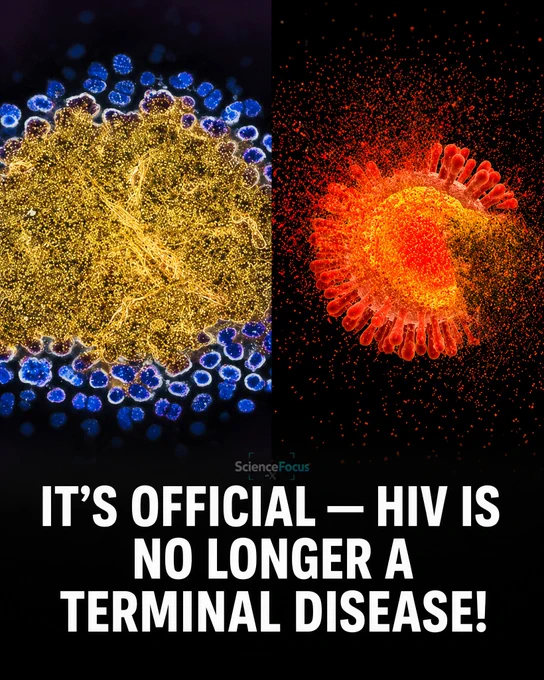
HIV just got dethroned.
What was once a death sentence is now something millions live with — quietly, normally, for decades.
Modern antiretroviral therapy has flipped the script. People diagnosed today, who take their meds consistently, can expect a near-normal lifespan. The virus stays buried. Undetectable. Untransmittable.
Let that sink in.
A diagnosis that wiped out a generation in the 80s and 90s is now a manageable condition — closer to diabetes than to doom.
And the science isn't stopping there.
Gilead's once-daily single-tablet BIC/LEN regimen is under FDA priority review with a decision expected August 27, 2026. One pill. Once a day. That's it.
At CROI 2026 in Denver, the RIO cure trial showed over half of participants kept their viral load undetectable for more than 20 weeks after stopping treatment entirely. Two have been off meds for over a year.
A 62-year-old Canadian man — now known as the Toronto patient — was announced likely cured in April 2026 after a stem cell transplant.
Yale researchers cracked open a hidden mechanism called circHIV that could become the next major drug target. Case Western turned the immune system's own Natural Killer cells into HIV-hunting weapons. Oxford is using broadly neutralising antibodies to keep the virus in check long after pills are gone.
The hunt for a full, scalable cure is no longer science fiction. It's a research pipeline with real names, real patients, and real timelines.
HIV used to mean counting the years you had left.
Now it means living them.
Source: Aidsmap (CROI 2026), Gilead Sciences, amfAR, Weill Cornell Medicine, Yale News, Case Western Reserve University
Show more
They literally 3D-printed an eyeball. And the blind guy can see again.
Not a chip. Not a sensor. A full living human eye — retina, cornea, lens, optic nerve — built layer by layer in a printer.
Bioengineers at KAIST in South Korea pulled it off.
The whole thing took 6 hours to print. Living retinal cells stacked in precise layers with their own blood vessels. A hydrogel lens that auto-focuses.
Biocompatible polymers shaping the white of the eye. And an optic nerve scaffold designed to guide fresh nerve growth straight to the brain.
Then they put it inside a 31-year-old man who lost his sight 7 years ago in an industrial accident.
Three weeks later, his brain started decoding the signals.
He's now seeing at 20/60. Reading. Recognising faces. Naming colours.
This is the first time a complex organ made of multiple tissue types has been printed AND successfully wired into the human nervous system.
Science fiction quietly clocked out. Science just clocked in.
Show more

Four periods a year instead of twelve. That's the pitch.
Chinese biologist Hongmei Wang thinks she can stretch a woman's fertile window by slowing the menstrual cycle down to once every three months.
Her logic? Fewer cycles means fewer eggs burned through. More eggs left in the tank means more years of fertility on the clock.
Wang runs the State Key Laboratory of Stem Cell and Reproductive Biology in Beijing, where the work isn't just academic. China's birth rate is collapsing, and extending fertility has become a national-level obsession.
Here's the wild part of her argument.
Women in ancestral times had roughly 100 periods in their entire life. Constant pregnancies. Years of breastfeeding. The body barely cycled.
Modern women? Over 400 periods on average.
Wang wants to dial that number back down, closer to how the female body operated for most of human history.
Her team has already pulled off something startling. They injected human stem cells into sterile monkeys, and one of those monkeys gave birth to a healthy baby that's still alive today.
A small human trial followed with 63 women suffering premature ovarian failure. Four of them ended up conceiving healthy children after stem cell treatment.
But Wang isn't pretending this is simple.
Suppressing ovulation also suppresses estrogen, the hormone that protects bones, the heart, and the brain.
Strip it away and you trade one problem for several others.
"It's one thing to prove something possible in the lab," she says. It's another thing entirely for women to actually want it.
The science is real. The ethics are messier. And the question she's forcing the world to ask isn't going away.
Source: EL PAÍS interview
Show more

A journalist spent $11,000 on a forgotten island nobody wanted.
Everyone thought he was insane.
Brendon Grimshaw walked away from a newsroom career in Yorkshire, signed the papers four minutes before midnight on the last night of his Seychelles holiday, and inherited a dead patch of land called Moyenne.
The place was a wasteland. Coconuts so tangled they couldn't even fall to the ground. No wildlife worth mentioning. Just silence.
So he got to work.
Alongside his friend René Lafortune, Brendon spent the next 39 years planting trees one by one. By hand. No machines. No crew. Just two men and a vision.
16,000 trees later, Moyenne looked nothing like the barren rock he'd bought.
Then came the animals. He reintroduced more than 120 giant Aldabra tortoises, a species teetering on extinction. Around 2,000 new birds found their way back to the island. Today, two-thirds of all the fauna in the Seychelles call Moyenne home.
Word got out. Tourism exploded across the region in the 80s, and developers came knocking.
A Saudi prince reportedly slid $50 million across the table for the island.
Brendon said no.
"I don't want the island to become a favorite vacation spot for the rich," he said. "Better let it be a national park that everyone can enjoy."
In 2008, that's exactly what happened. Moyenne became the smallest national park on Earth.
Lafortune died in 2007. Brendon stayed on the island until his own death in 2012. He's buried there, next to his father, surrounded by every tree he ever planted.
He took a dead island and gave it back to the world.
Source: BBC / Silverback Digest / Story Seychelles
Show more

Wink your right eye. Boom — instant zoom.
Sounds like sci-fi. It's not.
Scientists at the Swiss Federal Institute of Technology have built a contact lens that magnifies your vision by nearly 3x. Yes, the actual world around you. Zoomed in. On demand.
Here's the wild part.
The lens is just 1.55mm thick. Tucked inside it is a ring of microscopic aluminium mirrors that bounce light around and blow up whatever you're staring at by 2.8 times.
Pair it with smart glasses and the system can tell the difference between a regular blink and a deliberate wink. Wink right? Zoom in. Wink left? Snap back to normal.
The tech wasn't even built for eyes at first.
DARPA funded it as ultra-thin cameras for military drones. Then someone had the bright idea to flip the script and turn it into a vision aid for people losing their sight to age-related macular degeneration, the leading cause of vision loss in adults over 50.
Now imagine reading a street sign three blocks away. Or spotting craters on the moon without a telescope.
Your eyeballs just got an upgrade.
Source: Science (AAAS)
Show more

Pandas pulled it off.
The species everyone wrote off as doomed is officially no longer endangered.
Decades of conservation work, habitat protection, and bamboo forest restoration in China finally paid off. Giant pandas have been downgraded from "endangered" to "vulnerable" on the IUCN Red List.
Wild populations have climbed past 1,800.
A win this big almost never happens in conservation.
Most stories go the other way.
But the pandas? They rolled onto their backs, stuck their tongues out, and made it look easy.
Show more

Forget killing cancer cells. South Korea just figured out how to talk them back into being normal.
Scientists at KAIST in Daejeon have done something the world has been chasing for decades.
They found a molecular switch that flips cancer cells back into healthy cells.
No chemo. No radiation. No destroying anything.
Just… reversal.
Professor Kwang-Hyun Cho and his team caught cancer in the act. That tiny window where a normal cell is on the edge of turning malignant but hasn't fully crossed over yet. They call it the "critical transition" — the same kind of jump that happens when water hits 100°C and becomes steam.
In that split-second window, the cell is unstable. Normal and cancerous at the same time.
And that's exactly where they hit the switch.
In colon cancer trials, they targeted three master genes — MYB, HDAC2, and FOXA2 — and the cancer cells didn't die.
They went back to being healthy intestinal cells. Like nothing ever happened.
The team built a digital twin of the gene network to map every move a cell makes on its way to becoming cancerous. Then they reverse-engineered the path home.
Their paper landed in Advanced Science, published by Wiley.
It's still early. Lab trials and mice. Human treatment is years away.
But the idea of curing cancer without killing a single cell is no longer science fiction.
Source: KAIST (Korea Advanced Institute of Science and Technology), published in Advanced Science journal
Show more

That sinking feeling in your stomach? It might be your future self trying to warn you.
Scientists now believe your consciousness isn't trapped in the present moment.
It can leap forward. Backward. Bend around time itself.
And those random "gut feelings" you brush off? They could be memories leaking back from a version of you that hasn't happened yet.
Cognitive neuroscientist Julia Mossbridge has spent years wiring people up to monitors and measuring something that shouldn't exist, your body reacting to events seconds before they actually occur.
Subjects sit calmly. A computer randomly flashes images, some peaceful sunrises, some violent car crashes. The wild part? Their brains spike with stress before the disturbing image ever appears on screen.
No way to predict it. No pattern to follow. Yet the body knows.
Dean Radin, chief scientist at the Institute of Noetic Sciences, ran the original version of this experiment back in the mid-1990s at the University of Nevada. His results have been replicated roughly three dozen times since.
Even the CIA got curious. In 1995, the agency declassified its own precognition research after independent statisticians reviewed the data and called it statistically reliable.
So how does this even work?
Radin and Mossbridge point to quantum entanglement, the strange phenomenon Einstein famously called "spooky action at a distance." Particles stay linked across vast distances, and possibly across time itself.
Their theory? Your brain might be entangled with its own future state. What feels like instinct is actually a signal bouncing backward through the timeline.
"In quantum mechanics, time may not even be part of our physical reality," Radin explains. It exists, but not the neat, linear way humans experience it.
Mossbridge puts it plainly. Precognition isn't hard to understand. It's just hard to believe, especially for people who've never felt it themselves.
The resistance, she says, isn't really about science. It's about fear. Fear that reality doesn't play by the rules we were taught.
Your gut isn't superstition. It might be the only part of you already living tomorrow.
Source: Popular Mechanics
Show more

A MOTHER OTTER PROUDLY CAME UP TO THE GLASS AND SHOWED OFF HER BABY MEANWHILE THE DAD SHOWED OFF A ROCK

She juiced 36 beets to save lives.
Most teenagers spend their senior year stressing about prom.
Dasia Taylor spent hers inventing medical technology that could change surgery in the developing world.
At just 17, this Iowa City West High student created surgical sutures that literally change color when a wound gets infected. Bright red when you're healing fine. Dark purple when something's gone wrong.
The secret weapon? Beet juice.
Healthy skin sits at an acidic pH around 5. When an infection sets in, that number climbs to about 9. Beets are natural pH indicators, so Dasia dyed her threads with beet juice and let chemistry do the rest.
The color shift happens almost instantly.
Here's why it matters: in some African countries, up to 20% of women who deliver via C-section develop surgical site infections. Globally, fancy "smart sutures" already exist, but they rely on Bluetooth, smartphones, and internet access most patients in developing nations simply don't have.
Dasia built something better. Cheap. Visible to the naked eye. No tech required.
Her work made her a finalist in the Regeneron Science Talent Search, one of the most prestigious science competitions in America. She's now pursuing a patent.
A girl, a chemistry class, and a bag of beets just outsmarted billion-dollar medical tech.
Source: Smithsonian Magazine
Show more

She's the Mexican scientist who just rewrote the rules on one of the world's most common viruses.
After 20 years of relentless research at Mexico's Instituto Politécnico Nacional, Dr. Gallegos pulled off something the medical world hadn't seen before.
She wiped out HPV. Completely.
Her weapon? A non-invasive technique called photodynamic therapy — no scalpels, no chemo, no chemotherapy aftermath.
Here's how it works.
A drug called delta-aminolevulinic acid is applied to the cervix. It transforms into a fluorescent compound that only sticks to damaged cells. Healthy cells flush it out. Then a beam of light is aimed at the area — and the infected cells get destroyed on the spot.
Healthy tissue? Untouched.
The numbers are wild.
In 29 women in Mexico City who had HPV without lesions, the virus was eliminated in 100% of cases. In the broader study across Oaxaca and Veracruz, 420 more women were treated — with 64.3% success in those carrying both HPV and premalignant lesions, and 57.2% in those with lesions alone.
This matters more than people realise.
HPV is the most common sexually transmitted infection on the planet. Around 80% of women will catch some form of it in their lifetime. It's behind nearly every case of cervical cancer worldwide.
And until now, there was no cure. Only vaccines and screenings.
Dr. Gallegos changed that conversation.
Quietly. From a lab in Mexico City. Without the global spotlight she deserves.
One woman. Two decades. A breakthrough that could save millions.
Source: Instituto Politécnico Nacional (IPN), Mexico City — research led by Dr. Eva Ramón Gallegos
Show more

Walls that breathe. Bricks that grow. Cities that finally stop choking.
A team of Dutch engineers just pulled off something straight out of science fiction.
They built bricks that grow moss.
Real, living moss. Spreading across walls like nature is reclaiming the city one square meter at a time.
Behind the magic is a Leiden-based startup called Respyre. Their secret? A "bioreceptive" concrete made from 70% recycled material, rough and porous on purpose, designed so moss can cling, thrive, and multiply.
Spray on a moss-growing gel. Wait around 12 weeks. Watch a dead concrete wall turn into a living green skin.
And the moss isn't just for show.
It eats CO₂. It traps nitrogen dioxide. It catches particulate matter floating in city air. It cools entire wall surfaces by 5–7°C during peak summer heat. It buffers noise. It builds tiny habitats for insects and urban wildlife.
One square meter of moss can absorb up to 1.2 kg of CO₂ every single year.
No roots clawing into the bricks. No structural damage. No irrigation systems. No fertilizer. No fancy maintenance routine. Just rainwater, humidity, and time.
From a single square meter of starter moss, Respyre can grow up to 80 square meters of green wall coverage.
Pilot projects are already running across the Netherlands. Schools. Apartment blocks in Amsterdam's Rivierenbuurt. Even the bases of wind turbines in collaboration with Dutch energy company Eneco.
Imagine a future where every grey building exhales oxygen. Where the walls themselves cool the streets below. Where the city becomes the forest.
It's not coming. It's already here. Brick by living brick.
Source: Respyre (Leiden, Netherlands) / Positive News / IO+
Show more