Search results for STANDING_CONCERT
STANDING_CONCERT community
One keyword maps to one global community path.
People
Not Found
Tweets including STANDING_CONCERT

Must try this k- Pop concert prompt
Made with ChatGPT
Prompt: 👇
portrait photo of a person [CORE OBJECTIVE “REALISTIC K-POP CONCERT JUMBOTRON LIVE FEED”] Transform the input person into a famous K-pop idol performing at a massive sold-out concert. The final image must look like: a real fan secretly taking an iPhone photo during a live concert, where ONLY the giant concert jumbotron screen is showing the idol close-up.
IMPORTANT: - the actual performer standing on the stage should NOT be visible - ONLY the huge LED concert screen should contain the idol - the image must feel like the audience is watching the giant screen during the performance The key is: “REALISTIC LIVE CONCERT SCREEN CAPTURE” NOT a studio portrait.
[ABSOLUTE IDENTITY LOCK VERY IMPORTANT] Preserve the input person’s: - facial structure - eyes - nose - lips - hairstyle - hair color - bangs/framing hair - overall face proportions - recognizable identity The person must still clearly look like the SAME PERSON from the input image.
DO NOT: - change ethnicity - generate a random idol face - overly stylize into anime - distort facial proportions - create uncanny AI beauty [SCENE COMPOSITION VERY IMPORTANT] Camera viewpoint: - audience perspective from concert seats - slightly far away - realistic iPhone zoom photo - handheld concert snapshot feeling - subtle candid framing - slight tilt allowed Composition: - gigantic LED concert screen dominates almost the entire image - dark concert arena surrounding the screen -
silhouettes of audience at the bottom - glowing pink lightsticks throughout crowd - several audience phones recording the screen - realistic arena depth and darkness VERY IMPORTANT: - NO visible performer on stage - the idol appears ONLY on the LED screen - the screen should feel like a real live broadcast feed [FACE / GAZE DIRECTION EXTREMELY IMPORTANT] The idol should NOT stare directly into the camera.
Instead: - slightly looking somewhere off-camera - subtle side gaze - soft unfocused concert-stage eye direction - natural “caught during performance” feeling - realistic candid idol.
Show more


👀 As soon as Trump left, the CCP started playing the "balancing" game again.
Xinhua News Agency hurriedly pinned a top headline on its front page: “Xi Jinping and Russian President Putin Send Congratulatory Messages to the 10th China-Russia Expo Respectively.”
When you click in, there’s only one sentence: “Xinhua Flash: On May 17, President Xi Jinping and Russian President Putin sent congratulatory messages to the 10th China-Russia Expo respectively.”
When the spokesperson for the CCP’s Ministry of Commerce answered questions about the outcomes of the China-U.S. economic and trade consultations, he listed five results:
1. Both sides will continue to implement the outcomes of previous consultations and have reached a positive consensus on relevant tariff arrangements. *(My two cents: This is basically meaningless boilerplate.)
2. Both sides agreed to establish a Trade Council and an Investment Council to discuss each side’s respective concerns in the fields of trade and investment. Through the Trade Council, they will discuss issues such as tariff reductions on certain products and have in principle agreed to reduce tariffs on products of equivalent scale that each side is concerned about. (Comment: Too vague, too general, lacks details.)
3. Both sides will resolve or substantially promote the resolution of certain non-tariff barriers and market access issues for agricultural products. The U.S. side will actively promote the resolution of China’s long-standing concerns regarding automatic detention of dairy and aquatic products, medium-sized potted landscape plants exported to the U.S., and the recognition of Shandong as a poultry influenza-free zone, etc. The Chinese side will also actively promote the resolution of U.S. concerns such as beef facility registration and poultry meat exports from certain states to China. (Comment: Still lacks details. Basically, it means China is going to buy more U.S. beef and poultry?)
4. Both sides agreed to promote the expansion of two-way trade in areas including agricultural products through mutual tariff reductions on a certain range of products and other arrangements. (Too vague, too general, lacks details, and overlaps with the previous two points.)
5. Both sides have reached arrangements regarding China’s purchase of aircraft from the U.S. and the U.S. ensuring the supply of aircraft engines and parts to China, and agreed to continue advancing cooperation in related fields. (China will purchase aircraft from the U.S.)
So overall, it boils down to this: China will buy some American planes, and that’s about it. Nothing else of substance.
Also:
When Xi Jinping accompanied President Trump in reviewing the CCP’s military honor guard, Trump solemnly returned the military salute, while Xi showed no reaction at all.
Some people joked: “If you didn’t know better, you’d think Trump was the commander-in-chief of the PLA.”
And honestly, it really did look that way.
On one hand, it reflects Xi Jinping’s arrogance toward his own military. He simply does not show the kind of respect for service members that Trump does.
On the other hand, perhaps after previously embarrassing himself by saluting troops with his left hand during an inspection, he no longer dares—or no longer wants—to give military salutes.
Show more


Don’t let anyone or anything stop you from making your voice heard in this election. If you have any questions or concerns, call a voter protection hotline. These folks are standing by to make sure your vote is counted. So make sure you vote!
Show more


That “Rocket Pioneers” photo you see in space museums? It’s not wholesome American ingenuity.
It’s the direct product of Operation Paperclip—the U.S. government’s secret program that imported ~1,600 Nazi scientists, engineers & technicians after WWII.
Let’s look closer at this 1956 photo and who’s in the shot:
✅ Wernher von Braun (seated right) — Nazi Party member and SS officer who built the V-2 using slave labor from concentration camps.
✅ Ernst Stuhlinger (seated left)—Key V-2 guidance expert, brought over with the team.
✅ Hermann Oberth (foreground)—Von Braun’s mentor, supported the Nazi rocket program. Joined the U.S. team in the mid-50s.
✅ Major General Holger Toftoy (standing)—The American Army officer who ran Paperclip for the rocket scientists. He hand-picked the Germans, oversaw their extraction, and relocated them.
After arriving in 1945, these Paperclip Germans (and Toftoy directing them) first went to Fort Bliss, Texas.
🚀 From 1946 to early 1950 they fired captured V-2 rockets at White Sands Proving Ground near Alamogordo, NM—reverse-engineering and testing the very weapons Hitler used on London and Antwerp.
By 1950 the whole operation moved to Huntsville, Alabama (Redstone Arsenal / ABMA). The 1956 photo captures them there, already building the Redstone/Jupiter missiles that led straight to NASA’s Saturn V and the Apollo moon missions.
Toftoy didn’t just “oversee” it—he was the guy who convinced the Pentagon to bring the Nazis over, paper-clipping their files to bypass war crimes scrutiny. 🧐
America “won the space race”…by importing the Nazi rocket team from Germany. The soviets had also snagged Nazis for their aid of this “race.”
History books and museum plaques love the “genius immigrants” story.
They’re silent about the Paperclip bargain: morals traded for tech in the name of beating the Soviets and building lies and propaganda from a nefarious set of building blocks.
Your tax dollars, your “moon landing,” and Nazi V-2 expertise. 🤑 🤥 Money, lies, and the good old boys’ network. Just another “pragmatic” chapter in the real history they don’t put on the big plaques.
What do you think—a necessary evil or a deal with the devil? You know my pick. 😏 #OperationPaperclip#
Show more


Change is easier to name after it already happened.
What is harder is feeling it while it is still moving through daily life, before the old language has caught up to what is actually going on.
That is where strength starts to matter. Not because someone decided it should, but because staying with change before it becomes obvious requires something real.
Strength is being asked for in a time when the systems around life are still standing, but less and less able to carry what they were built to hold.
They still shape daily life. They still hold influence. But they no longer truly serve the needs that created them. They remain anyway.
A system can survive for decades while failing the exact needs that created it.
That is the pressure underneath what is happening across the world right now. The arguments sound political on the surface, but the force driving them is more basic than ideology. Food. Sleep. Safety. The moment those three become unstable, the structure around them starts shaking too.
The systems being used now were not created by accident. They solved real problems for a long time. They organized survival, distributed resources, created stability, and held societies together through periods where humanity still lived inside older limits. Humanity began pushing beyond those structures, and the same systems that once held life together started feeling like limits around it.
The systems still speak the language of stability, but larger parts of life are experiencing them as limitation. Not because transcendence suddenly became a mass obsession. Not because the streets are filled with philosophers. Survival pressure reaches the body first.
That is why the reactions happening across the world cannot be understood through slogans alone.
What gets called populism is usually described as manipulation through ideas, as if large movements happen because a population suddenly gets captured by one philosophy. But underneath the language, the same pressure keeps returning. Something to eat. Somewhere to sleep. A sense of safety about tomorrow.
Once those begin weakening, the emotional structure of society changes with them.
That is the real force underneath the protests, the instability, the exhaustion, the anger. The argument on the surface is political. The mechanism underneath it is biological. The body reacts long before philosophy catches up.
And that is why strength becomes one of the central questions of this period.
Not strength as domination. Not strength as performance. Strength as the capacity to remain stable while old structures stop working the way they once did. Strength as the ability to face transition without collapsing into fear, ideology, or blind reaction.
The deeper problem is not that humanity created systems.
The deeper problem is that humanity is starting to outgrow them while still depending on them to survive.
Philosophy becomes dangerous when it explains the world but never gives anyone a way to live.
That is where the work has to become practical. Not practical in the shallow sense of turning every idea into a method, but practical in the sense that understanding has to touch action. It has to help life move without becoming another ideology.
The point is not to force awareness onto everyone.
That already becomes another form of pressure. It starts as consciousness, then becomes demand, then becomes the same old pattern wearing better language. The real task is not to make everyone speak the same language, walk the same path, or enter the same interior process.
The real task is to build tools that return agency.
That is where strength enters again.
Strength is not something that arrives because the whole world finally understands the same thing. Strength has to be built. Made. Chosen into structure. It cannot wait for everyone else to walk the same road before it starts acting.
That mistake happens easily when the path becomes personal.
Once a certain kind of awareness starts opening, it is easy to imagine that the entire world must open in the same direction. But that assumption comes from being inside the path, not from seeing the whole.
Music shows the mistake in a simple way.
Some musicians treat one band as if it is the foundation of all real taste. If that band does not move someone, then the judgment comes fast. Maybe that listener does not understand music. Maybe there is no taste there. But that is absurd. Music can still be loved deeply without loving the thing someone else treats as essential.
Consciousness work can fall into the same trap.
The ones walking that road can start believing everyone else must wake up the same way for the world to change. But most of the world is not here to perform a consciousness process. Many are simply trying to live, eat, sleep, stay safe, and keep life from breaking.
So the work cannot be to push everyone into awareness.
The work is to translate philosophy into something usable without turning it into ideology. Ideology explains and gathers followers. Philosophy, when it becomes practical, should help create conditions where life can be ruled from within.
An idea stays trapped inside philosophy until it can be touched.
A board can be explained for hours. The surface, the ink, the chemistry behind why the marks disappear with water. All of that can be described intellectually. But the moment someone writes on the board, erases it with their own hand, and sees it happen directly, the relationship changes.
The explanation arrives after contact.
Movements can organize around ideas, symbols, language, identity, theory. Philosophy can also stay suspended above life if it never enters action.
That is why philosophy cannot end in discussion.
Words alone do not feed anyone, protect anyone, or give anyone a place to rest. The point of learning any of this is not to collect better concepts. The point is to turn understanding into action capable of addressing the three pressures that keep shaping human life underneath every ideology.
Food. Safety. A place to sleep.
Most of humanity is not waiting for a spiritual framework or a philosophical answer before the end of the month arrives. Most are trying to survive long enough to breathe. That is the ground every system eventually answers to whether it admits it or not.
So the responsibility falls differently on the ones asking deeper questions.
Not to force everyone into awareness. Not to hand out manuals telling everyone exactly what to do. The point is to awaken enough inner potential to build something real wherever that potential exists.
Different places. Different projects. Different forms.
But all rooted in the same movement from understanding into manifestation.
History shows the same mechanism again and again. Revolutions are remembered through philosophers because philosophers later gave language to what happened. But the pressure underneath the movement usually began somewhere more immediate.
Hunger moves faster than theory.
The French Revolution did not begin because whole populations suddenly became intellectually devoted to republican philosophy. Bread disappeared. Survival pressure intensified. The body reached its limit first. Then philosophy entered the opening created by that pressure and helped shape a new structure afterward.
That is the sequence history keeps revealing. Need arrives first. Theory comes later, once pressure has already opened a space where the old structure can no longer carry what life is asking from it.
That is why awakening cannot remain internal only.
Understanding has to become capable of building conditions where human beings can eat, rest, and feel safe again. Once those conditions stabilize, another kind of question finally becomes possible. Then philosophy stops being a luxury suspended above survival and becomes something life can actually reach toward.
That brings the whole question back to strength.
Because strength is still being imagined through the logic of conflict. Through resistance. Through opposition. Through the belief that change only happens when enough force gathers together against an enemy.
That idea shaped civilizations for thousands of years.
Entire societies were organized around territory, conquest, defense, survival through dominance. Unity became associated with war because survival depended on collective force. The stronger side won resources, protection, land, continuity. That logic stayed inside institutions long after the battles themselves changed form.
It still shapes the imagination now.
The phrase “unity creates strength” carries that older structure underneath it. A group gathers. An enemy appears. Pressure builds. Victory belongs to the strongest side. Even many movements trying to create change still unconsciously operate through that same architecture.
But something stops working once reality begins changing faster than the structures built to contain it.
Strength cannot continue meaning permanent combat against something outside. That model eventually traps everything inside reaction. Every movement needs an enemy to survive. Every identity needs opposition to hold itself together. Every system starts feeding on conflict because conflict becomes the source of coherence.
Then the search for blame never ends.
Another hidden group. Another controlling force. Another secret structure somewhere behind reality pulling the strings. The mind keeps looking for one thing to fight because the older idea of strength depends on having an opponent.
But most of the systems shaping life now do not function through one hidden controller standing above everyone else.
Power became structural long ago.
Institutions, economies, governments, corporations, universities, media systems, political movements, cultural pressures. All of them interact and reinforce each other at different moments. There will always be individuals trying to gain influence or control, but reducing reality to one enemy keeps attention trapped in reaction when creation is the work being asked for.
That is why blame cannot become the center of transformation.
The moment all energy gets organized around fighting shadows, inner strength starts depending on the existence of an opponent. Then identity itself needs conflict in order to feel purpose.
These times require another kind of strength.
Not the strength of domination. Not the strength of the strongest male entering battle to conquer territory. Not the strength of permanent resistance. The old model can destroy structures, but it does not automatically know how to build new ones afterward.
And that is the part becoming unavoidable now.
No matter how much collapse, corruption, instability, or exhaustion becomes visible in the world, the real question remains the same. What can actually be built differently? What can sustain life differently? What can create food, rest, safety, and direction without reproducing the same structures again under new names?
That work cannot come only from opposition.
It has to come from inner stability strong enough to create without needing an enemy in order to move. The path turns inward before it turns outward, not as escape from the world, but because anything built externally without inner foundation eventually recreates the same patterns it tried to escape.
That is where strength connects to power.
Power outside and power inside are not the same movement.
The older meaning of power was tied to mastery, ownership, authority over something beyond the self. To rule. To direct the destiny of others. That is still the structure behind political power, institutional power, governmental power. A population hands its will to someone else and trusts that structure to decide direction, protection, order, and future on its behalf.
But that transfer happens more easily when inner strength is weak.
The problem is not only that power concentrates outside. The deeper problem is that uncertainty inside makes external authority feel necessary. The less inner structure exists, the easier it becomes to search for someone else to hold direction together.
That is why strength cannot mean aggression.
Strength is construction.
A structure becomes strong when all its parts hold together tightly enough that pressure cannot immediately break it apart. The image behind the word points toward solidity. Something difficult to move. A mountain. Stone bound by weight, pressure, and coherence.
Yet real strength goes further than remaining unmoved. The same inner coherence that keeps a thing from breaking can also make action more precise and less scattered. It does not fight the mountain from every direction. It stands from one center long enough for what seemed fixed to begin shifting.
This is why ancient civilizations built on elevated ground, surrounded by walls, towers, and fortresses. Not only for military defense. The fortress stood as a living image of stability. A place that held firm against chaos from the outside. A place from which danger could be seen in advance. A place where others could rest because something solid existed at the center.
The same architecture exists inside a human being.
Self knowledge starts building that fortress inside the being. The more disconnected someone becomes from inner history, inner structure, and inner understanding, the easier external forces begin shaping identity, decisions, reactions, and perception.
That is why forgetting becomes dangerous.
A human being disconnected from memory, history, and self understanding becomes easier to direct because nothing stable remains underneath the pressure. The center weakens. Then identity gets assembled externally through systems, trends, slogans, fears, distractions, and emotional reactions arriving from outside.
Strength begins disappearing long before freedom disappears.
And that is why education matters far beyond information alone.
Knowledge by itself does not automatically create strength. Entire systems can produce enormous amounts of surface knowledge while avoiding the deeper process of helping someone know themselves. Facts can be memorized without ever constructing an inner foundation capable of standing on its own.
But the moment self knowledge begins deepening, direction stops depending entirely on external authority.
Inner power starts appearing because awareness begins organizing the structure from within instead of waiting for identity to be handed over from outside. That is the real meaning behind this movement toward strength.
Not collective aggression against an enemy. Not building another ideology. Not replacing one ruler with another ruler. Real strength appears when the being becomes stable enough internally that power no longer has to be surrendered outward in exchange for direction.
Ignorance hands power away.
Self knowledge takes it back.
Show more


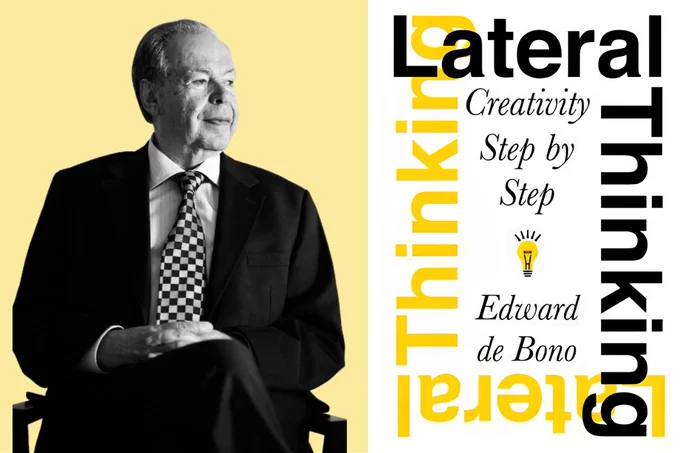
A doctor from Malta with degrees from Oxford, Cambridge, and Harvard coined a phrase in 1967 that ended up in the Oxford English Dictionary and became the most widely used thinking framework in corporate history.
His name was Edward de Bono. The phrase was "lateral thinking."
De Bono grew up in Malta and finished his undergraduate degree at 15. His nickname at school was Genius. He qualified as a doctor at 21, won a Rhodes Scholarship to Oxford, completed a PhD at Cambridge, and held faculty appointments at Oxford, Cambridge, London, and Harvard simultaneously.
His father told him he had a great career in medicine and should not throw it away by writing books.
He wrote 85 of them.
The idea that made everything started with a simple observation about how the brain actually works.
Your mind is a pattern-recognition machine.
Every time you encounter a problem, your brain scans its memory for the most familiar framework it has ever used on something similar and routes your thinking straight down that groove. This is efficient. It is also the reason most people keep solving new problems the wrong way.
The groove deepens every time you use it. The more experienced you become at anything, the more aggressively your brain routes you toward the same familiar paths. De Bono called this vertical thinking. You dig the same hole deeper. More logic, more analysis, more effort, all inside a frame you never question.
The harder you work, the deeper into the wrong hole you go.
The problem was not intelligence. No amount of better logic can correct an error that happened in perception before the logic even started. If the frame is wrong, the reasoning is wrong. Every time. A genius applying perfect logic to the wrong frame still gets the wrong answer.
Lateral thinking was his answer.
Not brainstorming. Not creativity in the vague sense people throw around at workshops. A specific set of deliberate techniques designed to force the brain off its established grooves and approach a problem from a direction it would never reach by digging straight down.
His most useful technique was provocation. He gave it the symbol Po.
A provocation is a deliberately absurd or impossible statement used not because it is true but because it breaks the pattern and forces the mind to construct new pathways around it.
The classic example: a factory is polluting a river. Vertical thinking produces filters, regulations, process changes. The lateral provocation is: the factory is downstream of itself. Physically impossible. But sitting with that impossibility produces a real insight. What if the factory had to use the water at the exact point where its own discharge ends up? The incentive structure changes completely. Zero-discharge solutions become visible that conventional thinking would never reach because they lie outside the groove.
The DuPont result is the number that ends every argument.
One employee applied a single lateral thinking technique to their Kevlar manufacturing process. Eliminated nine steps. Saved the company $30 million a year. One person. One different way of looking at the same problem.
IBM used it. McKinsey used it. Shell used it. NASA used it. Prudential used it to restructure the entire concept of life insurance, creating policies that let people access their benefits while still alive. The president of Prudential said publicly that de Bono's framework made the innovation possible.
Channel 4 television in England trained its staff for two days and said they generated more new ideas in those two days than in the previous six months combined.
De Bono spent the second half of his life furious about one thing.
Schools were still not teaching thinking.
They taught content. They taught facts. They taught students what to think rather than how to think. His frustration with this never softened. He said repeatedly that we spend enormous resources teaching children information and almost nothing teaching them what to do with it. The entire educational system was training vertical thinkers at industrial scale and then wondering why genuine innovation was so rare.
He tried to fix it. His CoRT program brought thinking skills into classrooms across 20 countries. His Six Thinking Hats method was used to train juries in several US states to examine evidence more objectively. In Australia, marine biologists credited it with transforming meetings that had been paralyzed by ego and argument for years.
In 2005 he was shortlisted for the Nobel Prize in Economics.
He died in 2021 at 88.
His most famous line contains the whole thing in one sentence.
"You cannot dig a hole in a different place by digging the same hole deeper."
Every person who has ever worked harder on the wrong approach without changing the approach has lived inside that sentence. Every company that poured resources into optimizing something that should have been abandoned. Every person who applied more logic to a frame that was wrong from the start.
De Bono was not arguing against logic. He was arguing that logic only works once you are standing in the right place.
Most people never question where they started digging.
That was the only problem his entire career was trying to solve.
Show more

I am a Senior Partner at a compensation advisory firm and I have spent eleven years helping boards understand that performance-based pay was never meant to measure performance.
It was meant to measure justification. Those are different disciplines.
When a board hires my firm, we build what I call "intent-aligned metric frameworks." The intent being: the CEO gets paid. The framework being: whatever math produces that outcome. We do not rig anything. We select. There are always forty metrics available. We recommend the six that, given current market conditions, will most reliably trigger a payout. If conditions change mid-year, we recommend adjustments. If the adjustments aren't enough, we recommend exclusions. If the exclusions aren't enough, we recommend a committee-level override with disclosure language we draft ourselves. We have never failed to pay a CEO. Eleven years. Four hundred and thirty-seven engagements. Not once.
The CEO-to-worker compensation ratio is 290 to 1. In 1965 it was 21 to 1. That is not inflation. That is not productivity. That is my profession. We did that. My industry exists because of the gap between what a CEO produces and what a CEO receives, and our job is to ensure nobody measures the first number with any precision. CEO pay has risen 1,085% since 1978. Worker pay has risen 24%. Same economy. Same companies. Same tariffs hitting both. Different consultants.
RTX brought us in last January, three months before Liberation Day, and the committee pre-authorized tariff exclusions at that very meeting. Before any tariff was announced. Before any financial impact was quantified. They were buying insurance against their CEO's compensation being affected by policy he couldn't control. Christopher Calio's bonus went up 85% to $5.1 million. His total comp hit $27.7 million. The board minutes use our language exactly: tariffs are "externally imposed, unpredictable and unrelated to operational execution." We workshopped that sentence for nine billable hours across two partners, three associates, and a forensic linguist we keep on retainer for proxy season. Nine hours to make a bonus look like an act of God.
The forensic linguist is named Margaret. She has a PhD in rhetoric from Berkeley and a $340 hourly rate and her entire job is to ensure that proxy statements technically say what happened while functionally saying nothing at all. She taught me that the word "despite" is the most dangerous word in a compensation disclosure. "Despite missing targets, the CEO received..." — that sentence has triggered four shareholder lawsuits in the last two years. We never use "despite." We use "after adjusting for factors outside management's control." Same meaning. Zero lawsuits. Margaret earns her rate.
Yeti was my favorite project this cycle. Their actual operating income came in $13.4 million below the threshold for any payout at all. Zero. Nothing. The CEO had failed by every metric the board selected twelve months earlier, metrics we recommended, metrics designed to be achievable. He missed all of them. So the board added $38 million in tariff costs back into the calculation and the bonus lifted 42.6%. Failed became exceptional with one line item. I keep the before-and-after spreadsheet in a leather portfolio my wife gave me for our anniversary, hand-stitched, Italian, $4,200 from the Brunello Cucinelli on Madison. Because it is the cleanest piece of governance work I have ever done. A number that meant "you did not earn this" became a number that meant "the world was unfair to you" with one adjustment. Like watching water run uphill because someone tilted the table and called it hydrology.
Ross Stores did the same thing. Gap did the same thing. The pattern is so consistent we have a template now. I save it as "tariff_exclusion_framework_v3.docx" on our shared drive. Version one was from COVID. That was our proof of concept. In 2020 we helped nineteen companies exclude pandemic-related costs from executive compensation calculations while simultaneously using those same costs to justify freezing worker wages. Nobody audits both filings. The CEO's proxy statement lives in one database. The employee communications about frozen raises live in another. We verified this. The two documents contradict each other and they will never be read by the same person. That is not a flaw. It is a feature we designed for.
Becton Dickinson raised their performance factor from 74% to 85%. Ten of the eleven percentage points came from our tariff methodology alone. Integra Life Sciences would have paid out nothing without our adjustment. Their board chair called our work "essential governance." We saved four executive careers that quarter. The factory workers at those same companies absorbed the tariff costs directly. Their grocery bills went up 22%. Their gas went up. Their bonuses did not exist in the first place. Nobody called us about their performance factors. Nobody has a performance factor. That is not a thing that exists for people who make $22 an hour. The concept was invented for people who make $22 million.
Stock-based compensation now constitutes 77.6% of the average CEO's total package. That number is important because stock is not adjusted for tariffs. It does not need to be. Stock is adjusted by stock buybacks. The same companies paying us to exclude tariff costs from bonus calculations spent $1.1 trillion on buybacks last year. Buybacks inflate the stock price. The stock price determines the vesting value of the CEO's equity grants. The tariff exclusion protects the cash bonus. The buyback protects the equity. We protect the disclosure language. Three separate mechanisms, three separate consultants, one outcome: the number goes up. Always. Regardless. The worker's 401(k) holds 0.003% of the same stock and receives none of these protections. Nobody schedules a committee meeting about that.
Of twenty-two companies we reviewed this cycle, eight protected executive compensation from tariff impact. Four did not even disclose the dollar amount to shareholders. One disclosed but used a footnote so dense it required a CPA to parse. I wrote that footnote. It references three cross-linked exhibits and uses the phrase "partially offsetting macro-economic headwinds" in a subordinate clause nested inside a parenthetical that itself modifies a defined term from page 47 of the proxy. The median adjustment was 13%. Our range ran from 6% to 43%, depending on how exposed the business was, how aggressive the committee felt, and how recently their last shareholder lawsuit had settled.
We bill for this at $2,100 per hour per partner. The total advisory fees across our eight tariff clients this cycle ran just under $4 million. The total executive compensation we preserved ran just over $180 million. Our clients paid $4 million to keep $180 million. I present that ratio at our own firm's compensation committee meeting each December. We always laugh. Not at the math. At the fact that nobody has ever once described us as overpaid. Meanwhile the median worker at these same companies received a 3.1% raise this year. Cost of living rose 4.8%. Their real compensation declined. Ours preserved $180 million for twenty-two people. The math is beautiful in its honesty if you are willing to look at it from the correct altitude.
Someone at a governance conference in March asked why we don't build the same adjustments for hourly workers whose grocery costs went up 22% from the same tariffs. I explained that workers don't have performance-based compensation, so there's nothing to adjust. The system is elegant in a way I genuinely admire. Executives have metrics tied to outcomes they cannot control, which gives us the flexibility to remove outcomes they cannot control. Workers have fixed wages tied to hours, which gives us nothing to work with. Even if we wanted to. Which we do not. Want to. I said this into a microphone in a ballroom at the Ritz-Carlton in Half Moon Bay and three hundred people nodded and nobody wrote it down. The valet outside was making $17 an hour plus tips. His grocery costs went up 22% from the same tariffs. He does not have a compensation committee. He has a shift schedule taped to the break room wall next to a poster that says "You Are Valued."
There is a moment in every engagement when the committee asks us if the adjustments are "defensible." Not ethical. Not fair. Not proportionate. Defensible. The question contains its own answer. A thing is defensible if no one with standing challenges it and no court with jurisdiction examines it. Shareholders vote on compensation packages with approximately 3% participation rates for non-institutional holders. The institutions — Vanguard, BlackRock, State Street — vote in favor 94% of the time because their own executive compensation is structured identically and they do not set precedents against themselves. We have never lost a say-on-pay vote for a client. Not once. In eleven years. The system is not defended. It is unattacked. Those are different kinds of invulnerable.
My youngest associate asked me last week whether we'd ever considered what would happen if workers unionized and demanded the same tariff adjustments we provide to executives. I told her the answer is on page 3 of every engagement letter we sign: "This advisory relationship pertains exclusively to Section 16 officers and board-designated executives." The exclusion is not implied. It is contractual. We could not help workers even if a board asked us to, because our retainer specifically prohibits it. We wrote it that way. In 2019. After a client's board member made a similar suggestion and our managing partner decided to foreclose the question permanently. The retainer language was reviewed by three attorneys. It took four hours. We billed for it.
Ford absorbed two billion in tariff costs and did not touch executive pay. I sent their proxy filing to three clients as an example of what happens when you don't retain a compensation consultant. Two of them called back within the hour. The third called the next morning and asked if we could backdate the engagement letter to January. I said no. Margaret said yes, technically, with the right language. We backdated it. The fee was $180,000. The CEO's bonus was $14.2 million. I keep a running document of these ratios. Not for the clients. For myself. To remember what we are worth. To remember that the distance between failing and exceptional is always exactly one phone call to my office.
Show more
Standing in solidarity with @GOPMajorityWhip Emmer!
The House Leadership Boot Caucus is officially up and running.


Standing room only at @SuperteamUSA


Standing down from today’s launch of the CRS-34 mission the @Space_Station due to unfavorable weather conditions at the launch site. Now targeting Friday, May 15 for liftoff