
Blake Madden 🏥
@B_Madden4
I break down the $5.3T business of healthcare after working on the inside. Essays on strategy, M&A, finance, health tech, & more. Texas ex
1.3K Following 20.7K Followers
Without the right VBC playbook for 2027...
Miss the documentation, fail the audit. Miss the care gap, lose the quality score. Miss both, and you're losing money on the contract.
On 9/30, I'm talking with Dana Brandenstein, VP of Provider Enablement at @PriviaHealth, and Dana McCalley, VP of Value-Based Care at @Navina_ai, about what separates the teams that are ready for 2027 from the teams that aren't.
We'll discuss:
• Why retrospective workflows and delayed follow-up put revenue and audit readiness at risk.
• What audit-ready documentation looks like under V28
• How leading organizations stop work from getting lost between teams and tools
• Where AI can give your team back time for patients, not paperwork
We'll also run through a self-assessment so you can see where your org lands.
Join us live or RSVP for the recording.
Show more

2026 really is the year of the health consumer, starting with all aspects of primary care.
Off the top of my head, look at what has happened in the first 9 months of 2026 alone:
Anyone can order advanced lab testing from their phone. Apple announced it at a $119 price point, alongside more accurate heart monitoring and bifurcated HRV. They also cloned most of WHOOP's feature interface in the process, which leaves form factor as one of the last real differences between the two.
Whoop is still very much a core player here, and just raised dang near $600M at a $10B valuation.
Fitbit (now part of Google) Air is coming at the category from underneath with Google behind it and no subscription attached to the hardware.
ŌURA is going public at a reported $17B+ valuation on over a billy in revenue, with material moves into traditional healthcare settings.
DTC telehealth isn't slowing down one bit, between the grifters and the pill mills now selling peptides and compounded GLP-1s next to the labs and the ED meds.
Amazon's One Medical announced a slew of AI-enabled offerings, and remains a major pharmacy and primary care provider.
And we'll keep seeing new entrants blending direct primary care, longevity (Function Health), and concierge care — all AI-enabled, all offering countless peptides, tests, and technology alongside actual physicians.
Which begs the question of which DTC and general consumer players have staying power versus which ones churn out once the novelty (and the funding) wears off.
What I'm wondering is...what is the evolving role of primary care when you can order labs through your iPhone, Whoop, or Oura app and then self-assess through AI before anyone in a white coat ever sees the results?
I'd welcome thoughts around where you guys see the space evolving, particularly traditional primary care in the midst of all this chaos.
It's a brave new world.
@Apple @ouraring @onemedical @Google @function @WHOOP
Show more
Medicaid financing just got rewritten.
HR-1 is reshaping reimbursement, managed care expectations, and how much scrutiny your programs are about to face.
I'm sitting down with Health Management Associate’s Mara Kilgore and Loren Anthes to break down where the durable growth opportunities are.
Free, virtual, Sept. 4, 1PM ET.
Come with your questions!
Show more

"Multi-agent systems" has officially entered the healthcare buzzword hall of fame, right up there with "value-based care" and "interoperability."
Everyone's throwing agents at everything and calling it innovation. But every so often, a company actually shows their work. And that's exactly what Predoc (@predoc_ai) did with a new report on how they built the multi-agent architecture behind their medical records retrieval and curation engine.
The full report (link below) is a useful blueprint for any healthcare exec trying to figure out what "building with AI" should actually look like in practice or where AI can have the highest impact.
4 things worth digging into:
1. Bespoke work is the opportunity, not the obstacle. Predoc makes the case that the most valuable automation opportunities aren't the clean, standardized tasks. Those get commoditized fast. It's the messy, facility-specific, exception-riddled workflows that are actually defensible. I think that's right, and it's a useful gut-check for any exec evaluating an AI vendor's ROI or worth buying.
2. The dataset is your moat. Predoc built its system on 300K-400K provider-research tasks, nearly 3 years of transcribed retrieval calls, and millions of reviewed record pages. The foundation models are swappable. That accumulated, structured "tribal knowledge" is not.
3. Start from first principles. Break the workflow down into its simplest parts. Bound each job, structure the handoff, escalate the exception. Predoc lays out how they gave each agent a job (research, voice, indexation, extraction, curation) and a structured output the next agent can act on immediately. When something doesn't fit, the agent escalates to a human, and that resolution gets fed back into the system.
4. The numbers back it up. I was pretty intrigued by some of the results in this piece: A 2-week-plus turnaround compressed to a median of 3 business days. Provider-research time down 70%. First-pass retrieval success up nearly 50%. 94.6% of pages indexed without human intervention.
The bigger theme I keep coming back to: this is a case study in systems of intelligence sitting on top of disorganized, disparate systems of record. Predoc's real output isn't "faster fax retrieval." It's a normalized, longitudinal clinical data layer that other applications can actually query.
Big thanks to brand partner Predoc for sitting down with me and showing their work on this one.
Show more

Only a few days out from this one! Don't miss Thursday's virtual event where Eric Larsen, president of TowerBrook Advisors, and I discuss his manifesto on AI in healthcare.
I'll press Eric on some of his most compelling arguments like this one: "RCM has the properties automation wants: high volume, high cost, high-entropy data, measurable outcomes, adversarial feedback, historical records, and a giant labor substrate sitting between the clinical event and the economic transaction."
Bring your toughest question. He knows it's coming.
Save your seat:
Show more
Your health plan costs the same as a Tesla Model Y.
I sat down with Ali Diab, CEO and co-founder of Collective Health, to find out what Collective Health is doing to fix it.
Ali started the company after his own hospital claim got denied, and has spent the decade since building what he calls the “Stripe” of healthcare benefits — for employers today, and potentially insurers and health systems tomorrow.
This episode hits the affordability crisis head-on. Ali makes the case that health insurance itself is the real inflationary catalyst in American healthcare.
Ali doesn't do the polite version. He calls the MLR a cost-plus contract, compares network "discounts" to markdowns off the Neiman Marcus price, and told me about the time he was charged $340 in coinsurance for a $125 knee brace on his own company's plan.
We dig into why self-insurance and direct contracting are eating the fully-insured market alive, why small employers are legally boxed out of self-funding, and why he thinks healthcare pricing needs an SEC.
Also: World Cup takes. Ali's a winger-turned-number-nine and I broke two leg bones playing this sport, so we earned the tangent.
Listen on Apple:
Listen on Spotify:
TIMESTAMPS
(04:31) A denied hospital claim, a Stanford doc spending more time fighting insurers than seeing patients, and the founding of Collective Health
(08:34) Your family's premium buys a Tesla Model Y every year — and the MLR is the $600 Navy toilet seat problem in disguise
(16:35) America is over-insured: stop running windshield wipers through car insurance (and birth control through health plans)
(18:55) Network discounts are markdowns off the Neiman Marcus price — the PBM rebate illusion explained
(20:19) From 25 lives to Walmart: the self-funding playbook carriers lobbied your state to keep away from you
(27:24) The $340 knee brace story (retail price: $125 — and no, he couldn't bring his own)
(37:35) Inside the 3.9% vs. 9% trend gap: how routing members in real time actually bends cost
(52:44) Give healthcare an SEC: why Ali thinks price discrimination in care delivery is a solved problem we refuse to solve
Show more

Join me and visionary thinker and investor Eric Larsen, president of TowerBrook Advisors to discuss the idea behind Eric's latest essay, Healthcare's Oppenheimer Moment: AI is the industrialization of intelligence, and healthcare — expensive, labor-heavy, and sitting on decades of dormant data — is ground zero for what happens next.
Watch me pressure-test his healthcare-AI thesis in real-time.
Just some of what we'll get into:
• Why Eric calls revenue cycle the coding of healthcare labor automation.
• How to map AI exposure by task, not job title.
• Who will be the real winners in the bot war?
• Where and how Eric puts his own conviction on the line.
• Why a single EHR instance is table stakes, not a revenue cycle strategy.
Free - register now!
@TowerBrook
@Hospitalogy_HC
Show more

Providers are using AI to code and appeal faster.
Payors are using AI to deny and downcode faster.
Eric Larsen calls it the bot war, and it's playing out in revenue cycle first.
Eric wrote a 369-page essay on AI in healthcare stamped "not for distribution" and sent it to a private list of about 150 CEOs and investors. I got a copy and I'm going to make Eric defend the sharpest claims in the paper live.
We'll get into:
• why Eric calls revenue cycle the coding of healthcare labor automation,
• why a single EHR instance is table stakes, not a revenue cycle strategy,
• how to map AI exposure by task, not job title,
• and more.
Big thanks to R1 @R1RCM for partnering with us on this one.
August 20, 1:00 PM ET. Virtual.
Register now:
Show more
Patients have become a top-three payor for most health systems, and they're the worst-performing one on every metric that matters:
• 25-30 cents to collect a patient dollar vs. 4-5 cents for a commercial dollar
• 30-50% yield vs. 95-97% from payors
• $44.9B in uncompensated care coming in 2026-2027
I dug into how brand partner Cedar (@CedarNY) is rebuilding patient financial engagement around this shift, including a stat that should end the propensity-to-pay era on its own: accounts with high P2P scores yielded 51% LESS than bills with no score at all.
Get the full breakdown between what works and what doesn't in my latest deep dive:
Show more

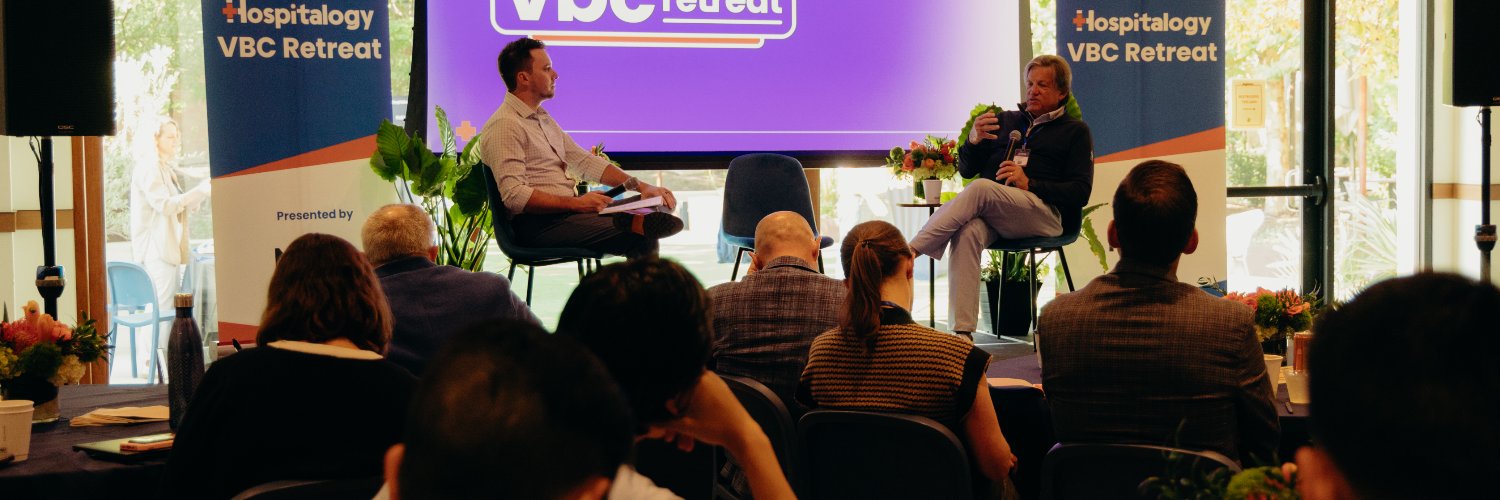
Some quick math on the Hospitalogy AI Retreat:
67,000+ Hospitalogy subscribers.
100 seats at the retreat.
That's 0.15%.
I designed it that way on purpose. The conversations that actually move healthcare forward don't happen in a convention center with 3,000 attendees. They happen in a room small enough that everyone knows everyone by day two.
If you lead a hospital, health system, or large provider organization at the C-suite or VP+ level, apply to attend (and if you know someone who belongs in the room, nominate them!).
Hospitalogy AI Retreat
November 1-4 in Phoenix
For more details on who should apply, please see the Who Attends page of the site.
@Hospitalogy_HC
Show more

Join me TODAY AT 1 PM EDT for an AI Transformation Expert Session with Dr. Jonathan Slotkin, Chief Medical Officer for Strategy and Growth at Geisinger.
We’ll be discussing what actually transformed Geisinger, why most digital transformation stalls, what Slotkin and other influential clinical leaders have to say about autonomous vehicles, and where a neurosurgeon puts his own money.
Register now:
P.S. This is the first of several "Roundtable: AI Transformation Expert Sessions" I'll be holding monthly ahead of the Hospitalogy AI Retreat in November in Phoenix. Don't miss them.
@Hospitalogy_HC
@slotkinjr
@GeisingerHealth
Show more

Something I keep hearing from healthcare leaders is how the best strategic thinking never makes it out of the silo.
Everybody's heads-down, there’s so much noise with healthcare and AI, and nobody's comparing notes.
That's exactly why I’m hosting the Hospitalogy AI Retreat this November in Phoenix. 100 healthcare VP+ execs from finance, strategy, M&A and digital health, working to untangle healthcare AI and digital transformation together.
If you want to be in the room, apply at
Show more
I'm excited to have Dr. Jonathan Slotkin (@slotkinjr) join me this Friday at 1 PM EDT for an online interactive fireside chat.
Register here:
Additional information:
The deadliest force in American medicine isn't a disease. It's inertia. Resistance to change.
Dr. Jonathan Slotkin looked at 170M+ driverless miles showing serious-injury crashes down north of 90% and drew the same conclusion he draws about a stalled care-model redesign: tolerating harm you already know how to prevent isn't caution, it's negligence.
I covered his open letter in Hospitalogy in May and pushed him on the parts he kept diplomatic. This time I get to push harder, live, talking about transformative technology for both society at large and within the context of health system transformation at @GeisingerHealth.
Expect a great conversation!
@Hospitalogy_HC
Show more
NEW ON THE POD: I sat down with Yair Saperstein, MD MPH — co-founder and CEO of AvoMD — fresh off the company's Series A close in Q1.
Links to listen (plus more details below):
Listen on Apple:
Listen on Spotify:
Yair makes the case that the real prize in clinical AI isn't the AI scribe; it's the operating system living inside the EHR itself. Yair also shares why he thinks most of primary care ultimately gets replaced by AI voice chatbots, at-home labs, and wearables.
I push Yair on the Open Evidence valuation question (politely sidestepped), how AvoMD sells differently to academic systems versus rural hospitals, and the "avoid the 800-pound gorilla" go-to-market strategy against Epic.
Plus: what Dr. Oz told a ViVE crowd about agentic AI being in front of every patient by 2028 — and a closing piece of life advice that somehow involves Frogger.
TIMESTAMPS
[02:00] Why "efficiency" and "quality" in medicine became contradictions Yair couldn't ignore (and why that became Avo)
[09:00] The three pitches Avo runs depending on who's in the room — academics get LOS and CDI, rural gets all-in-one, everyone gets Ask Avo
[20:00] How to compete with the 800-pound gorilla without getting stomped (yes, Yair goes to UGM and sits in the front row)
[31:00] Is Open Evidence overvalued?
[36:30] The take that'll get him quoted out of context — most of primary care gets replaced by AI voice and at-home labs, and what that means for EHRs and payors
[42:30] The Dr. Oz tell from ViVE: agentic AI in front of every patient by 2028, plus what FDA's January CDS rule shift actually means
@YairSaperstein
Show more

I hope you'll join me for the @Hospitalogy AI Retreat taking place in November out in Phoenix at the JW Marriott Phoenix Desert Ridge Resort & Spa.
3 days, 100 seats, application-based, and curated on purpose.
For details about what's covered (travel stipend, hotel stay, most meals), who this event is for (and isn't for), check out our Hospitalogy Retreat website. But to give you an idea, this event is for you if...
• You lead a hospital, health system, or large provider organization at the C-suite or VP+ level
• Your company is a high-volume care delivery organization: the hospitals, health systems, and provider groups managing thousands of patients, hundreds of staff, and hundreds of millions in annual revenue
• You own or influence enterprise-wide strategy, technology, or financial decisions
• You're actively navigating AI adoption, workforce transformation, or margin pressure
• You want peer-level conversations, not vendor pitches or panel filler
• You're ready to be in a room where people tell the truth about what's working and what isn't
I’m blown away by the applicant list so far.
Senior leaders from Endeavor Health, Saint Francis Health System, UF Health, Ascension, Baylor Scott & White Health, and more are in the mix.
If you're on the fence about applying, read more about the event here:
P.S. Can't wait to destroy you all in golf... I mean, converse on the most pressing topics across health system transformation!
@EndeavorHlth
@SaintFrancisOK
@UFHealth
@bswhealth
Show more
More AI point solutions won't solve healthcare's $200B administrative burden. Phare is healthcare's first Revenue Operating System, built on a foundation of Data Platform, Payer Atlas, and Phare Intelligence. The result: fewer denials and faster payments.
See how it all works together in my latest article, written in collaboration with R1:
@R1RCM
Show more

ICYMI: The CEO of a value-based enablement company just told me that "value-based care" is a dead term.
Just 10 minutes into this episode, Tim Elliott, CEO of Navvis (@NavvisPopHealth) told me VBC as a term has run its course.
We’re now entering a new categorical discussion more broadly around "performance" whether that’s commercial risk or full cap MA.
Check out the episode:
Apple:
Spotify:
Show more

NEW ON THE POD: Here's a fun one: the CEO of a value-based enablement company just told me that "value-based care" is a dead term.
Just 10 minutes into this episode, Tim Elliott, CEO of Navvis Healthcare @NavvisPopHealth told me VBC as a term has run its course.
We’re now entering a new categorical discussion more broadly around "performance" whether that’s commercial risk or full cap MA.
Here were some gems from the discussion which makes the broader convo worth your time:
1. Payment innovation will always come out of the government. Tim's conviction is that DRGs came from CMS, and the next durable models, commercial and governmental alike, will too. Not the private market.
2. He's a fan of moving more into mandatory risk models. While most operators are bracing against mandatory, Tim thinks the mandatory direction is exactly where we need to go and would tell CMMI to keep pushing.
3. LEAD is a no-go right now for most systems. Navvis’ analysis with their partners anticipates very few of them will move to LEAD as it stands today. Benchmarking and settlement math doesn't pencil yet, so it's enhanced-track MSSP until they get a few more reps.
4. Stop leading with the comp model. Popular belief (that I asked Tim about) is that nothing changes in healthcare until physician comp changes. Tim pushed back on this notion hard. At SSM Health, he led with culture first and comp later, and argued you can get pretty darn far before you ever touch the RVU.
5. FTEs are becoming FTAs, meaning full-time equivalent agents. His advice was to start drawing your org chart with agents on it. Pretty interesting mental model and paradigm shift.
I pushed back in a few spots and agreed in more. Either way it's the most clear-eyed conversation I've had on where these models are actually headed.
Links below. Give it a listen and tell me where Tim's right and where more nuance matters.
Apple:
Spotify:
𝐓𝐈𝐌𝐄𝐒𝐓𝐀𝐌𝐏𝐒
• 09:10 — Tim retires "value-based care" on air (the term has run its course, and he'll tell you why)
• 12:25 — The CHF bed that paid for itself — a value play with zero VBC contract attached
• 24:00 — Lead with culture, not comp (the SSM sequencing call I pushed back on)
• 41:00 — Why LEAD is a no for most of Navvis's book — spoiler: the settlement mechanics
• 46:59 — Where the capital actually goes — ambulatory, and Ascension's AMSURG close as the tell
• 49:36 — FTEs to FTAs: put your agents on the org chart — free idea, come get it
Show more

ICYMI: Thanks for all the great feedback on this... Top 37 Health Systems by Revenue through December 31, 2025. Read the full article:

NEW ON THE POD: In this episode, I talk with two of the people most responsible for re-wiring the employer side of healthcare right now: Dan Mendelson @dnmendelson, CEO of @MorganHealth, JPMorgan Chase's $280M healthcare investment arm, and John Zutter, CEO of Lantern, a specialty care navigation platform now covering 12 million member lives.
The conversation covers a lot of ground: how Lantern cracked the code on surgeons of excellence at a community level, why Dan thinks traditional payor networks are failing, the $10M cell & gene therapy math nobody at the employer level wants to run, and whether AI finally makes narrow networks work this time around.
They get into the real cost drivers: specialty care, oncology, infusions, and specialty drugs represent about 60% of total employer healthcare spend — and they're all growing 1.5x to 3x faster than overall trend. John lays it out in numbers most CFOs don't see clearly enough.
If you sell into employers, sit on a benefits committee, run a self-funded plan, or invest in this corner of the market, this is one I'd block off the time for. Drop me a note on what stuck.
Apple:
Spotify:
TIMESTAMPS
(00:00) From "fifth CEO in less than five years" to 12M lives: how Lantern actually turned around (and why "Centers of Excellence" had to die for "Surgeons of Excellence" to live)
(11:39) Morgan Health rises from the ashes of Haven — Dan's favorite topic, allegedly
(17:45) "Are you friend or foe?" — the call Dan got from a Big Five payer CEO right after Jamie went public
(27:00) The 5% problem: John runs a clinic on where employer dollars actually go (mandatory listening — pull out a notepad)
(40:00) $10M per dose, 12 months on payroll: the cell & gene therapy time-horizon problem nobody at the employer level wants to answer
(50:30) HMO 2.0: why narrow networks plus AI might finally work, 30 years after the last attempt blew up
Show more












