
Anissa Gardizy
@anissagardizy8
covering AI infrastructure for @WSJ. Signal: 215-896-1307
4K Following 16K Followers
NEW: In a tense late-summer meeting, Jensen Huang called his Chief Financial Officer Colette Kress a “deer in the headlights.”
His concern: Nvidia’s plans to fund the AI boom with its balance sheet were running into problems. He needed to figure it out.
He called her a “reporting CFO,” not someone who could help him define a strategy or make decisions.
With @RWhelanWSJ for @WSJ
Show more


Nvidia was under immense pressure—even before the spy scandal.
And Jensen Huang was taking it out his CFO.


NEW: In a tense late-summer meeting, Jensen Huang called his Chief Financial Officer Colette Kress a “deer in the headlights.”
His concern: Nvidia’s plans to fund the AI boom with its balance sheet were running into problems. He needed to figure it out.
He called her a “reporting CFO,” not someone who could help him define a strategy or make decisions.
With @RWhelanWSJ for @WSJ
Show more
NEW: Japanese billionaire Masayoshi Son was so swept up by the AI frenzy in 2025, he placed reservations for a large chunk of the market for gas power plant turbines.
He overdid it.
from me and @eliotwb for @WSJ:
Show more

NEW: Japanese billionaire Masayoshi Son was so swept up by the AI frenzy in 2025, he placed reservations for a large chunk of the market for gas power plant turbines.
He overdid it.
from me and @eliotwb for @WSJ:
Show more
Jensen Huang Apologized to Nvidia for His Infidelity. His Kids Are On Staff.
From and @RWhelanWSJ in @WSJ:


Jensen Huang apologized to staff and his loved ones for cheating on his wife and for violating trust. In some notable cases, his family and his employees are one and the same. Read my profile of how its All In The Family at Nvidia, with @anissagardizy8
Show more

Jensen Huang Apologized to Nvidia for His Infidelity. His Kids Are On Staff.
From and @RWhelanWSJ in @WSJ:

SCOOP: During a Q&A with employees Wednesday, Sam Altman said he understood why people might not want to live near data centers and at one point mused that OpenAI should put data centers in the *desert*, according to people familiar with the matter.
Show more


Here is an early look at the front page of The Wall Street Journal

Here is an early look at the front page of today's Wall Street Journal

SCOOP: Broadcom CEO Hock Tan was getting impatient.
He needed lenders to commit $40 billon in the largest AI debt deal ever—so Anthropic could afford TPUs—but some were getting cold feet.
In the end, Broadcom’s CEO held 11th-hour talks with bank executives over the weekend to get them to finalize their commitments. Broadcom also agreed to higher interest rates on the loans, sweetening the deal.
With @ajsaeedy @ mattwirz for @WSJ
Show more

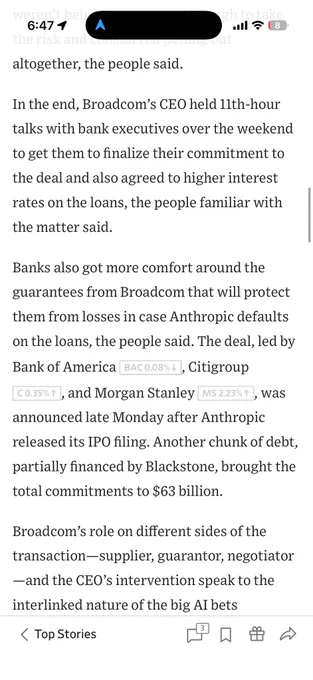
SCOOP: Broadcom CEO Hock Tan was getting impatient.
He needed lenders to commit $40 billon in the largest AI debt deal ever—so Anthropic could afford TPUs—but some were getting cold feet.
In the end, Broadcom’s CEO held 11th-hour talks with bank executives over the weekend to get them to finalize their commitments. Broadcom also agreed to higher interest rates on the loans, sweetening the deal.
With @ajsaeedy @ mattwirz for @WSJ
Show more

Scoop: Broadcom's CEO, Hock Tan, intervened at the 11th hour to wrap up a record-breaking $63 billion deal for Anthropic to lease chips used to power the AI lab's models. Some banks were getting ready to walk from the mega-deal, but Tan promised them to pay them more. The deal was announced hours after Anthropic's S-1, and shows how crucial intermediaries like Broadcom are to unlock the billions Anthropic and other AI companies need. w/@anissagardizy8 & @wildberrycaters
Show more


New: The three researchers OpenAI fired last month spent the summer fighting to keep AI's chain-of-thought process visible.
Then, OpenAI asked to see their Signal chats. A week later, they were let go.
More below from @keachhagey, @berber_jin1, and me.
Show more


Last month, OpenAI called in the three outspoken safety researchers and asked them to unlock their personal phones. It was conducting a leak investigation into a story in The Information about Astra’s use of opaque architectures, and the company’s plans to continue down that path. A week later, at 2 p.m., they were all fired.
Our story, w/ @ZeffMax and @berber_jin1 , looks at the battle over how much AI companies should share with third-party monitors like METR and Redwood to ensure AI safety via @WSJ
Show more

Here is an early look at the front page of today's Wall Street Journal

Exclusive: Anthropic's draft IPO filing reveals red-hot growth, massive computing costs and an $80 billion net loss. Here are the highlights.

SCOOP: Anthropic's latest draft S-1 documents show financials results for the first half of the year, gigantic spending plans for the future, and a laundry list of risk factors.
- Anthropic recorded a net loss of $80.7 billion in the first half of the year, tied to accounting adjustments related to previous financings
- Anthropic is set to spend >$600 billion on compute in the coming years, inclusive of cloud agreements and chip leases.
More in @WSJ:
Show more








