Greg Feibus
@gregfeibus
Global Head of Capital Markets @SkyEcosystem | Deepening capital flows between traditional finance and the onchain world | Ex @MidasRWA @Ondo @Anchorage
Joined November 2021
1.6K Following 715 Followers
I spent the first decade of my career in traditional markets, and it's fair to say that not long ago, token buybacks would have been written off as some niche, aspirational crypto phenomenon.
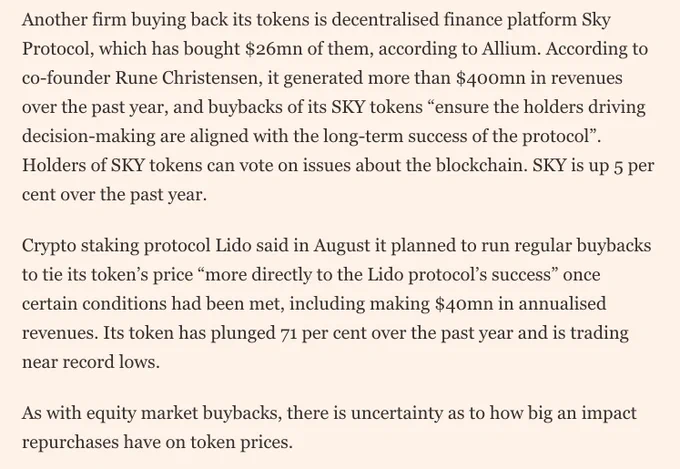
This week, they’re being covered by the @FinancialTimes for readers who want to know how these programs are structured, who/what funds them, and what they say about the businesses behind them. That feels like a meaningful shift.
@SkyEcosystem was one of the protocols that was covered.
Buybacks aren’t novel; public companies have used them for decades. Apple is probably the most obvious example: year after year it funds the business, invests heavily, maintains the balance sheet and still generates enough cash to return tens of billions through repurchases. In FY '25 alone, they generated more than $111b of operating cash flow and spent roughly $91b buying back shares.
The orders of magnitude are obviously a bit different, but this same principle is relevant to Sky. Savers get paid via sUSDS yield, the capital buffer gets funded, reserves are built, and surplus revenue beyond those requirements can be allocated to SKY buybacks.
Here's Sky Protocol in numbers:
>$400m in revenue over the last twelve months, a record $124m and $107m quarters of revenue in succession, and a fifth straight profitable quarter in a market where profitability has been scarce. Cumulative SKY repurchases are ~$125m since the program began in Feb '25.
That’s the part I keep coming back to. In public markets, the ability to consistently fund buybacks out of earnings has long been viewed as a sign of financial strength. I don’t think that reads much differently onchain.
Onchain markets are increasingly being judged by the same things public markets always have been: revenue, profitability and capital allocation. This feels like progress.
Show more