

Semiconductor Business Intelligence
@nsightfactory
Data, trends and insights from the Semiconductor and related industries. Business intelligence for your strategy and business plans.
4.9K Following 4.9K Followers

Long before I realised they had a role in the AI Infrastructure supply chain, I used Ajinomoto products in my kitchen. The inventor of umami in powder form should have a place in every serious spice cabinet.
Show more

On the surface, the Oracle result was very strong from a cash-flow perspective, but the bride was not entirely dressed in white.
You can read more about the changes in strategy of the large hyperscalers here:
Show more

While the DX division has lost the power battle, its employees have lost the bonus battle and must live on one-tenth of DS employees' bonuses.
When the people begin to dislike each other and the power struggle is over, the hacksaw comes out.
Show more

The entire semiconductor industry recorded its first half-a-trillion-dollar quarter in the second quarter of 2026. Revenue grew by more than $100B QoQ to $545B, or 22.7% growth. Of the total, $75B was driven by memory growth
Show more


The sniper rifle has been put away.
As of the end of this month, the US government is significantly tightening the control of advanced computing and semiconductor manufacturing technology.
High bandwidth memory features prominently, as does the advanced packaging of HBM and GPUs.
140 companies, including investment companies and entities outside China, have been added to the embargo list.
The Foreign Direct Product rule is extended, allowing the US administration to influence the export of subcomponents with the slightest traces of US technology.
Also included in the Christmas gift to China is the inclusion of software keys to enable design software and semiconductor manufacturing equipment already in use. This could cripple the installed manufacturing capacity in China.
ASML which this could impact, has thrown the hot potato on to the Dutch government by stating they follow Dutch legislation.
The new administration has been armed to the teeth.
Show more

The AI revolution has made the semiconductor industry's demand equation less dependent on consumer sentiment.
This can dramatically change the semiconductor's four-year boom-and-bust cycle, during which we collectively make the same mistakes as the last cycle, laying the foundation for the next.
One critical element that will drive this trend forward is Nvidia's success outside the training needs of cloud customers. Will Nvidia also succeed in the enterprise segment's inference business?
Read more here:
Show more

The first stage of Nvidia's impressive growth journey has been fuelled by the AI training needs of Cloud companies and AI Natives like OpenAI.
While the AI investment commitments from the cloud companies remain strong, Nvidia is looking to develop more income streams.
Given the number of names mentioned in the conference call, the Enterprise segment is a high-value target. Nivida mentioned 19 Enterprise companies in the call.
I have yet to detect meaningful AI investments outside Tesla in the enterprise segment, but I could be missing something. The AI models could be deployed elsewhere.
As an IT infrastructure novice, I needed to upgrade my knowledge. This is what I found.
Show more

The semiconductor industry simmers and bubbles. The demand is shifting rapidly to data centre CapEx while the supply chain is trying to catch up. From one semiconductor cycle to many. From a complex supply chain to an even more complex supply chain.
I will present my analysis at the online MicroFab Summit 2024 conference ( Register today to attend on December 11-12! To receive a discount code for your registration, please email Jessica Ingram at jessica@microtechventures.com.
@microtechv @MikePinelis #MicrofabSummit#
Show more

If you think it is irrelevant to be mentioned on an investor call, you should talk to Samsung. They were not mentioned in the Nvidia Investor Call, while their two main competitors, SK Hynix and Micron, were.
Jensen was immediately confronted with the omission: "Nvidia is working as fast it can to certify Samsung’s AI memory chips", CEO Jensen Huang tells Bloomberg TV. This did not make things less embarrassing for Samsung.
From being a rarity in the Semiconductor industry, Nvidia has increased the number of company name drops from 14 before AI popped to 57 mentions in the latest call.
For the first time, Jensen mentions suppliers. Given the insatiable demand for Blackwell, it is reasonable that they are on his mind.
If you think mentions and omissions are essential, check whether your company or competitor was mentioned.
We've got you covered:
Show more

There is no company name-dropping in most investor calls in the Semiconductor industry except for competitor names. Information about suppliers and customers can be sensitive, and in general, it is not shared.
However, a graphics gaming company changed that right before becoming an AI GPU company. On the investor call just before the lid went off the AI kettle, Nvidia mentioned 14 companies in their investor call. Last week, that number had grown to 57 mentions! The call is turning into the AI Academy Awards.
From not wanting to be mentioned, companies likely need to be mentioned on the Nvidia call. That means you are at least a billion-dollar friend to Jensen and worth noticing.
I take a look at the data and share it with you in this free blog post:
Show more

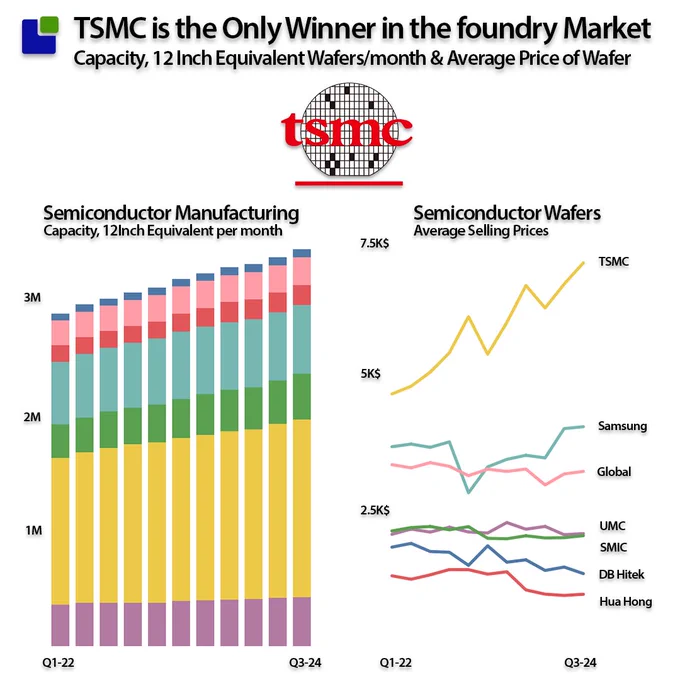
Despite responding to the market downturn by cutting CapEx investments, semiconductor foundries had to fight over fewer orders while more capacity came online.
The capacity is growing at 8%, similar to the current average global semiconductor market growth.
The problem is the timing. When you invest at the peak, you get it in the trough.
With declining utilisation rates, some of the less fortunate foundries had to fight over the scraps and have seen declining wafer ASP's.
TSMC's leadership in technology meant they could afford to compete and outcompete everybody in the mature technologies but decided not to.
Despite 3 quarters of improving utilisation rates, TSMC is still only at 72% utilisation rate. This typically means depressed profitability, but the Taiwanese powerhouse is capturing 90% of all the operating profits in the foundry market.
TSMC could have crushed the competition in this down-cycle but decided not to. Only TSMC knows why, but the company has more depth than your average corporation.
Read more about the foundry industry here:
Show more
The supply chain is whispering while accelerated computing continues dominating the Semiconductor industry after Nvidia's release.
The Hybrid Semiconductor companies dependent on the Industrial, Automotive and Communications markets guided Q4 revenue down collectively. But now recovery sprouts are beginning to show in the shadow of TSMC's computing business. The foundry business is ahead of the Semiconductor business in the cycle, and the people tuning the machines know what is coming.
Read more about insights from the business of the foundries in my blog:
Show more

RT @siliconomy: Once again, the stock market survived the apocalypse as Nvidia brought the bacon home. If you compare the gains to Nvidia's…
To get a quick overview of Hybrid Semiconductors' current and future fab capacity, I use the Meteor Chart (which I call the Fireworks chart in better times). It shows the distance travelled in a year regarding the financial value of the capacity (Property, plant, and equipment) and the investment in future capacity (CapEx).
Two leading comets have significantly reduced their CapEx over the last year. While Texas Instruments is also spending less, the Lone Star company spent more than its two large competitors combined in Q3-24.
The Meteor Chart is a snapshot in time and cannot stand alone, but when used effectively, it can tell a story.
Show more

Like a slow rollercoaster, the Semiconductor industry moves in four-year cycles. The cycle length is more or less constant, but the timing of cycles is different in each industry subsector.
While Nvidia will report on its own upcycle tomorrow, the Hybrid Semiconductor Companies will remain stuck on the downslope for at least another quarter.
The cycles are no surprise, but navigating the downcycle is risky, and two CEOs did not make it. The two companies that changed leadership pursued two very different strategies.
While Microchip took the frugal route of expense control, pay cuts and reduction in CapEx, Wolfspeed maintained its wild spending spree on fab expansions despite not being profitable for years. Where the two companies strayed away from the pack was in operating profits. While Microchip stayed profitable, it got too close to the line for CEO survival.
Read more about the status of Hybrid Semiconductor Companies here:
Show more

One of my favourite Buffett quotes is: “Only when the tide goes out do you learn who has been swimming naked.”
While none of the Semiconductor companies using hybrid manufacturing has been swimming naked, some are now revealing the colour of their bathing suits.
It is not attractive to cut operational budgets as they typically have a long horizon and effect, but sometimes it is necessary. When things get tough and decisions about limiting operational budgets emerge, the underlying strategy can emerge.
I use the Snake Plot to gain insights into the operational strategy, mapping the R&D% vs. the SG&A%. The plot describes the current downturn (7 quarters of snaking) in the Hybrid Semiconductor market with three companies popping out:
1. Microchip's sharp decline in revenue has resulted in operational cuts but not as deep as the revenue decline. The response has been balanced with equal cuts to R&D and Sales/marketing efforts.
2. On Semiconductor is prioritising the R&D effort over Sales
3. Renesas is prioritising sales over R&D efforts.
The snake diagram should not stand alone; it is an excellent way to illuminate semiconductor companies' strategies.
Read more about the Hybrid Semiconductor Companies here:
Show more

"Never waste a good crisis!"
Hybrid semiconductor companies serving broader markets, such as automotive and industrial, must maintain faith in their business and manufacturing models.
While it is easy to invest in upturns, investments in the downturn often create the foundation for the following market share gain.
If you want to know what the hybrids are up to, read more:
Show more

In the shadows of the AI revolution and Nvidia's meteoric rise, the Semiconductor Workhorses are still stuck in the downcycle that has lasted 8 quarters. What looked like a turning point was shot down by the Q4 guidance that will mark a new low point.
These companies use the hybrid manufacturing model, operating their fabs for analog, power and other specialised manufacturing while getting their leading-edge controller products done by foundries.
The hybrids are the backbone of the industry and are vital for everything that keeps us occupied, warm, fed and safe. You would miss these companies a lot more than Nvidia if they disappeared.
If the business of the hybrids is important to you, read my Q3-24 update that dives into the hybrids market and current situation here:
Show more

Investigating the CapEx of large cloud companies gives good insight into the near-term future of the Data centre capacity. Still, it is possible to look even deeper into the future.
Investigating gross property, plant, and equipment in the balance sheet shows the share of buildings compared to equipment (acquisition cost before depreciation).
As AI server equipment is much more expensive per square meter than traditional CPU server equipment, I would have expected the share of equipment to grow faster than the share of buildings and improvements, but for Microsoft, this is different.
Over the last year, Gross PPE in buildings has grown faster than in equipment. At the same time, Committed Construction skyrocketed more than 2.5 times to over $35B.
Microsoft is constructing a lot of new bit barns for the future.
This indicates that Microsoft's massive investment commitment will continue for a longer period, regardless of the return on AI.
Show more

Despite worries about diminishing returns on large LLM's the cloud companies will continue to increase CapEx investments in Q4-24 and into 2025. That is if you believe in investor communication from large cloud companies.
Another question is whether accelerated computing is starting to encroach on the CPU workloads in data centres as Jensen Huang predicts they will or if the priority investments into AI temporarily drive the CPU decline.
For now, there are no signs of a CPU comeback, and revenue has declined by 14% CAGR since the last peak, while AI revenues have grown 10x.
Read more about the state of the cloud and processing business here:
#Nvidia# #AI#
Show more











