Percy Liang
@percyliang
professor of computer science @Stanford @stanfordnlp, co-founder of @togethercompute, @simile_ai, pianist
424 Following 124.6K Followers
A year ago, David was the only FTE on Marin. Today, thanks to Open Athena, Marin has 10 FTE. Read his post to better understand the context of Marin. And David tokens are always a pleasure to read.
Marin 535B-A23B is 13% through training. This hero run would not be possible without the generous support of the Jen-Hsun and Lori Huang Foundation, which provided the funding for the compute (Coreweave). Thanks @JensenHuang for supporting open models!
Show more

🚢 Marin 535B-A23B started training this week! As usual, the whole process is open.
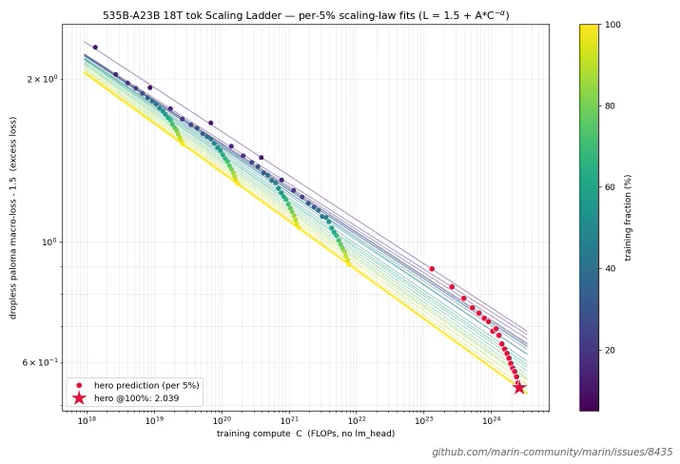
Voyage plan: pretraining (80%) + midtraining (20%) on 18.75T tokens on 11 x GB200 NVL72 for ~3 months (2.7e24 FLOPs). Post-training will follow.
Before kicking off the run, we trained a 4-rung scaling ladder from 1.6B-A61M (48B tokens) to 27.7B-A1.2B (926B tokens) to debug issues, and to make a forecast of our hero run. This is by far our biggest run, so definitely expecting the unexpected.
Show more


At Marin we’ve found that scaling laws let us simulate the entire training trajectory. This became clear in our last 67B MoE run. The run hit the loss target within 1%, but perhaps more interestingly, arbitrary points during training could also be predicted to within 1%. This model is finishing up long context and will soon enter RL. Based on this finding, we’ve used a scaling ladder to simulate the training trajectory of the 535B MoE we kicked off yesterday. Will see how it goes. Now if someone can figure out how to fit a scaling law to each parameter we can just predict our final model and skip this training business.
Something else I've learned from this process is that getting a training run off the ground is way more than just fiddling with the architecture. Lot of herculean efforts from teammates to get trillions of tokens curated, get hardware running on a new GPU stack, improve MFU, and propose great ideas that were tested and integrated.
Given that this is our largest run to date, I anticipate lots of learning and adapting along the way. But thats part of the fun. Details:
Show more




Excited to share MarinDNA, a 1B gLM that rivals Evo 2 40B on variant effect prediction while being 2,330x faster.
With @eczech0, we built around a standard Transformer so we could reuse LLM infra and methods while focusing on data curation and scaling.
🧵
Show more


A hidden detail in the recently released Muse Glimmer model: its per-matrix weight RMS norm is pinned almost exactly at ~6e-3!
If you’re curious why fixing weight RMS like this can work, feel free to checkout Hyperball:
Show more


Announcing Discovery Loop!
I am very excited to announce that, along with my longtime friends and collaborators @Sanjay_Ghemawat, @OriolVinyalsML and @quocleix, we are founding Discovery Loop (@DiscoLoopAI), a Public Benefit Corporation whose mission is to automate machine learning, science, and engineering to accelerate discoveries and progress. The four of us have worked together for 14 to 30 years, and have helped build some of the world’s most used products, infrastructure and AI models, and we’re excited to turn our attention to this ambitious endeavor.
♾
Learn more at:
Show more


Five months ago, we launched @simile_ai with the belief that simulation would become a new way for the world to make decisions.
Today, that belief feels less like a thesis and more like the beginning of a new category.
Incredibly proud of my team. We are just getting started.
Show more
It's time to scale that Simile.
Our ambition is to build a foundation model that can predict what anyone will do in any situation.
Research-wise, Simile in 2026 for simulation is like OpenAI in 2019 for AI assistants - signs of life, a path to scaling, yet still many open research questions.
Commercially, Simile is already a company with many amazing enterprise partners who understand the potential of simulation and will help us grow sustainably.
If simulation and this special combination of research and product is appealing to you, we’re hiring.
Show more

Today we’re announcing our Series B.
We’ve raised $200M at a $2B valuation from Greenoaks with participation from Index Ventures, Hanabi, A*, Bain Capital Ventures, CVS Health Ventures, and Definition.
Our mission is to simulate all eight billion people on earth, accurately.
Show more

The most important word here is *ecosystem*. It's not just about having an open-weight model. Open-weight models are a means to an end. To have a truly strong, open ecosystem, we need four critical frontier-level ingredients: open-weight models, open training datasets, open software stacks, and open process knowledge. Few people realize that NVIDIA actually has been pushing beyond open weights by releasing code and datasets for their Nemotron models, which is something open-weight model developers don't do. Marin further opens up the process knowledge - not just how to train one model, but how to iteratively improve and shape a model given particular goals, custom data, and hardware, e.g., how to design scaling laws and evals to guide architecture and data ablations. Open weights, datasets, software, process knowledge: these are the four critical ingredients (renewable resources) that give everyone the ability to most efficiently turn their compute (consumable resources) into the best models according to their needs and values.
Show more

⚡! Tokenization is the first thing you do in CS336 (language models from scratch). If Marcel can work his magic for the rest of the LM pipeline, the world will be a better place.

Introducing the world's fastest tokenizer implementation, Gigatoken!
Gigatoken is ~500-1000x faster than HuggingFace, and ~100x faster than OpenAI's tiktoken for most tokenizer definitions on most machines.
These baselines are already multithreaded Rust implementations! 🧵
Show more

Question for the LLM Research Community: Is anyone aware of fully reproducible experimental results showing that MLA beats GQA under the same KV cache? I ask for two reasons: (1) I find it surprising that there is still a divide between Chinese labs using MLA, and Western labs using GQA + sliding window, when certainly many ablations have been run by many parties. (2) At Marin we are considering MLA for our next large scale run, but in early (!) smaller scale ablations it appears worse than heavily tuned feature-rich GQA, even after controlling for KV cache. I would like to run better experiments here. Below I cover my thoughts on general reproducibility, then specifics on MLA.
Every empirical result in ML is only contextually true. Conditioned on the data distribution, optimizer settings, model width, model depth, finer architecture details, hardware, kernel engineering, initialization, token count, tokenizer, context length, and evaluation protocol, one can reach different conclusions.
Contextual results are still useful. Typically if I see a promising method, I will first attempt a full 'context jump', where I apply it to my own context, hoping results transfer. Sometimes they do. If they don't, I can try 2 things: modify the implementation of the method, or modify the context. Ideally I have access to the full context of the original result. Then I can perform a 'context bridge', where I ablate one aspect of the context at a time, isolating exactly why a method performs differently. This lets me make an informed decision to either update my context to let the method shine, or stick with my context and leave the method out.
MLA is tricky to assess at small scale. A core aspect of MLA is compressing hidden_dim->latent_dim. Then for each head, latent_dim->head_dim. Typically head_dim is fixed at 128, partially for hardware reasons, and partially for learning dynamics (head_dim of 8 wouldn't have sufficient representational capacity). To get MLA dynamics, you want hidden_dim>>latent_dim, and latent_dim>head_dim. This window closes at small scale.
The degree of tuning can unfairly alter the scales. In GQA we have partial RoPE, QK Norm, Gated Attention, attention sharpening, sliding window, and other techniques that give a 30%+ training boost. They don't seem to give the same boost to MLA. On one hand, you want to compare techniques apples:apples with equal tuning. On the other hand, there is a finite amount of future tuning you can do, so prior tuning influences which approach is most pragmatic.
Creating controlled tests between MLA and GQA is tricky. Several factors: kv_cache, quadratic attention flops, attention projection flops. kv_cache is controlled by scaling down kv_heads to match MLA, or scaling up kv_latent to match kv_heads. quadratic attention flops are controlled by scaling up GQA's query head count to match MLA head count, or scaling down MLA head count. Also scaling up GQA head_dim 128->192, or scaling down MLA head_dim to 192->128. In general, it's informative to context match to both option A's preferred context and option B's preferred context. Sliding window is another confounder.
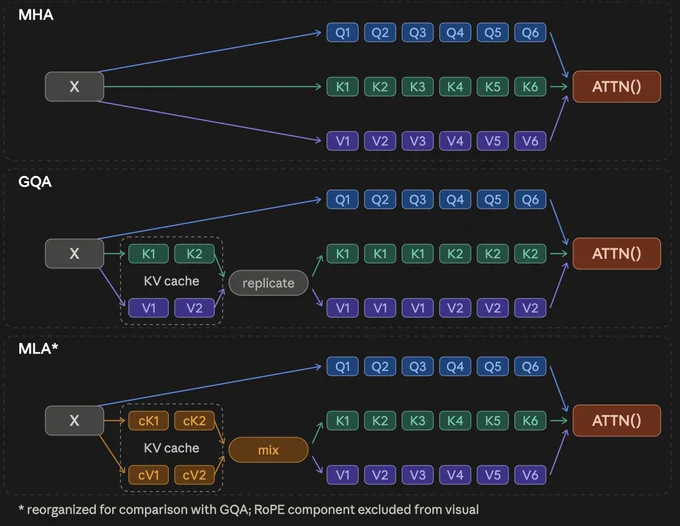
MLA is theoretically elegant, if we ignore RoPE. It replaces the 'replicate' op of kv_heads in GQA with a 'mix' op (pic below). Since the 'mix' can learn to 'replicate' if it wants, MLA is purely more expressive, and the cost of 'mix' is hidden at inference with absorb trick. Yet in practice, I find that at small scale this 'mix' op doesn't add much value and interacts poorly with the optimizer dynamics. And the change to RoPE hurts.
My current plan is to first tune and ablate our model features around MLA, then run 3 scaling ladders: MLA, GQA with 2 kv_heads, and GQA with higher kv_heads. For each ladder, fit a loss vs compute projection. If MLA performs worse at our target compute compared to both GQA options, drop it. If MLA beats 2 kv_heads but loses to higher KV_heads, then it becomes a kv_cache tradeoff. Early results indicate MLA will perform worse than both feature-rich GQA ladders, but we will see. Any positive external reproducible results for MLA would help make sure I give it the best chance possible.
Show more

Congratulations to @tatsu_hashimoto for making the 2026 @TauBetaPi Teaching Honor Roll!
CS336 has fans inside Stanford as well as more widely!
Catch the 2026 edition here:
Playlist:
Course website:
Show more


Thrilled to share that I am joining UC Berkeley as an Assistant Professor in the School of Information!
I start in Fall 2027, and I am recruiting PhD students this cycle. List me in your application if you're interested in frontier AI evaluation, AI policy, and AI's impacts on institutions such as science, law, and medicine.
I'm especially keen to work with students interested not just in high-quality research, but also in communicating it with a broad audience such as by public writing and policy impact. Fill out the form in the next tweet to indicate your interest.
As for this coming year, I'm moving to Berkeley this fall to start something new with @RishiBommasani and @random_walker. We'll have much more to share soon.
Show more


I’m one month into @SimileAI, and I’m even more convinced that evals for simulating human behavior is one of the most interesting problems in AI.
That's why we’re growing our small-but-mighty Evals team by hiring multiple Evals -- MTS roles in SF + NYC.
Show more


One year in, the @DARPA AIQ program is moving beyond better benchmarks toward a science of AI capability: measuring what models can do on specific questions, predicting performance across classes of problems, and understanding how capabilities arise from model architectures.
Show more

Launch FLARE-AI 🎆: Flaw & Incident Reporting for AI.
Reporting AI flaws is broken: forms are scattered, non-standardized, and reports get siloed instead of reaching everyone who needs them (think universal jailbreaks).
We built one open-source place to fix that: create your report + route.
Open source + free.
🧵/
Show more


We @togethercompute believe intelligence should be abundant, not expensive.
Today we announced our Series C funding of $800m @ $8.3B valuation, to continue to build the world's most efficient platform for generative AI.
Thanks @nikogallogly for telling our story in @nytimes!
Show more


Frontier AI models are built from thousands of small decisions: data sourcing, filtering, mixtures, curricula, scaling experiments, optimizer choices, kernels, evals, failed runs, and protocols for deciding what gets scaled.
This is process knowledge.
Show more

40% of benchmarking effort targets math/coding, but the related occupations are only 3.5% of US jobs.
We introduce EconEvals, an open-source evaluation suite to measure capabilities and predict job disruption across the US labor economy.
Show more












