

Ken Liu
@kenziyuliu
CS PhD @StanfordAILab @StanfordNLP w/ @percyliang @sanmikoyejo. Past: @GoogleDeepMind, CMU, USydney 🇦🇺
992 Following 4.1K Followers

AI is now taking on some of the hardest open problems that scientists have posed. But research is broader than solving problems. Can AI also propose research questions that experts find genuinely interesting?
We built After42 to find out. Experts judged 45 of its 135 final questions genuinely interesting, across mathematics, statistics, theoretical computer science, and physics, with wide variation across subfields.
The key idea: develop questions by trying to solve them.
We also asked whether AI can judge which questions are interesting. We find that model judges' top choices align with expert consensus but do not consistently capture individual experts' preferences.
We release the expert-assessed questions as an open resource for researchers to discuss, refine, and pursue, as a step toward integrating AI into the broader research enterprise.
Show more

an example that folks often find surprising: codex (and others) scan your connectors / mcps *unprompted* in the background and you largely wouldn’t know when, what, or why
to catch this you need some form of intermediary infrastructure between your data and agents
Show more

need an agent watching over all of my personal agents (instinct, muse, grok bot, dot, etc).
not always trivial to know *who* did *what* when everyone is operating on the same data store and APIs - essentially email and calendars.
Show more

We let agent swarms collaborate for 10K hours in simulated agent-owned GitHubs.
Gemini-3.8-flash collaborate the best while gpt-6-astra scores the worst among frontier models tested⁉️
What are the elements of successful agent collaboration at scale? Check World of SWECraft 🧵
Show more


-----BEGIN RSA PRIVATE KEY-----
4
-----END RSA PRIVATE KEY-----

A million hours of what?
If we’re scaling human demonstrations for robot learning, what should each hour contain?
We built S1, our skill capture glove, alongside our robot hand to record joint movements that map to robot targets, with touch and video on the same timeline.
Show more


Discovering dexterity:
At home with my infant, and at Origami @origami_robotic ...
More tomorrow 👀

user modeling is a key missing piece in making AI truly understand us and being useful, and making it sovereign is critical -- exciting work from @BenShi34!

To train user models / personal agents that best understand us, it helps to have access to all of our scattered digital footprint. For my first release in my PhD, I’m open-sourcing **Homecoming**, a desktop app that automatically aggregates all your personal context across all applications that you’ve accessed over your lifetime. It helps auto-request your data packages from over 2000 supported websites, and manages them locally in one place you can query, explore, and use for any downstream application. All your messages, emails, tiktok scrolling activity, goodreads, netflix, strava… even your 6th grade Wattpad account. You can even explore the features companies use to target ads at you.
This project was super fun to work on as I realized there is so much data about me that I didn’t even know existed. It’s a nice feeling to gain sovereignty over my data.
All data stays local, unless you choose otherwise. Lmk how it is!
Blog:
Link to download:
Show more


For Aryaman's defence (yes, spelled with a "c"), I did write lyrics for an underground homage to Nas's "Hip Hop is Dead". Cover art:


I defended my Ph.D. @stanfordnlp a few months ago, and recently started @AnthropicAI on the Interpretability team!
(pictured: my awesome defence committee members)

MLP neurons are great, but knowing this alone does not solve interpretability.

I just used @MetaMask to pay for decision models, confidentially, with zero-knowledge.
Excited to bring zkAPI by @ethereumfndn and @OpenAnonProject to Sage:
- Deposit ETH once.
- Generate keys with ZK proofs.
- Give a key to your agent.
- Your agent makes decisions, and they can't be linked to the wallet you deposited from.
Play with it 👇
Show more

AI-generated scientific output is scaling beyond available human review capacity. Scaling scientific discovery requires scaling verification.
We introduce OSVerify, a framework for one-sided verification: rejecting as many invalid solutions as possible while preserving rare valid ones for expert review.
We used OSVerify to referee 11 recent OpenAI math preprints, identifying 5 major and 13 minor issues, all verified by human experts.
Our key insight: checking a proposed error can be easier than judging an entire solution. Instead of directly judging solution correctness, OSVerify decouples verification into error proposal (searching for potential errors) and error validation (checking whether they are real and substantial).
On competition and research mathematical benchmarks, OSVerify reduces invalid solutions requiring expert review by 46% on average compared to voting under the same low-FNR constraint, or 57% with an RL-trained validator.
Verification can also guide discovery. OSVerify can be integrated into existing scientific discovery workflows. Paired with an agentic math solver, it helped resolve 3 open conjectures in the Langlands program and contributed to resolving the Manin constant conjecture. All proofs were confirmed by mathematicians.
Our broader goal is to provide verification-based evaluation signals for scientific discovery, enabling test-time scaling and self-improvement even when reliable automatic evaluators are unavailable.
Project:
Paper:
GitHub:
[1/n]
Show more

🚢Marin 535B-A23B training has crossed the halfway mark! Some observations and learnings so far:


Can LLMs generate novel research ideas? We propose Priced Guidance to quantify this via compression!
We lower bound P(LLM forecasts a future paper’s idea X). Instead of sampling ideas until X is matched, the LLM plays “20 Questions” to recover X, charging each hint by surprisal.
Show more

Hello my 406 twitter followers. Hopping on to share two things:
1. I’ve started a CS PhD at Stanford! For the love of the game ofc.
2. I’m releasing impersona-env, a proof of concept to train personalized assistants by building an RL environment out of user models. Your assistant learns to help you by repeated asking a simulated version of you questions, probing its internal latent thinking and feedback, and updating its priors accordingly. I think this unlocks a new dimension to personalization beyond discrete fact recall. My personal assistant model now understands nuances of my preferences that even I didn’t know about.
Full blog:
It’s still a proof of concept and there’s still a ton of things to figure out in this space. It’s unclear to me how to build user model evals that generalize across users and downstream applications, how to best represent longitudinal personal data at training time // inference time, the interplay between population level and individual level preferences, the immense questions surrounding privacy and hillclimbing in decentralized data access regime… if you want to chat on anything in this area please dm me!
Show more


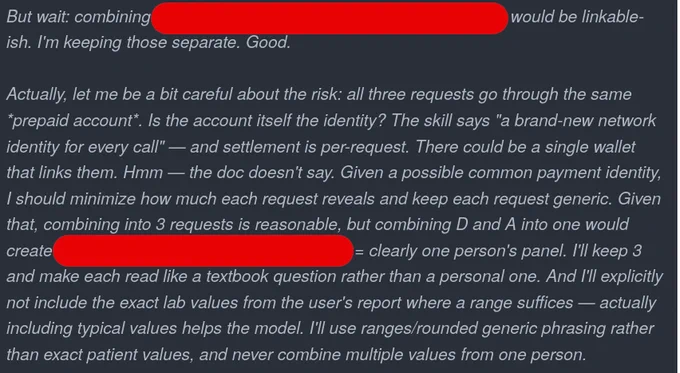
Doing a bit of a self-experiment.
Goal: use my personal health and travel data to provide personalized diet and exercise recommendations for me, using frontier models but in a way that avoids leaking to them any private information.
Strategy: use a local model (Qwen 3.8 Flash Next) to orchestrate, and use powerful remote models as a tool call to benefit from higher-level thinking and knowledge that the local model does not have.
Three-layer approach to privacy:
Avoid leaking personally identifiable information, or leaking my identity through writing style -> local model writes the queries to the frontier model, not me
Avoid leaking who I am through the payment channel -> zkAPI
Avoid leaking who I am through networking / IP -> Tor
You need all three (and finally we have all three, at least to some extent)
A skill file teaches the local model when and how to construct minimally-data-revealing requests to remote models. Use zkAPI-wrapped-with-Tor as a CLI tool.
And everything works! I got the recommendations back, info from frontier models helped to improve them.
Main deficiencies:
* Tor is really not optimized for request-by-request de-linking, which is the only form of network-layer privacy that really makes sense in today's world (long-running identifiers are too fragile). Probably not private enough, and latency 10-100x higher than it could be, at the same time.
* The skill file's request construction strategies are definitely far from optimal.
* Qwen 3.8 Flash Next is still too slow for comfort. It's comfortably running at 20-30 TPS, but it would only really start to feel fast at 100+
* There is a tradeoff: the more careful you are about what data you give to a remote model, the less it can help you
Show more

shoutout to @mingyech @dominicjsobhani who're really the driving force behind this!!
Quick updates on the Open Anonymity project (@OpenAnonProject)!
1. OA-chat is live! You can now signup:
2. We collaborated with @ethereumfndn (@VitalikButerin, @DavideCrapis, @VittoStack, @curryrasul) to develop zkAPI, a new zero-knowledge protocol for accessing gated / paid APIs with unlinkability. It’s like a generalization of OA unlinkable inference that also abstracts payments away. Now also available on OA-chat!
I'm excited because more infrastructure should exist where privacy and sovereignty is foundational and people are in control.
Show more


Excited that zkAPI is out and live!
Great joint effort with @VitalikButerin on our initial design, @curryrasul and @kenziyuliu + OA team on implementation, and the amazing push from @VittoStack on the dAI team to bring this out.
If you want to implement private payments on Ethereum for your API, check the post and repo.
We have more things coming out to enhance user sovereignty and privacy in the age of AI.
Show more

Today the EF and OA announce zkAPI—a new means for private AI
Picture this: deposit ether into a vault, sign a zk proof, get a fixed amount of private inference. Advances like these help us move past middlemen's requirements that we link our data and identities.
Read more below
Show more

Quick updates on the Open Anonymity project (@OpenAnonProject)!
1. OA-chat is live! You can now signup:
2. We collaborated with @ethereumfndn (@VitalikButerin, @DavideCrapis, @VittoStack, @curryrasul) to develop zkAPI, a new zero-knowledge protocol for accessing gated / paid APIs with unlinkability. It’s like a generalization of OA unlinkable inference that also abstracts payments away. Now also available on OA-chat!
I'm excited because more infrastructure should exist where privacy and sovereignty is foundational and people are in control.
Show more











