Jensen: “Do you want the Wifi password?”
Elon: “I’m good. I own the sat network.”
Someone should start vibe coding a Robotaxi tracker for China.
There are only 3 reasons for this:
1. Grok Build glitch
2. Elon asked Tom Zhu to scale everything
3. Xi thought xAI and X are named after him and approved everything
Wait, what? ALL 975 job postings on Tesla China’s careers site is now marked “URGENT”!
❤️🔥Tesla China is URGENTLY hiring Robotaxi Electrical Engineers.
Probably nothing.
I said what I said by sundown.
By sundown on May 14, Applied Materials will have a higher stock price than Tesla. $TSLA $AMAT
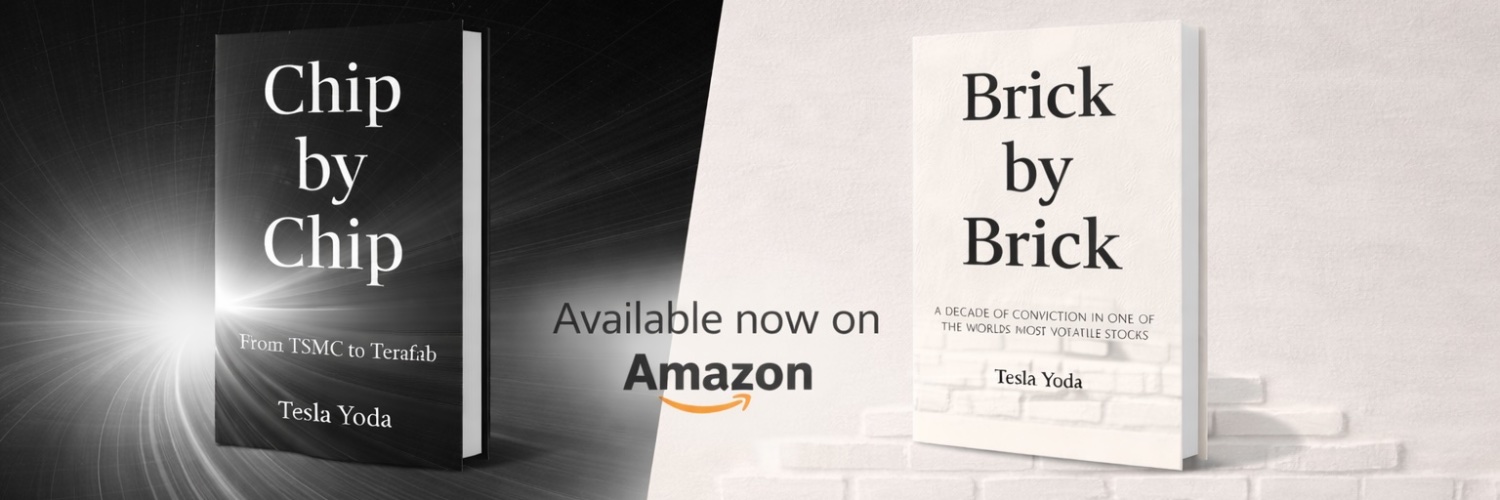
Chip by Chip
TSMC 2026 Technology Symposium (Taiwan 5/14) Summary:
Global Expansion & Operations
· Global Build-out: Constructing or modifying 18 fabs worldwide (includes 5 advanced packaging plants).
· Taiwan Core: 12 of these 18 facilities are located in Taiwan.
· Acceleration: Expansion speed has doubled to 9 new plants per year (2025–2026) vs. 4 per year (2017–2024).
International Site Progress
· Arizona (USA):
-Fab 1 output to grow 1.8x in 2026.
-Fab 2 equipment move-in 2H-2026 (N3 production 2H-2027).
-Fab 3 broke ground 1H-2025.
-Fab 4 and first advanced packaging plant (AP1) are in initial construction.
· Kumamoto (Japan):
-Fab 1 (28/22nm) yield already equals Taiwan levels; 2026 output target is 2.3x YoY.
-Fab 2 began construction in 2025 for N3 production.
· Dresden (Germany):
-ESMC facility focusing on 12nm–28nm for Automotive/Industrial.
Advanced Process Roadmap (N2 / A14 / A12)
· N2 Momentum: Fab 20 (Hsinchu) and Fab 22 (Kaohsiung) are in mass production. Taichung Fab 25 to follow in 2028.
· N2 Performance: First-year output expected to be 45% higher than N3's first year. Capacity expansion CAGR of 70% seen 2026–2028.
· Yield Maturity: N2 yield learning curve is 2 quarters ahead of N3 at the same stage, driven by AI-optimized manufacturing.
· A14 (1.4nm): Already achieved >80% yield on 256Mb SRAM; offers 10–15% speed boost or 25–30% power reduction vs. N2.
· New Nodes:
-A12 (Performance-focused with Backside Power/Super Power Rail) and A13 both targeting 2029 production.
-N2U(enhanced 2nm) slated for 2028.
· Next-Gen: CFET architecture reduces SRAM cell area by 30%vs. Nanosheet.
Advanced Packaging & Silicon Photonics
· CoWoS Scale: 5.5x reticle size now at 98% yield. Scaling to 14x reticle for 20 HBMs by 2028 and 24 HBMs by 2029.
· System on Wafer (SoW): Future "Super Exchange" chips to integrate 64 HBMs/16 CoWoS units, exceeding 40x reticle size with 100TB+ bandwidth.
· Growth: 3DIC/CoWoS capacity CAGR of >80% 2022–2027.
· COUPE: All-optical interconnects to replace copper as data centers scale to millions of GPUs and power needs surge 200x.
Specialty & Memory Shift
· The Memory Divorce: Shifting from eFlash to RRAM (ReRAM) and MRAM for advanced nodes (≤28nm) in Auto, AI Glasses, and Edge AI.
· Edge AI Specs:
-N4PRF (RF process) for 39% power reduction
-N16HV(16nm High Voltage) specifically for AI Smart Glasses/AR displays.
$TSM $NVDA $AAPL $AMD $AVGO $MRVL $INTC $AMZN $GOOGL $MSFT $META #
semiconductors#
Links:
Show more
From Ming-Chi Kuo:
"Even if Intel successfully begins shipments early on, TSMC would still account for more than 90% of Apple’s supply."
Full Analysis by Ming-Chi Kuo:
AI Reallocation of Advanced Process Resources: The Three-Way Shift Between Apple, Intel, and TSMC
Below is my latest industry research on the Apple–Intel partnership, which helps provide deeper context and interpretation:
Apple has initiated projects on Intel’s 18A-P series (using Foveros packaging) for lower-end / older-generation iPhone, iPad, and Mac processors.
In terms of order structure, iPhone accounts for roughly 80%, similar to the proportion of end-device sales.
Apple’s wafer allocation planning at Intel reflects the expected lifecycle of the 18A-P series: small-scale testing in 2026, volume ramp in 2027, continued growth in 2028, and decline in 2029.
Apple is also simultaneously evaluating Intel’s other advanced process technologies.
Intel’s mass-production timeline and shipment scale remain unclear, and assembly/EMS partners have not yet seen concrete shipment plans.
Intel’s target for 2027 is to first stabilize production yields above 50–60%.
Even if Intel successfully begins shipments early on, TSMC would still account for more than 90% of Apple’s supply.
Internally, Intel has mixed feelings about Apple’s orders.
Apple began discussions with Intel before TSMC’s advanced-node supply constraints intensified.
Apple recognizes that TSMC’s resources will continue tilting toward AI.
Based on the above findings, we can analyze how changes in the advanced-node industry structure are influencing the behavior of all three companies. Among them, TSMC is particularly interesting. As the industry leader and also the passive party in this situation, it may appear to have limited options — but its position is actually the most worthy of deeper interpretation.
Apple Is Systematically Cultivating Intel to Become a Long-Term Strategic Supplier
Apple is simultaneously launching projects across three major product lines at Intel, and the wafer allocation ratios closely mirror actual product sales. This suggests Apple is simulating and validating the possibility of Intel eventually becoming a supplier across Apple’s full product portfolio.
Rather than merely testing a low-risk order, Apple is using the full 18A-P generation cycle to optimize mass-production coordination and collaborative manufacturing processes.
Beyond the usual motivations — reducing sole-source risk and improving bargaining leverage — the key reason behind Apple’s strategy is its realization that AI/HPC and smartphones will continue diverging dramatically in their contribution to TSMC’s revenue.
As a result, Apple must cultivate alternative suppliers while it still possesses meaningful bargaining power, leveraging its design leadership to simultaneously maintain its relationship with TSMC while advancing cooperation with Intel.
Intel Faces an Unprecedented Opportunity — and an Enormous Challenge
Over the next several years, the vast majority of advanced-node orders will still concentrate at TSMC. This makes Apple almost Intel’s only — and most complete — foundry training opportunity:
Orders span Apple’s entire product lineup
The scale is sufficiently large
Production and design must dynamically adapt to market demand changes
Even if Apple’s orders cannot dramatically reverse Intel Foundry Services’ quarterly losses in the short term, and even if supply share remains constrained by capacity and yield, the partnership still carries enormous strategic significance.
However, Apple’s extremely high standards, combined with Intel’s strategy of simultaneously taking on other foundry customers, greatly magnify the execution difficulty of rebuilding Intel’s advanced foundry business.
Intel now stands at a once-in-a-generation window of opportunity created by:
its own restructuring efforts,
geopolitical dynamics,
and customer diversification needs.
But whether Intel can capitalize on this opportunity now depends entirely on execution.
TSMC Is Safe for Years — But Its Leadership Position Has Become the Focus of Global Hedging
As TSMC’s advanced-node capacity becomes an increasingly scarce resource — and continues shifting toward AI — Apple naturally seeks cooperation with Intel to improve bargaining leverage.
But Apple is not unique.
Every major advanced-node player is now hedging against TSMC:
The U.S. government through semiconductor policy initiatives
Apple through cultivating Intel
Samsung through using memory profits to subsidize advanced-node investments
By contrast, TSMC’s primary response today remains operational excellence — effectively betting its competitive advantage on the assumption that its execution will continue to lead.
Execution is critical. But beyond execution, TSMC’s hedging tools are actually quite limited due to structural realities.
From a geopolitical perspective:
The United States is both TSMC’s most important market and technology partner
Yet simultaneously its largest source of policy pressure
Other potential balancing partners — China, Europe, and Japan — either cannot or are unable to provide effective counterbalance.
From a market strategy perspective:
External hedging strategies such as business diversification, customer dispersion, technology licensing, and supply-chain localization all exhibit diminishing marginal returns precisely because of TSMC’s dominant position.
Accelerating the accumulation of internal capital may therefore be the most practical option — and that internal capital comes from advanced-node pricing power.
Accumulating internal capital requires not only generating reasonable profits, but also pricing future risks into capacity allocation decisions.
Intel provides a concrete example:
When Intel outsources its own product orders to TSMC in order to free up internal capacity for training with Apple, those are no longer ordinary orders from TSMC’s perspective. They become orders carrying future competitive risk.
If TSMC chooses to transact with Intel, it should incorporate this emerging competitive relationship — created by geopolitics and customer realignment — into both its risk pricing and capacity allocation decisions.
Show more
From Ming-Chi Kuo:
"Even if Intel successfully begins shipments early on, TSMC would still account for more than 90% of Apple’s supply."
Full Analysis by Ming-Chi Kuo:
AI Reallocation of Advanced Process Resources: The Three-Way Shift Between Apple, Intel, and TSMC
Below is my latest industry research on the Apple–Intel partnership, which helps provide deeper context and interpretation:
Apple has initiated projects on Intel’s 18A-P series (using Foveros packaging) for lower-end / older-generation iPhone, iPad, and Mac processors.
In terms of order structure, iPhone accounts for roughly 80%, similar to the proportion of end-device sales.
Apple’s wafer allocation planning at Intel reflects the expected lifecycle of the 18A-P series: small-scale testing in 2026, volume ramp in 2027, continued growth in 2028, and decline in 2029.
Apple is also simultaneously evaluating Intel’s other advanced process technologies.
Intel’s mass-production timeline and shipment scale remain unclear, and assembly/EMS partners have not yet seen concrete shipment plans.
Intel’s target for 2027 is to first stabilize production yields above 50–60%.
Even if Intel successfully begins shipments early on, TSMC would still account for more than 90% of Apple’s supply.
Internally, Intel has mixed feelings about Apple’s orders.
Apple began discussions with Intel before TSMC’s advanced-node supply constraints intensified.
Apple recognizes that TSMC’s resources will continue tilting toward AI.
Based on the above findings, we can analyze how changes in the advanced-node industry structure are influencing the behavior of all three companies. Among them, TSMC is particularly interesting. As the industry leader and also the passive party in this situation, it may appear to have limited options — but its position is actually the most worthy of deeper interpretation.
Apple Is Systematically Cultivating Intel to Become a Long-Term Strategic Supplier
Apple is simultaneously launching projects across three major product lines at Intel, and the wafer allocation ratios closely mirror actual product sales. This suggests Apple is simulating and validating the possibility of Intel eventually becoming a supplier across Apple’s full product portfolio.
Rather than merely testing a low-risk order, Apple is using the full 18A-P generation cycle to optimize mass-production coordination and collaborative manufacturing processes.
Beyond the usual motivations — reducing sole-source risk and improving bargaining leverage — the key reason behind Apple’s strategy is its realization that AI/HPC and smartphones will continue diverging dramatically in their contribution to TSMC’s revenue.
As a result, Apple must cultivate alternative suppliers while it still possesses meaningful bargaining power, leveraging its design leadership to simultaneously maintain its relationship with TSMC while advancing cooperation with Intel.
Intel Faces an Unprecedented Opportunity — and an Enormous Challenge
Over the next several years, the vast majority of advanced-node orders will still concentrate at TSMC. This makes Apple almost Intel’s only — and most complete — foundry training opportunity:
Orders span Apple’s entire product lineup
The scale is sufficiently large
Production and design must dynamically adapt to market demand changes
Even if Apple’s orders cannot dramatically reverse Intel Foundry Services’ quarterly losses in the short term, and even if supply share remains constrained by capacity and yield, the partnership still carries enormous strategic significance.
However, Apple’s extremely high standards, combined with Intel’s strategy of simultaneously taking on other foundry customers, greatly magnify the execution difficulty of rebuilding Intel’s advanced foundry business.
Intel now stands at a once-in-a-generation window of opportunity created by:
its own restructuring efforts,
geopolitical dynamics,
and customer diversification needs.
But whether Intel can capitalize on this opportunity now depends entirely on execution.
TSMC Is Safe for Years — But Its Leadership Position Has Become the Focus of Global Hedging
As TSMC’s advanced-node capacity becomes an increasingly scarce resource — and continues shifting toward AI — Apple naturally seeks cooperation with Intel to improve bargaining leverage.
But Apple is not unique.
Every major advanced-node player is now hedging against TSMC:
The U.S. government through semiconductor policy initiatives
Apple through cultivating Intel
Samsung through using memory profits to subsidize advanced-node investments
By contrast, TSMC’s primary response today remains operational excellence — effectively betting its competitive advantage on the assumption that its execution will continue to lead.
Execution is critical. But beyond execution, TSMC’s hedging tools are actually quite limited due to structural realities.
From a geopolitical perspective:
The United States is both TSMC’s most important market and technology partner
Yet simultaneously its largest source of policy pressure
Other potential balancing partners — China, Europe, and Japan — either cannot or are unable to provide effective counterbalance.
From a market strategy perspective:
External hedging strategies such as business diversification, customer dispersion, technology licensing, and supply-chain localization all exhibit diminishing marginal returns precisely because of TSMC’s dominant position.
Accelerating the accumulation of internal capital may therefore be the most practical option — and that internal capital comes from advanced-node pricing power.
Accumulating internal capital requires not only generating reasonable profits, but also pricing future risks into capacity allocation decisions.
Intel provides a concrete example:
When Intel outsources its own product orders to TSMC in order to free up internal capacity for training with Apple, those are no longer ordinary orders from TSMC’s perspective. They become orders carrying future competitive risk.
If TSMC chooses to transact with Intel, it should incorporate this emerging competitive relationship — created by geopolitics and customer realignment — into both its risk pricing and capacity allocation decisions.
Show more
The day is still young.
By sundown on May 14, Applied Materials will have a higher stock price than Tesla. $TSLA $AMAT
In an advanced-node production line (e.g. CoWoS, CoPoS), Applied Materials' cumulative equipment installed value can be at least comparable to ASML’s total installed value.
Yet, $AMAT currently has 1/2 the market value of $ASML.
Show more
The chessboard is 4D. ♟️
Xi: “Elon, I heard you named your social media and AI companies after me. What can I do for you?”
Elon: “Approve FSD.”
I'm surprised Elon owns two ties. Green and black.
Elon sporting the green tie I lent him.
By sundown on May 14, Applied Materials will have a higher stock price than Tesla. $TSLA $AMAT
I sense partnership announcement between Terafab and Applied Materials.
2026.14.6 for HW3 is butter. 🧈