
Sawyer Merritt
@SawyerMerritt
EV/space/tech news. Bringing you the latest news in a single, easy-to-read feed. $TSLA investor & Model Y owner.
Joined January 2011
410 Following 989.4K Followers
A new 30-minute presentation from @aelluswamy, Tesla’s VP of AI, has been released, where he talks about FSD, AI and the team’s latest progress.
Highlight from the presentation:
• Tesla's vehicle fleet can provide 500 years of driving data every single day.
Curse of Dimensionality:
• 8 cameras at high frame rate = billions of tokens per 30 seconds of driving context.
• Tesla must compress and extract the right correlations between sensory input and control actions.
Data Advantage:
• Tesla has access to a “Niagara Falls of data” — hundreds of years’ worth of collective fleet driving.
• Uses smart data triggers to capture rare corner cases (e.g., complex intersections, unpredictable behavior).
Quality and Efficiency:
• Extracts only the essential data needed to train models efficiently.
Debugging and Interpretability:
• Even though the system is end-to-end, Tesla can still prompt the model to output interpretable data:
3D occupancy, road boundaries, objects, signs, traffic lights, etc.
• Natural language querying: ask the model why it made a certain decision.
• These auxiliary predictions don’t drive the car but help engineers debug and ensure safety.
Tesla’s Advanced Gaussian Splatting (3D Scene Modeling):
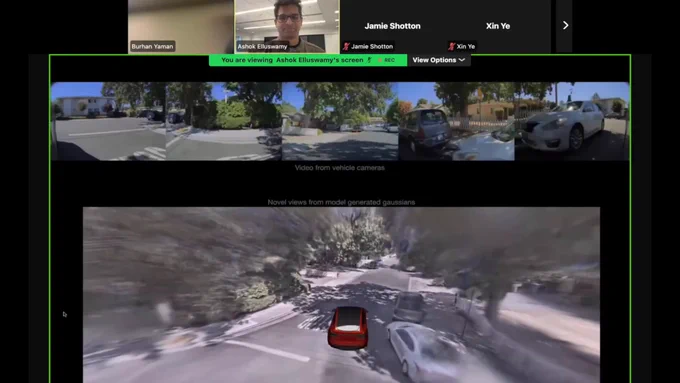
• Tesla developed a custom, ultra-fast Gaussian splatting system to reconstruct 3D scenes from limited camera views.
• Produces crisp, accurate 3D renderings even from few camera angles — far better than standard NeRF/splatting approaches.
• Enables rapid visual debugging of the driving environment in 3D.
Evaluation & World Models:
• Evaluation is the hardest challenge: models may perform well offline but fail in real-world conditions.
• Tesla builds balanced, diverse evaluation datasets focusing on edge cases — not just easy highway driving.
Introduced a learned world simulator (neural network-generated video engine):
• Can simulate 8 Tesla camera feeds simultaneously — fully synthetic.
• Used for testing, training, and reinforcement learning.
• Allows adversarial event injection (e.g., adding a pedestrian or vehicle cutting in).
• Enables replaying past failures to verify new model improvements.
• Can run in near real-time, letting testers “drive” inside a simulated world.
What’s Next:
• Scale robotaxi service globally.
• Unlock full autonomy across the entire Tesla fleet.
• Cybercab: next-gen 2-seat vehicle designed specifically for robotaxi use, targeting lowest transportation cost (cheaper than public transit).
• Same neural networks will power Optimus humanoid robot.
• The same video generation system is now being applied to Optimus.
• The system can simulate and plan movement for robots, adapting easily to new forms.
via the International Conference on Computer Vision (ICCV).
Full presentation: https://t.co/Mdswdz4oqh
Show more
0
0
134
3.6K
488