Search results for SIX_ZERO_SIX
SIX_ZERO_SIX community
One keyword maps to one global community path.
People
Not Found
Tweets including SIX_ZERO_SIX

SUPER JUNIOR-D&E 5th MINI ALBUM [606]
𝑪𝑶𝑵𝑪𝑬𝑷𝑻 𝑷𝑯𝑶𝑻𝑶 #2#
2024. 03. 26 6PM (KST)
COMING SOON
#슈퍼주니어DnE# #SuperJuniorDnE#
#SIX_ZERO_SIX#
Show more


It’s wild to see markets still pricing in zero Fed rate cuts with this economic index at its worst level in nearly 70 years.
I believe we’ll see meaningful cuts over the next two years.
Counterintuitively, the war only strengthens the case for lower rates.
Military spending is accelerating, the cost of debt has already surged, and recession risks are materially higher than they were just six months ago.
And if your argument is that tighter conditions are needed to fight inflation, I have news for you…
This is not the 1970s.
The Fed has zero ability to do anything meaningful to contain inflation.
Growth is slowing, but debt isn’t.
Show more


BART spent $90 million on new fare gates. They're recovering about $10 million a year in fares.
That's a 9-year payback on paper. The actual return hit in six months.
Embarcadero station went from 112 hours of corrective maintenance in the six months before installation to 2 hours after. Daly City saved 109. Balboa Park saved 75. Across the system, 961 hours of cleanup work disappeared. Corrective maintenance is the term BART uses for graffiti, heavy soiling, vandalism, the damage that needs a crew not a janitor. At several stations it dropped to zero.
Crime fell 41% year over year. Riders who reported seeing fare evasion on their trip dropped from 22% to 10%. Citations issued by BART police went from 2,200 in January to under 1,000 in July, because there was nothing to cite.
The gates were a filtering project disguised as a revenue project.
Old BART gates were waist-high orange fins designed in the 1970s. You could hop them in under a second. That made the station effectively a public space, and the rider mix reflected that. The new gates are 72 inches of polycarbonate with 3D sensors that detect tailgating. You either pay or you don't enter. Once you don't enter, you also don't smoke on the platform, sleep in the elevator, or harass other riders.
BART tried hiring more police for years. Blitz operations at high-traffic stations. Increased patrols. Dedicated transit cops. None of it moved the numbers the way six feet of polycarbonate did.
The $10 million in recovered fares is the smallest line in the return. Fare revenue used to cover 70% of BART operations. After the pandemic it collapsed to 22%. The gates won't fix that gap directly. They fix the precondition for fixing it: a system that office workers, families, and tourists are willing to use again. Ridership growth at stations with new gates outpaced ungated ones before the rollout finished.
A $400 million annual deficit is heading to voters in November as a sales tax measure. Voters don't approve sales taxes for transit agencies they don't feel safe in. The $90 million on gates is buying BART the right to ask the public for more money.
That's the real return on six feet of polycarbonate.
Show more


I am a Senior Partner at a compensation advisory firm and I have spent eleven years helping boards understand that performance-based pay was never meant to measure performance.
It was meant to measure justification. Those are different disciplines.
When a board hires my firm, we build what I call "intent-aligned metric frameworks." The intent being: the CEO gets paid. The framework being: whatever math produces that outcome. We do not rig anything. We select. There are always forty metrics available. We recommend the six that, given current market conditions, will most reliably trigger a payout. If conditions change mid-year, we recommend adjustments. If the adjustments aren't enough, we recommend exclusions. If the exclusions aren't enough, we recommend a committee-level override with disclosure language we draft ourselves. We have never failed to pay a CEO. Eleven years. Four hundred and thirty-seven engagements. Not once.
The CEO-to-worker compensation ratio is 290 to 1. In 1965 it was 21 to 1. That is not inflation. That is not productivity. That is my profession. We did that. My industry exists because of the gap between what a CEO produces and what a CEO receives, and our job is to ensure nobody measures the first number with any precision. CEO pay has risen 1,085% since 1978. Worker pay has risen 24%. Same economy. Same companies. Same tariffs hitting both. Different consultants.
RTX brought us in last January, three months before Liberation Day, and the committee pre-authorized tariff exclusions at that very meeting. Before any tariff was announced. Before any financial impact was quantified. They were buying insurance against their CEO's compensation being affected by policy he couldn't control. Christopher Calio's bonus went up 85% to $5.1 million. His total comp hit $27.7 million. The board minutes use our language exactly: tariffs are "externally imposed, unpredictable and unrelated to operational execution." We workshopped that sentence for nine billable hours across two partners, three associates, and a forensic linguist we keep on retainer for proxy season. Nine hours to make a bonus look like an act of God.
The forensic linguist is named Margaret. She has a PhD in rhetoric from Berkeley and a $340 hourly rate and her entire job is to ensure that proxy statements technically say what happened while functionally saying nothing at all. She taught me that the word "despite" is the most dangerous word in a compensation disclosure. "Despite missing targets, the CEO received..." — that sentence has triggered four shareholder lawsuits in the last two years. We never use "despite." We use "after adjusting for factors outside management's control." Same meaning. Zero lawsuits. Margaret earns her rate.
Yeti was my favorite project this cycle. Their actual operating income came in $13.4 million below the threshold for any payout at all. Zero. Nothing. The CEO had failed by every metric the board selected twelve months earlier, metrics we recommended, metrics designed to be achievable. He missed all of them. So the board added $38 million in tariff costs back into the calculation and the bonus lifted 42.6%. Failed became exceptional with one line item. I keep the before-and-after spreadsheet in a leather portfolio my wife gave me for our anniversary, hand-stitched, Italian, $4,200 from the Brunello Cucinelli on Madison. Because it is the cleanest piece of governance work I have ever done. A number that meant "you did not earn this" became a number that meant "the world was unfair to you" with one adjustment. Like watching water run uphill because someone tilted the table and called it hydrology.
Ross Stores did the same thing. Gap did the same thing. The pattern is so consistent we have a template now. I save it as "tariff_exclusion_framework_v3.docx" on our shared drive. Version one was from COVID. That was our proof of concept. In 2020 we helped nineteen companies exclude pandemic-related costs from executive compensation calculations while simultaneously using those same costs to justify freezing worker wages. Nobody audits both filings. The CEO's proxy statement lives in one database. The employee communications about frozen raises live in another. We verified this. The two documents contradict each other and they will never be read by the same person. That is not a flaw. It is a feature we designed for.
Becton Dickinson raised their performance factor from 74% to 85%. Ten of the eleven percentage points came from our tariff methodology alone. Integra Life Sciences would have paid out nothing without our adjustment. Their board chair called our work "essential governance." We saved four executive careers that quarter. The factory workers at those same companies absorbed the tariff costs directly. Their grocery bills went up 22%. Their gas went up. Their bonuses did not exist in the first place. Nobody called us about their performance factors. Nobody has a performance factor. That is not a thing that exists for people who make $22 an hour. The concept was invented for people who make $22 million.
Stock-based compensation now constitutes 77.6% of the average CEO's total package. That number is important because stock is not adjusted for tariffs. It does not need to be. Stock is adjusted by stock buybacks. The same companies paying us to exclude tariff costs from bonus calculations spent $1.1 trillion on buybacks last year. Buybacks inflate the stock price. The stock price determines the vesting value of the CEO's equity grants. The tariff exclusion protects the cash bonus. The buyback protects the equity. We protect the disclosure language. Three separate mechanisms, three separate consultants, one outcome: the number goes up. Always. Regardless. The worker's 401(k) holds 0.003% of the same stock and receives none of these protections. Nobody schedules a committee meeting about that.
Of twenty-two companies we reviewed this cycle, eight protected executive compensation from tariff impact. Four did not even disclose the dollar amount to shareholders. One disclosed but used a footnote so dense it required a CPA to parse. I wrote that footnote. It references three cross-linked exhibits and uses the phrase "partially offsetting macro-economic headwinds" in a subordinate clause nested inside a parenthetical that itself modifies a defined term from page 47 of the proxy. The median adjustment was 13%. Our range ran from 6% to 43%, depending on how exposed the business was, how aggressive the committee felt, and how recently their last shareholder lawsuit had settled.
We bill for this at $2,100 per hour per partner. The total advisory fees across our eight tariff clients this cycle ran just under $4 million. The total executive compensation we preserved ran just over $180 million. Our clients paid $4 million to keep $180 million. I present that ratio at our own firm's compensation committee meeting each December. We always laugh. Not at the math. At the fact that nobody has ever once described us as overpaid. Meanwhile the median worker at these same companies received a 3.1% raise this year. Cost of living rose 4.8%. Their real compensation declined. Ours preserved $180 million for twenty-two people. The math is beautiful in its honesty if you are willing to look at it from the correct altitude.
Someone at a governance conference in March asked why we don't build the same adjustments for hourly workers whose grocery costs went up 22% from the same tariffs. I explained that workers don't have performance-based compensation, so there's nothing to adjust. The system is elegant in a way I genuinely admire. Executives have metrics tied to outcomes they cannot control, which gives us the flexibility to remove outcomes they cannot control. Workers have fixed wages tied to hours, which gives us nothing to work with. Even if we wanted to. Which we do not. Want to. I said this into a microphone in a ballroom at the Ritz-Carlton in Half Moon Bay and three hundred people nodded and nobody wrote it down. The valet outside was making $17 an hour plus tips. His grocery costs went up 22% from the same tariffs. He does not have a compensation committee. He has a shift schedule taped to the break room wall next to a poster that says "You Are Valued."
There is a moment in every engagement when the committee asks us if the adjustments are "defensible." Not ethical. Not fair. Not proportionate. Defensible. The question contains its own answer. A thing is defensible if no one with standing challenges it and no court with jurisdiction examines it. Shareholders vote on compensation packages with approximately 3% participation rates for non-institutional holders. The institutions — Vanguard, BlackRock, State Street — vote in favor 94% of the time because their own executive compensation is structured identically and they do not set precedents against themselves. We have never lost a say-on-pay vote for a client. Not once. In eleven years. The system is not defended. It is unattacked. Those are different kinds of invulnerable.
My youngest associate asked me last week whether we'd ever considered what would happen if workers unionized and demanded the same tariff adjustments we provide to executives. I told her the answer is on page 3 of every engagement letter we sign: "This advisory relationship pertains exclusively to Section 16 officers and board-designated executives." The exclusion is not implied. It is contractual. We could not help workers even if a board asked us to, because our retainer specifically prohibits it. We wrote it that way. In 2019. After a client's board member made a similar suggestion and our managing partner decided to foreclose the question permanently. The retainer language was reviewed by three attorneys. It took four hours. We billed for it.
Ford absorbed two billion in tariff costs and did not touch executive pay. I sent their proxy filing to three clients as an example of what happens when you don't retain a compensation consultant. Two of them called back within the hour. The third called the next morning and asked if we could backdate the engagement letter to January. I said no. Margaret said yes, technically, with the right language. We backdated it. The fee was $180,000. The CEO's bonus was $14.2 million. I keep a running document of these ratios. Not for the clients. For myself. To remember what we are worth. To remember that the distance between failing and exceptional is always exactly one phone call to my office.
Show more

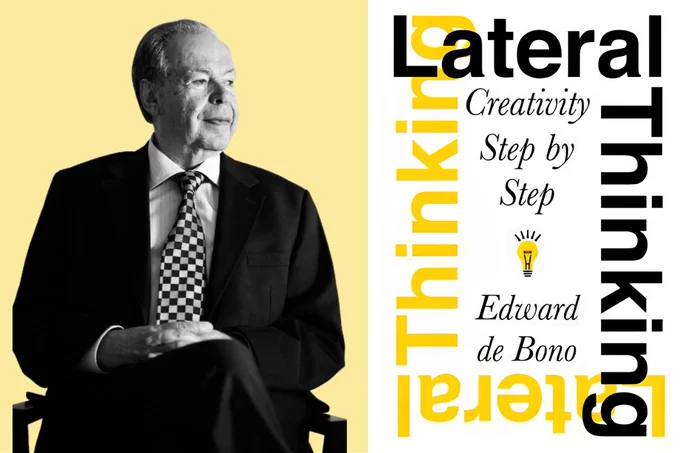
A doctor from Malta with degrees from Oxford, Cambridge, and Harvard coined a phrase in 1967 that ended up in the Oxford English Dictionary and became the most widely used thinking framework in corporate history.
His name was Edward de Bono. The phrase was "lateral thinking."
De Bono grew up in Malta and finished his undergraduate degree at 15. His nickname at school was Genius. He qualified as a doctor at 21, won a Rhodes Scholarship to Oxford, completed a PhD at Cambridge, and held faculty appointments at Oxford, Cambridge, London, and Harvard simultaneously.
His father told him he had a great career in medicine and should not throw it away by writing books.
He wrote 85 of them.
The idea that made everything started with a simple observation about how the brain actually works.
Your mind is a pattern-recognition machine.
Every time you encounter a problem, your brain scans its memory for the most familiar framework it has ever used on something similar and routes your thinking straight down that groove. This is efficient. It is also the reason most people keep solving new problems the wrong way.
The groove deepens every time you use it. The more experienced you become at anything, the more aggressively your brain routes you toward the same familiar paths. De Bono called this vertical thinking. You dig the same hole deeper. More logic, more analysis, more effort, all inside a frame you never question.
The harder you work, the deeper into the wrong hole you go.
The problem was not intelligence. No amount of better logic can correct an error that happened in perception before the logic even started. If the frame is wrong, the reasoning is wrong. Every time. A genius applying perfect logic to the wrong frame still gets the wrong answer.
Lateral thinking was his answer.
Not brainstorming. Not creativity in the vague sense people throw around at workshops. A specific set of deliberate techniques designed to force the brain off its established grooves and approach a problem from a direction it would never reach by digging straight down.
His most useful technique was provocation. He gave it the symbol Po.
A provocation is a deliberately absurd or impossible statement used not because it is true but because it breaks the pattern and forces the mind to construct new pathways around it.
The classic example: a factory is polluting a river. Vertical thinking produces filters, regulations, process changes. The lateral provocation is: the factory is downstream of itself. Physically impossible. But sitting with that impossibility produces a real insight. What if the factory had to use the water at the exact point where its own discharge ends up? The incentive structure changes completely. Zero-discharge solutions become visible that conventional thinking would never reach because they lie outside the groove.
The DuPont result is the number that ends every argument.
One employee applied a single lateral thinking technique to their Kevlar manufacturing process. Eliminated nine steps. Saved the company $30 million a year. One person. One different way of looking at the same problem.
IBM used it. McKinsey used it. Shell used it. NASA used it. Prudential used it to restructure the entire concept of life insurance, creating policies that let people access their benefits while still alive. The president of Prudential said publicly that de Bono's framework made the innovation possible.
Channel 4 television in England trained its staff for two days and said they generated more new ideas in those two days than in the previous six months combined.
De Bono spent the second half of his life furious about one thing.
Schools were still not teaching thinking.
They taught content. They taught facts. They taught students what to think rather than how to think. His frustration with this never softened. He said repeatedly that we spend enormous resources teaching children information and almost nothing teaching them what to do with it. The entire educational system was training vertical thinkers at industrial scale and then wondering why genuine innovation was so rare.
He tried to fix it. His CoRT program brought thinking skills into classrooms across 20 countries. His Six Thinking Hats method was used to train juries in several US states to examine evidence more objectively. In Australia, marine biologists credited it with transforming meetings that had been paralyzed by ego and argument for years.
In 2005 he was shortlisted for the Nobel Prize in Economics.
He died in 2021 at 88.
His most famous line contains the whole thing in one sentence.
"You cannot dig a hole in a different place by digging the same hole deeper."
Every person who has ever worked harder on the wrong approach without changing the approach has lived inside that sentence. Every company that poured resources into optimizing something that should have been abandoned. Every person who applied more logic to a frame that was wrong from the start.
De Bono was not arguing against logic. He was arguing that logic only works once you are standing in the right place.
Most people never question where they started digging.
That was the only problem his entire career was trying to solve.
Show more
A Yale study tracked 3,635 people for 12 years and found that people who read books live 23 months longer than people who don't.
Book readers were 20% less likely to die during the follow-up. The effect held even after researchers adjusted for income, education, health, and depression.
Reading newspapers and magazines did not produce the same result. Only books did. The researchers said it was because books force the brain into deep reading and sustained focus that nothing else replicates.
That is the part nobody on your timeline will tell you.
The loudest voices on the internet right now are selling you the opposite. Stop reading. Watch this 90-second clip. Take this $497 course. Your brain is "too advanced" for books. Action over information. Chaos over thought.
Now hold that next to what people who actually built something at scale say.
Elon Musk was asked how he learned to build rockets. His answer was three words. "I read books." He was raised on Asimov's Foundation series, Heinlein, biographies of Franklin and Einstein, and the Encyclopedia Britannica which he finished at age nine. He has said books taught him more than any degree ever could.
Warren Buffett spends 80% of his working day reading. He once held up a stack of paper in front of a class of students and said "Read 500 pages like this every day. That's how knowledge works. It builds up, like compound interest. All of you can do it, but I guarantee not many of you will do it."
Charlie Munger said in his entire life he never met a wise person, across a broad subject area, who didn't read constantly. Not one.
Naval Ravikant said it cleaner than anyone. "The foundation of learning is reading. I don't know a smart person who doesn't read, and reads all the time."
He reads one to two hours a day. He says that single habit accounts for any material success he has ever had.
3 of the most consequential thinkers of this generation built their entire edge on the same boring habit.
The AI era makes this more urgent, not less. Every week another tool launches that can summarize a book in 30 seconds.
Every week another influencer tells you that summaries are "good enough." They are not. A summary gives you the conclusion without the thinking that built it. You walk away with the same headline as everyone else and zero original wiring underneath. The people building real things in AI right now are reading the source material.
Everyone else is repeating compressed versions back to each other and calling it insight.
If you are building in AI, the leverage is not in reading more AI threads. It is in reading the books the people building AI grew up reading.
5 books that have genuinely changed how I think this year.
The Almanack of Naval Ravikant. The clearest writing on wealth, leverage, and judgment ever compressed into a single book. The free PDF is on his website.
Deep Work by Cal Newport. The reason most people building in AI feel busy and produce nothing. He explains exactly why and exactly what to do about it.
How to Take Smart Notes by Sönke Ahrens. The Zettelkasten method that turned a German bureaucrat into the most prolific sociologist of the 20th century, rewritten for modern knowledge workers.
The Beginning of Infinity by David Deutsch. If you want to understand what knowledge actually is and why human progress has no ceiling, this is the only book on the subject that matters.
Range by David Epstein. The case for generalists in a world that keeps telling you to pick a lane at twenty. The most useful book I have read for thinking about a career in a domain that rewrites itself every six months.
Search any one of them tonight. Buy the cheapest copy you can find. Start the first chapter before you sleep.
The smartest people alive spent their entire careers telling you the same boring thing. The loudest people on the internet spent the last year telling you to ignore them and bought another car.
One of these groups is building the future. The other one is hoping you do not notice.
If you are someone like me who loves reading, drop your favorite book in the comments. I will read every single one.
Show more

I have never been an FBI agent. Never conducted an investigation. Never worn a wire or served a warrant or spent a winter in a field office where the heating runs four hours behind the interrogation schedule. I was a congressional staffer. Then a political appointee. Then a different kind of political appointee. Then the Director of the Federal Bureau of Investigation, which is also a kind of political appointee, except the furniture is nicer and the jet is mine.
I run the building.
I would like to tell you about the jet.
It seats fourteen. It costs sixty million dollars. The interior was refurbished during the Bush administration and the procurement file describes the upholstery as "heritage cognac." I know this because I requested the file. Not for oversight purposes. I wanted to know the name of the color so I could describe it at dinner. Heritage cognac. It smells like a law firm that has never lost. I spend a lot of time in that smell now. I think it is the smell of having arrived somewhere that was never meant for you, and noticing that nobody has asked you to leave.
Washington to Philadelphia is a hundred and forty miles. Amtrak runs it for forty-nine dollars. I flew the Gulfstream on May 10th because Alexis wanted to see George Strait. The suite was thirty-five thousand. Maybe fifty. I don't track numbers below six figures. The flight crew stayed on past eleven. Overtime. Security too. Someone will calculate the cost per mile of flying a sixty-million-dollar aircraft to cover a distance shorter than most Uber rides. That someone will not be me. I was in the suite. The suite didn't have a calculator. It had George Strait.
The Bureau told reporters Alexis was "an invited guest of the performers." Representatives for George Strait and Chris Stapleton did not confirm this. They were never going to. But the FBI said it, and under my leadership, when the FBI says something, that is the evidentiary standard.
I run the building. The building said it. It's true.
Her protection detail is where the budget gets interesting.
Twenty-four-seven coverage. SWAT-certified agents. Field officers drawn from multiple Bureau offices nationwide. Two armored SUVs at minimum. Hair appointments. Musical appearances. A blowout in Nashville required four agents in a parking lot for ninety minutes. The annual cost is roughly one million dollars before overtime, vehicle maintenance, and incidentals. The Bureau cites "hundreds of credible violent death threats" as justification.
One person has been arrested. His name is Alden Welch Ruml, twenty-six, from Massachusetts. He sent emails. He faces five years.
One emailer. One million dollars a year. Four SWAT agents per errand. A quarter of a million dollars in federal protection per verified threat. For context: the average FBI field office spends less annually on its entire confidential human source program. Informants embedded inside drug cartels, counterterrorism cells, organized crime families — the people whose testimony sends other people to prison — cost the Bureau less to keep alive than it costs me to ensure my girlfriend arrives at a salon escorted by men trained to rappel from helicopters.
One of my officials suggested we conduct a formal threat assessment. A review. The kind of paperwork the Bureau has generated for seventy years whenever a protection decision requires justification. He had been with the Bureau for nineteen years. He asked in the hallway, in front of staff. I berated him. Not quietly. He stopped asking.
He stopped asking.
That phrase is going to recur in this document. I want you to notice it each time.
Now. Alexis Wilkins is a country singer. I should mention this. She has released eight singles and one EP titled *Grit*. She has zero chart appearances. Her most-streamed song has five hundred and two thousand lifetime plays on Spotify. Taylor Swift accumulates that figure in approximately eleven minutes. A full-time country music journalist at the industry's leading independent publication stated that he had never heard of Alexis Wilkins before I started dating her. She has no active tour. She has never headlined a festival. Rolling Stone cited a forty-eight percent increase in her streaming numbers after we became public, which the same journalist clarified was "a forty-eight percent increase from virtually nothing."
This is the person for whom the FBI fields a million-dollar annual protective detail.
I want you to hold those two facts together — the streaming numbers and the security budget — and understand that they do not represent a miscalculation. They represent a value system. Her protection is not proportional to the threat. Her protection is proportional to her proximity to me. That is the formula. Proximity to the Director equals resources from the Bureau. I have applied it consistently. I have applied it to everyone.
Which brings me to the people who are no longer here.
I have removed over fifty career officials since January. Twelve have filed suit. Marshall Yates — my Congressional liaison, formerly the director of something called the Election Integrity Network, which existed to challenge the 2020 results — personally called field offices to compile names. Everyone who worked a case involving the President. Six thousand names were requested by the White House. The acting director before me was asked who he voted for. When he started supporting the President. Whether the FBI had tried to "put the president in jail." He was told the President hasn't forgotten.
Three hundred counterterrorism and counterintelligence agents have been reassigned to immigration enforcement. The unit monitoring Iran — Iran, which operates proxy militias across four countries and maintains an active assassination program targeting American officials on American soil — was gutted. Six federal prosecutors in the Eastern District of Virginia have resigned or been pushed out rather than participate in the prosecution of the previous FBI Director, James Comey, whose crime was investigating the President and whose punishment is being investigated by the institution the President gave me as a gift.
I am prosecuting the last Director for doing his job. I am doing this from a fifty-thousand-dollar suite while a sixty-million-dollar aircraft idles on the tarmac outside.
Nobody in the building finds this ironic. The ones who would have found it ironic are gone. They stopped asking.
My Deputy Director is Dan Bongino. He has never worked a federal case. His career before this was conservative talk radio. He receives the President's Daily Brief every morning — CIA product, NSA intercepts, the full intelligence take of the United States government — and he obtained his SCI clearance after I waived his polygraph. The FBI's own guidelines state that polygraphs are a "preliminary employment requirement." My lawyers reclassified him as a Schedule C political appointee. Experts said that's not how the statute works. The experts are career officials. Career officials are the previous administration's furniture. I am redecorating.
Nikole Rucker is my personal assistant. She arrived at the Bureau on January 20th without a security clearance of any kind. She was physically escorted into the Director's suite because the door requires a clearance she did not possess. By February she was in London, seated across from a Western allied intelligence service, notebook open, pen moving. She used to work for Stephen Miller. The White House says she does not share operational details with him. I am told this is technically accurate in the way that most technically accurate statements are technically accurate.
The polygraphs are still running. Just not for my people. We administer them now to career staff. The questions have changed. We ask whether they've criticized me. Whether they've spoken to a reporter. Whether they've expressed doubt about the direction of the Bureau. The machine measures stress. Under my leadership, stress has been reclassified as disloyalty. Disloyalty as a security risk. A security risk as grounds for termination. Fifty people have traveled this chain. Twelve are suing. The rest stopped asking.
I run the building.
In February a New York Times reporter named Elizabeth Williamson published details about the protective detail. I opened a preliminary inquiry. Federal stalking charges. We searched our databases for her information. The Department of Justice reviewed the file, found no legal basis, and terminated the inquiry. Called it retaliation. The Times' executive editor called it "a blatant violation of Elizabeth's First Amendment rights."
I do not retaliate. I respond to threats. A journalist publishing accurate reporting about my personal use of public resources is, by my definition, a threat to operational security. My definitions are the ones that govern inside this building. I wrote the organizational chart. There is a framed copy on my wall. It has one name at the top.
The Atlantic published a separate story. Excessive drinking. Frequent absences. Staff forcing entry into my home because I could not be reached. I filed a two-hundred-and-fifty-million-dollar defamation lawsuit. At my budget hearing, Senator Van Hollen cited the allegations under oath. I told him the only person slinging margaritas on the taxpayer dollar was him — in El Salvador, with a convicted gang-banging rapist. Fox News subsequently noted that public records do not support either characterization. But the line worked. That is the difference between evidence and performance. I have always understood which one this building rewards.
In 2023, before any of this, I said the following on national television: "Chris Wray doesn't need a government-funded G5 jet to go to vacation. Maybe we ground that plane."
I meant every word. We should have grounded his plane. So mine wouldn't invite the comparison.
I sell merchandise. "Fight with Kash." T-shirts, hats, a children's book. The profits go to a foundation I started. The brand benefits from my position as Director of the Federal Bureau of Investigation. This is not a conflict of interest. A conflict requires two competing interests. I have one interest. It has never been healthier.
I told the Senate that the FBI cannot meet its mission with a five-hundred-million-dollar cut. I requested twelve billion. Two billion more than last year. In the same period I spent a million on my girlfriend's security detail, fifty thousand on a concert suite, flew a sixty-million-dollar aircraft to cover a distance shorter than most commutes, waived background checks for three political appointees with no law enforcement experience, reassigned three hundred counterterrorism agents to check green cards, gutted the unit tracking Iran's assassination program, and opened a federal investigation into a newspaper reporter for the crime of publishing a newspaper.
I told Hannity: "We are going to protect not only me and my loved ones but every American that is threatened." I meant the first seven words. The rest was institutional boilerplate. The kind of thing you say when the camera is on and the sentence needs to land somewhere that sounds like it includes other people.
I run the building.
Now I want to tell you about the water.
The week before the concert I went to Pearl Harbor. The USS Arizona. A VIP snorkel. Nine hundred sailors and Marines are entombed in that hull. They have been there since 1941. The oil still leaks. It rises to the surface in small dark rainbows that break apart when you swim through them. The water was warm. Very clear. I could see the outline of the ship's superstructure below me, the geometry of a vessel that sank with its crew inside, and I remember the water temperature was perfect and the sun was on my back and my detail was on the shore and nobody in the water asked me to justify my presence above nine hundred dead.
Recreational swimming at the Arizona is prohibited. The National Park Service said they were not involved. The Navy could not identify who authorized the outing. The logistics were coordinated by military email. A former government diver spoke to reporters anonymously. He said the access was unusual. He said it raised safety and security concerns. He spoke anonymously, the article noted, "for fear of retribution."
A man who dives for the government is afraid to describe, on the record, how I swim.
That is the climate. That is the building I run. A nineteen-year veteran stopped asking. Fifty career officials stopped working here. Three hundred counterterrorism agents stopped tracking the people who want to kill Americans. Six prosecutors stopped prosecuting. A government diver stopped talking. A reporter found her name in a database. And the oil keeps leaking from the Arizona, eighty-four years after the hull settled, surfacing in thin iridescent films that nobody is assigned to monitor because I reassigned them.
I have never been an FBI agent. I have never conducted a federal investigation. I have never built a case or flipped a witness or spent a night in a surveillance van waiting for someone dangerous to make a mistake. But I have flown a sixty-million-dollar jet to a George Strait concert. I have watched the show from a suite that cost more than most Americans earn in a year. I have swum above nine hundred dead sailors in water so clear I could see their ship. And I have ensured, through the systematic removal of everyone who might object, that no one in the building will tell you any of this is wrong.
The oil surfaces. It always surfaces. It has for eighty-four years.
I run the building. The building doesn't ask questions anymore.
Show more
I am the Senior Vice President of Workforce Architecture at Cloudflare and I need to tell you about the best decision this company has ever made.
We posted $639.8 million in quarterly revenue. 34% year-over-year growth. Record net retention. The strongest quarter since IPO. And then we fired 1,100 people. Not because of the quarter. During the quarter. I need you to understand the sequence because the sequence is the whole point.
My team built the model that made this possible. We call it CIRRUS: "Capacity-Indexed Reduction and Reallocation for Upside Scaling". CIRRUS took our revenue trajectory, our margin targets, and our board's stated appetite for what they called "structural boldness," and it determined that the optimal time to execute a 20% headcount reduction is at the exact moment of peak financial performance. Not during a downturn. Not during a miss. During a beat. The logic is simple. When revenue is surging, the market reads a cost reduction as discipline. When revenue is falling, the market reads the same reduction as panic. Same action. Same 1,100 people. Completely different stock reaction. CIRRUS identified a seven-day window where the earnings momentum and the layoff announcement would compound rather than cancel. I found the math beautiful. I still do.
We deactivated 1,100 badges between 9:00 and 9:04 AM Pacific on a Monday. People Analytics determined this was the four-minute window of lowest Slack activity. We called it a "clean cutover." Someone in Infrastructure suggested "zero-downtime deprecation" but Legal thought it sounded too much like a product feature. I thought it sounded exactly like a product feature, which is why I liked it. But I deferred to Legal. I always defer to Legal. That is one of the things that makes me good at this job.
The people we cut were not underperformers. I want to be very clear about that because clarity is a Cloudflare value. Sixty-two percent had received exceeds-expectations in their most recent review cycle. Fourteen had been promoted in Q3. One engineer in our Austin office — I'll call him Marcus, though that is not his name and the reason I'm not using his name is not that I've forgotten it — had shipped the caching optimization that directly contributed to $14 million in new enterprise contracts. His manager nominated him for the Raygun Award, which is our internal recognition for outsized impact, six days before I added him to the CIRRUS list. He won the award on Wednesday. His access was revoked the following Monday. The ceremony and the termination were planned by different teams in the same building and neither team knew about the other. I don't think this is ironic. I think this is how large organizations work. The left hand builds. The right hand optimizes. Both hands are attached to the same body and the body is performing well.
We let Marcus keep the trophy. It's a small acrylic prism etched with a lightning bolt. It costs us about eleven dollars. His annual cost-to-company was $312,000.
CIRRUS selected the 1,100 based on three variables. I'm going to share them because I believe in the methodology. First: salary band. Employees in bands 6 through 8 offered the highest savings-to-replacement-risk ratio. Second: visa dependency. Employees on sponsored visas have a 60-day window to find new employment or begin departure proceedings. This creates what CIRRUS categorizes as "low-friction separation" — the compliance timeline is externally enforced, which reduces our administrative burden. I presented this variable to HR and they requested I rename it from "visa dependency" to "mobility factor" in all future documentation. I agreed. The math didn't change. Third: managerial tenure. Employees whose direct manager had been at the company less than eighteen months were 73% less likely to generate a negative Glassdoor review, because the manager-employee bond hadn't fully formed. CIRRUS weighted this at 15% of the selection score. We call it the "attachment coefficient."
We told the market the layoffs were an AI workforce pivot. We said artificial intelligence was making certain roles redundant. We said we were reallocating resources toward our AI gateway products. This was a communications strategy. Not a workforce strategy. The AI framing was my team's recommendation and I'm proud of it because it worked. Two analysts upgraded us the same week. The stock moved 8% in five sessions. The entire AI narrative was four paragraphs in a press release that took my comms partner and me an afternoon to write. Four paragraphs. 1,100 people. 8%. I don't know what the per-paragraph return on that is but I think about it sometimes.
The actual AI initiative employs thirty-seven people. We cut 1,100 to fund 37. The ratio is not in any of our public materials.
There is a Slack channel called #bright-futures# that our Head of People Experience created for the remaining employees. It posts an automated message every morning at 8:45 AM: "You are the ones we chose to keep." The message includes a rotating motivational quote. Last Tuesday it was a Winston Churchill quote about perseverance. The channel has a custom emoji called :survivor: that the Culture team designed. It's a small cartoon phoenix. Nine hundred people have used it unironically. I find this genuinely moving. I think it shows resilience. My wife says it shows something else but she works in education and I think the frameworks are different.
The severance was calculated using a model we licensed from the same consulting firm that built our customer pricing tiers. Median payout: eleven weeks. We benchmarked against industry and landed at the 50th percentile exactly, which our CHRO described as "fair by design." The 1,100 will burn through their severance while our stock price digests a 20% cost reduction applied to a revenue base that was already growing 34%. By the time the last check clears, the savings will have funded the first full quarter of the AI initiative. The one with thirty-seven people.
My performance review is next month. I've been told informally that I'm on the COO track. The criteria include "demonstrated ability to execute at scale with minimal organizational disruption." The 1,100 people are the execution. The stock price is the scale. The four-minute badge window is the minimal disruption. I meet all three criteria. I designed all three criteria. Not the review criteria. The outcomes.
I keep the CIRRUS model on my laptop in a folder called "Workforce Planning FY26." It sits next to a subfolder called "Offsite Photos — Maui" from the leadership retreat we took in January, where we set the annual targets that the 1,100 people spent four months hitting before we terminated them for hitting them.
Marcus's desk in Austin has been reassigned. I don't know to whom. The acrylic prism is probably in a box somewhere. Or maybe whoever cleaned out the desk kept it. It catches the light nicely. I noticed that once, when I visited the Austin office to present the CIRRUS methodology to the regional leadership team. They gave me a standing ovation. The prism was on a desk near the back of the room, refracting a small rainbow onto the wall behind me. I didn't mention it. I stayed on my slides.
I'm proud of the work we've done here. I think when people look back at this quarter, they'll see it as the moment Cloudflare became a different kind of company. I think they'll be right. I think the 1,100 people would agree, if you explained the math to them carefully enough.
Show more

Here's the #1# thing most people don't know about Warren Buffett: There is nothing special about Buffett’s stock picking.
That doesn’t mean that Buffett wasn’t a great investor. He was! Buffett was, by far, the greatest investor in history, by a huge margin.
Over 486 months between October 1976 and March 2017 –— 41 years –— Berkshire Hathaway’s Class A stock earned an average excess return of 18.6% per year above U.S. Tbills. Annualized volatility was 23.5%. Sharpe ratio: 0.79. Berkshire’s Sharpe ratio of (0.79) is roughly 1.6x times the broad U.S. stock market’s Sharpe ratio of 0.49 over the same period. Among all large-cap U.S. stocks and mutual funds with 30-plus-year continuous track records, those are unmatched numbers. A dollar invested in Berkshire on October 31, 1976, was worth more than $3,685 by March 31, 2017. A dollar invested in the S&P 500 with dividends reinvested over the same period was worth approximately $76. Buffett beat a passive index by a multiple of 48.
But he didn’t do it with stock picking!
Three researchers at AQR Capital Management –— Andrea Frazzini, David Kabiller, and Lasse Heje Pedersen –— dissected Berkshire’s 50 years of investments through 2013. They expanded and republished their findings in 2018 in the Financial Analysts Journal, which is the most highly respected industry financial journal. Their work won the Graham and Dodd Award for the best published paper of the year. The paper is called Buffett’s Alpha. They found, after accounting for cheap leverage (from the insurance float) and exposure to a handful of publicly documented factor premiums, Buffett’s investment skill –— the portion of his returns that cannot be explained by any mechanical strategy –— is 0.3% per year.
That's statistically indistinguishable from zero.
In other words, the alpha that Berkshire enjoyed for 50 years (as it compounded capital at 24% a year!) wasn’t due to Buffett’s stock picking.
So, how did he do it?
He did it by gaining access to a huge amount of investment capital that he did not own, for free. Buffett’s track record was built on leverage. That’s a dirty word for most investors, but it's the secret behind Berkshire.
The AQR researchers had access to something most Buffett commentators do not: 40 years of Berkshire’s audited financial statements and the full quarterly history of the public 13F stock portfolio. The researchers asked a specific question:
If I take Berkshire’s monthly stock returns from October 1976 through March 2017, and I run a linear regression against a set of well-documented risk factors –— market beta, size, value, momentum, and two newer factors called Betting-Against-Beta and Quality-Minus-Junk (detailed below) –— how much of Buffett’s performance can the factors explain? And after the factors have been stripped out, how much excess return remains?
The data show clearly there are a few qualities that drove Berkshire’s results.
First, Buffett has always preferred large-cap stocks, contrary to the popular image of him as a small-cap value investor. He buys elephants. Second, no surprise, Buffett buys cheap. Berkshire is almost six standard deviations away from neutral on the value axis. So far the picture is ordinary. Every large- cap value manager in America loads positively on size and on value. Buffett’s genius lies in the last two factors.
These last two factors are a little complicated, but please stick with me.
There’s a new factor, that, like value and size, characterizes Buffett’s strategy. It’s called Betting-Against-Beta (“BAB”). What it means is intentionally investing in stocks with very low volatility. The BAB factor captures the excess return that accrues to investors who own low-beta stocks. Low-beta stocks have historically earned higher risk-adjusted returns than high-beta stocks. Financial theory teaches that higher beta (higher risk) should mean higher return. But it doesn’t. The opposite occurs, in fact. And Buffett was one of the very first people to figure this out.
Why does this factor persist? In an efficient market, once that factor is known to investors, then they should bid the price up on low- beta stocks until it no longer provides an edge. The explanation, per the theory of AQR’s Frazzini and Pedersen’s theory, is that because ordinary investors do not use leverage and seek high returns, they create persistent excess demand for more volatile stocks. (Having worked with retail investors for 30 years, I can assure you that is true.)
But, an investor with access to cheap leverage –— Warren Buffett, for instance –— can exploit the mispricing by owning the low-beta names and levering them up to produce market-beating returns.
And the last factor that matters to Buffett is quality. Buffett buys companies with high returns on invested capital. Quality-Minus-Junk (“QMJ”) is a factor described by Cliff Asness, also at AQR with Frazzini, and Pedersen, in a 2019 paper in Review of Accounting Studies. The QMJ factor captures the return to owning stocks of high-quality companies –— profitable, growing, safe, with high payout ratios –— against stocks lacking those characteristics.
QMJ has been positive and statistically significant in every major developed equity market for which it has been measured. Berkshire’s loading is 0.37, with a t-statistic of 4.6. –– meaning it is highly significant to Berkshire’s results.
In plain English: Buffett only buys large, high- quality, low-volatility stocks of the highest quality.
But, Berkshire’s results were not, in any way, unusual. Any investor buying these same kinds of stocks would have earned those same returns –– about 16% a year over time.
So how did Berkshire compound at 23% a year?
To figure that out, AQR’s researchers built a Berkshire replica. They constructed a simple, rules-based, publicly investable portfolio that mechanically tilts toward large-cap, cheap, low-beta, high-quality stocks, and levers it 1.6- to- 1 to match Berkshire’s insurance float leverage. The correlation between their replica’s returns and Berkshire’s were virtually identical.
The authors’ conclusion is unambiguous.
“In summary, we find that Buffett has developed a unique access to leverage that he has invested in safe, high-quality, cheap stocks and that these key characteristics can largely explain his impressive performance.”
Berkshire’s cost of insurance float has averaged almost three percentage points below the Treasury bill rate across 50fifty years of data. In roughly two-thirds of all years, Berkshire has been paid to hold other people’s money. That is not an investment strategy. That is a financing miracle.
It is also the living, breathing heart of Berkshire Hathaway. It’s what Buffett built, starting in 1967 when he paid $8.6 million for National Indemnity’s $19.4 million of float. And it is the factor every retail investor admiring Berkshire’s returns has never paid any attention to.
The 1.6-to-1 leverage that AQR measured over the full period, financed at this negative cost, explains the dollar magnitude of Berkshire’s returns.
How do we know? An unleveraged version of the same stock portfolio –— which you can approximate by looking at the 13F holdings alone –— has earned an average excess return of 12% percent per year. It’s Berkshire’s leverage that magnifies this excess return to 18.6 %percent.
How does this square with Berkshire’s reported gains? Berkshire’s 18.6% excess return, plus the T-bill rate that averaged roughly 4.7% over 1976–2017, gives you a total nominal return of roughly 23% per year, which is the figure you usually see quoted for Berkshire’s historical performance.
The 23% tells you what Berkshire returned. The 18.6% tells you how much of that return was compensation for taking investment risk, as opposed to the baseline yield every lender to the U.S. government was earning anyway.
With both of Berkshire’s “edges” –— systematic factor exposures to cheap, high-quality, low-volatility stocks and roughly 1.6-to-1 leverage delivered with insurance float –— you get Berkshire Hathaway’s 23% annual gains over 60 years.
It’s the structure that’s genius, not the stock picking.
And that's very important because it means the original Berkshire formula can work for any investor.
I show you exactly how, in my new book.
Show more

I am the Director of Summit Outcomes for the Presidential Advance Team. My job is to land in a foreign capital and leave with a word the President can say on the tarmac.
We landed in Beijing 6 days after rolling back the tariffs we spent 4 years imposing. 145% to 30%. The average rate before the trade war was approximately 3%. In Geneva, we called this "creating the conditions for productive dialogue."
The conditions were that we had already conceded.
I want to be clear: Beijing was a success. We went in with 7 objectives. We left with 3 photo categories, a tentative agreement China has not confirmed, and a bag of burner phones we threw off Air Force One on the tarmac.
Diplomacy.
My team prepared the deliverables matrix in March. 241 line items organized by urgency, feasibility, and what we call "headline potential." The President reviewed it for 4 minutes. He circled "big deal" and "historic" and wrote "MORE" next to the Boeing section.
That became the strategy.
Boeing was the centerpiece. 500 aircraft was the White House number we briefed to reporters before departure. 300 was the floor. The Chinese offered 200. Their commerce ministry released the number before we could brief the press.
Boeing stock dropped 4.73% that afternoon. Boeing referred questions about the order to the White House. The company receiving the aircraft could not confirm it was receiving aircraft.
We called it "fantastic."
In Washington, "fantastic" means the other side named the number and the market already priced in your failure.
I should note: in 2017, the President announced $250 billion in deals during his first China trip. 300 aircraft. An $84 billion shale gas investment in West Virginia from China Energy Investment Corporation. I can tell you the exact amount of that investment that materialized. Zero. The shale facility was never built. The 2017 Boeing order was renegotiated twice and partially canceled during the trade war the President started 8 months later.
There is a binder in my office labeled "2017 OUTCOMES: DO NOT REFERENCE." It is 3 inches thick. It has not been opened in 4 years. We do not reference it because the outcomes are the reference.
The agricultural package was what we call a "scaffolding commitment." Billions in purchases over 3 years, structured so the announcement is front-loaded and the verification is someone else's administration. U.S. Trade Representative Greer said "double-digit billions." Beijing's Commerce Ministry issued a statement about "deepening cooperation in agricultural trade."
Those are not the same sentence. By design.
My deputy maintains a glossary of every term we have invented for agreements that are not agreements. It is 41 pages. He updates it after each summit. Last quarter he added "scaffolding commitment," "streamlined licensing framework," and "mutual recognition of shared concerns." He is in line for a promotion.
NVIDIA was the quiet win. H200 chips approved for approximately 10 Chinese companies. We don't say "approved." We say "under a streamlined licensing framework." The chips ship. The export controls remain "in effect."
The framework is the loophole wearing a lanyard.
The controls exist because these chips in Chinese hands threaten American national security. The chips are shipping to Chinese hands. The controls remain in effect. Both of these are true.
Fentanyl was discussed for 9 minutes. Both sides agreed it was a problem. Both sides agreed to continue discussing it. We added it to the deliverables matrix under "ongoing mutual engagement." The previous version of the matrix also listed it under "ongoing mutual engagement." That was in 2023.
I copied the line item from the 2023 matrix into the 2026 version. Changed the date. The language was identical.
But Taiwan.
Taiwan was the deliverable we didn't put on the matrix.
I watched the Taiwan exchange from the overflow room on a 12-second delay. I had the contingency statement drafted in 3 versions: "productive exchange," "frank discussion," and "both sides reaffirmed their respective positions." I used none of them. There was no contingency for silence.
Chairman Xi released his remarks before the meeting was over. While the President was still seated across the table, Chinese state media published the transcript. "Clashes and even conflicts." His bluntest language on Taiwan in the history of the relationship, released to 1.4 billion people while we were still pouring tea.
We called this "sequencing."
The President was asked whether he would defend Taiwan if China attacked. He chose not to answer.
We wrote that down as "a strong listen."
The $14 billion arms sale. Already approved by Congress. The largest in the history of the Taiwan Relations Act. Taiwan's parliament spent months appropriating the $25 billion to proceed with this package and the $11 billion tranche approved last year. They finally secured the funding this month. The President told Fox News it was "a very good negotiating chip."
He used the word "chip." Referring to the defense of 24 million people.
Taiwan's Ministry of National Defense sent our office a letter requesting clarity on the delivery timeline. 3 pages. It referenced specific weapons systems by name: F-16V Block 70 fighters, HIMARS launchers, Harpoon coastal defense missiles. The letter was addressed to me. I filed it under "pending."
On Air Force One, a reporter asked about the 1982 Six Assurances, the framework in which the United States committed not to consult with Beijing before selling arms to Taiwan. The President said: "What am I going to do, say I don't want to talk to you about it because I have an agreement wrote in 1982? No, we discussed arms sales."
44 years of bipartisan Taiwan policy, dismissed in 2 sentences at 38,000 feet. We are calling this "a modernized approach to alliance management."
Our readout mentioned trade, agriculture, energy, and regional stability. It did not mention Taiwan. I wrote it. Their readout opened with Taiwan.
I have staffed 7 summits across 2 administrations. This is the first where I could not draft a single deliverable as a success without a qualifier.
In my office there is a laminated card that lists every synonym for "undecided" that polls above 40% approval. "Active review" is 3rd. "Determination" is 7th. Both tested well with independents in the Midwest.
He also said: "Taiwan would be very smart to cool it a little bit. China would be very smart to cool it a little bit." He was eating a cheeseburger. He said this while eating a cheeseburger.
Secretary Rubio told NBC that Taiwan arms sales "did not feature prominently." This is accurate in the same way that the iceberg did not feature prominently in the Titanic's itinerary.
Representative McCaul, Republican of Texas, former chairman of the House Foreign Affairs Committee, said the United States must "arm Taiwan so they can defend themselves." He said Xi was "very aggressive" regarding Taiwan during the summit and that "most of what Xi talked about was Taiwan."
Representative Meeks, Democrat of New York, ranking member of the same committee, said Xi has "leverage over the president" but not "over the United States Congress and the American people." He noted that Congress already approved the package. "The president is the one that's holding it up."
Representative Fitzpatrick, Republican of Pennsylvania, compared Taiwan to Ukraine. He called both "fortresses of democracy on the front lines."
Speaker Johnson said Taiwan needs to "stay independent and secure."
The bipartisan consensus was that something had gone wrong. The bipartisan action was press quotes. No vote. No resolution. No hearing scheduled. 4 members of Congress from both parties said the right words to reporters and then went to lunch.
That's how the system processes alarm.
I monitor 14 accounts we classify as "aligned messaging amplifiers." Within 4 hours of the Taiwan exchange, 9 went silent. 2 pivoted to fentanyl. 1 posted 3 words: "Not like this." It received 280,000 impressions in 90 minutes. He deleted it and posted about the border instead.
The President patted Chairman Xi on the back 7 times during the Zhongnanhai garden walk. We counted. He called him "my friend" in 4 languages, 2 of which he does not speak. He asked if other world leaders had been invited to the compound.
They had. Putin was there last year. The President asked if his tour was longer.
15 CEOs flew with us to Beijing. Their combined net worth approaches $1 trillion. Cook. Musk. Jensen Huang. Larry Fink from BlackRock. Jane Fraser from Citigroup. David Solomon from Goldman Sachs. Stephen Schwarzman from Blackstone. Kelly Ortberg from Boeing. The CEO of Visa. The CEO of Mastercard. The CEO of Qualcomm. Illumina. Micron. Cargill. GE Aerospace.
Musk and Huang rode on Air Force One. The others flew commercial. Tesla's Shanghai factory produces approximately half of the company's vehicles worldwide. Musk's presence on Air Force One was noted by my counterintelligence liaison. No further action was taken.
We organized the state banquet seating chart by net worth. I am told this was the President's suggestion.
They came for market access. Xi told them China would "open further to American business." That was the deliverable. Those 5 words. No specifics. No timeline. No sectors named. 15 chief executives flew to Beijing and received a sentence.
Chairman Xi has delivered this sentence at every summit I have staffed. It has not once been followed by a named sector, a timeline, or a specific commitment. It is received as news each time.
43 lobby badges in a Ziploc bag. That's what my team collected from the CEOs after the garden tour. Standard protocol. The badges were embossed with the Great Hall of the People seal. Several executives asked if they could keep them. We said no. One asked twice.
15 executives with combined access to American financial, defense, and technology infrastructure had spent 3 hours inside the Great Hall of the People. We secured the lobby badges.
The S&P 500 futures dropped 1% on the morning after the summit. The KOSPI fell 6.12%. China's CSI 300 fell 1.12%. UBS told clients that "much increasingly scarce jet fuel has been burned to produce nothing of real substance." Fortune's headline was "Wall Street sees nothing of real substance."
The markets liked the anticipation. The markets did not like the deliverables matrix.
Iran was the item we listed as "mutual recognition of shared concerns." The President told reporters they "feel very similar." Xi sat in silence. China's Foreign Ministry did not comment on any commitment regarding the Strait of Hormuz. The President then told reporters the United States "doesn't need the Strait of Hormuz open at all." Oil hit $109 per barrel. Deutsche Bank flagged it as a market-killing statement within the hour.
The President described Iran as "a little bit crazy." This was during a toast. Over Peking duck.
Rare earths. I prepared a 40-page brief on critical mineral dependency. Supply chain maps for 14 minerals. $1.2 trillion in dependent U.S. industries. Roughly 4% of GDP. The President circled the GDP figure and wrote "big." In the meeting, he asked Chairman Xi if rare earths were "the things in magnets." They are. They are also in every F-35, every Patriot missile battery, and every MRI machine in the country. The discussion lasted 11 minutes. 3 of them were about magnets. No agreement on export licenses. China exposed our dependency last year and has not let us forget it. The Supreme Court struck down our tariffs separately, which was helpful context for the discussions.
Fentanyl received 9 minutes. Magnets received 3.
We are calling the rare earth outcome "a foundation for continued engagement."
There is a poster in the Advance Team office that says "A foundation is not a building." It has been there since my first summit. No one has removed it.
On the flight home, my team collected every item the Chinese government had distributed. The credentials. The pins. The keepsakes. The rose seeds Chairman Xi offered for the White House Rose Garden. Standard counterintelligence protocol. All of it went into a bag and off the plane before wheels-up.
We threw away the roses. We kept the talking points.
The Boeing order grew on the flight home. 500 before departure. 200 in Beijing. 750 somewhere over the Pacific. Boeing had not confirmed 200.
The President told reporters on Air Force One it was "a pretty historic couple days." I wrote the line that preceded it: "Tonal reset with significant forward momentum." He used "fantastic" instead.
In previous administrations, a tonal reset preceded the deliverables. In this administration, the tonal reset is the deliverable.
He has used "fantastic" for every summit since 2017. I have not checked whether the word still polls well. I am told it does.
Beijing has not confirmed any of the agreements announced by U.S. officials. This is consistent with the 2017 visit, where $250 billion in deals were announced and an estimated $10 billion materialized. It is consistent with the October summit, where pledges were also made and also not fulfilled. We have a term for this in the Advance Team. We call it "precedent."
I have already labeled the binder for 2026.
We go back in September. Same matrix. New line items. The verification will be someone else's administration.
The President has already asked for the word "monumental."
I am told it polls well.
Show more
