Search results for dualarm
dualarm community
One keyword maps to one global community path.
People
Not Found
Tweets including dualarm

🔥 #reBot# Arm T701 HT is now on pre-sale!
One arm learns to operate.
Two arms start to work.
An #OpenSource# #dualarm# platform built for Physical AI research and real collaborative manipulation.
⚙️ 14 DOF (7 per arm) + dual grippers
· 758 mm single-arm reach · 1,596 mm dual-arm span
· 10 kg peak payload
· ±0.5 mm repeatability
🧩 Designed for tasks single arms struggle with:
Unscrewing bottle caps, two-handed assembly, precise connector insertion.
🔓 Open by design:
🔹 Open SDK🔹 Open Model 🔹 Open Data
From data collection → trajectory replay → force control → policy deployment.
All on one platform.
Currently in Beta. More open resources coming.
🛒 Pre-sale:
⭐ GitHub:
Built for dual-arm collaboration, #LeRobot#, imitation learning, and #PhysicalAI#.
#OpenSourceRobotics#
Show more

🔓 Hardware Fully Open-Sourced: #reBot# Arm T701
We’ve released the complete hardware BOM for the reBot T701 dual-arm #robotic# manipulator.🙌
From CNC metal parts, sheet metal, SLA resin to FDM prints, everything comes with detailed manufacturing process parameters.
🔩 Direct purchase links are included down to every fastener, sensor, and joint motor.
🤖 What is reBot T701?
A fully #OpenSource# #dualarm# platform, with hardware and software free for commercial use.
• Rated payload: 7 kg per arm (10 kg peak)
• Advanced thermal management for joint actuators
• Full machining parameters + procurement links
• Rich SDK: ROS, Python API, Pinocchio, VR teleoperation & more
🚀 What's Next?
The full software SDK and step-by-step tutorials are coming soon.
Customization services and global shipping are also available.
🔗 GitHub:
🛒 Product Page:
👀 Watch the walkthough below to explore the GitHub repo!s
#OpenSourceRobotics# #PhysicalAI#
Show more

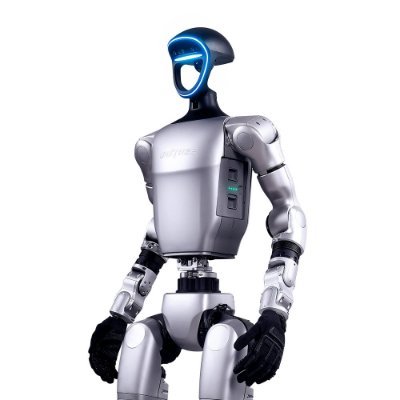
Unitree Launch | Dual‑Arm Humanoid Robot, from $4290🤩
Powered by high‑performance motors and sensors, with integrated binocular vision and voice interaction. Lightweight, compact, and ready for smarter task development.
Show more


Japan’s ugo just unveiled Nova, a wheeled dual-arm robot with mass production planned for 2027.
Nova has a 22-DOF humanoid upper body on mecanum wheels, with a 4 kg payload per arm and up to 10 kg using both. Runtime is about six hours.
Operators can record demonstrations using force-feedback or VR controllers for AI training. Trained models can run onboard on NVIDIA Jetson Thor.
ugo is also offering help with what comes after buying the robot: collecting task data and adapting models for a factory’s handling, picking and assembly work.
Show more


Crazy how far robot foundation models have come in terms of true fine motor skills:
Without task-specific training,
no sim-to-real transfer, and...
fully autonomous ❗
The dual-arm robot places an O-ring onto a hydraulic rod and removes it again in a fully autonomous and repeatable manner, with frequent contact, precision, and without task-specific training.
The model uses short physical prompts (a demonstration lasting just a few seconds) for one-shot learning and adapts to new manipulations in just a few gradient steps.
No sim-to-real transfer is necessary; instead, pretraining is performed on real interaction data. It is precisely these types of tasks (O-rings, seals, small components) that are classic bottlenecks in assembly.
If this can be reliably scaled up, the cost-effectiveness of robots in manufacturing will change significantly.
Source: @GeneralistAI /
Congrats to @peteflorence, @andyzengineer and the team on the GEN-1.5 demo!
Show more


Lumos Station Lite Officially Launches: From Model Training to Real-Robot Validation, Accelerating the Development of the Industrial Embodied AI Developer Ecosystem.
Meet Lumos Station Lite, a real-robot development and validation platform powered by NexCore.
From skill development and model deployment to dual-arm execution and task evaluation, Station Lite helps developers turn embodied AI capabilities into real-world performance.
Data → Skills → Deployment → Validation → Evolution
Build skills. Validate in the physical world. Keep evolving.
Show more

Lumos Robotics is heading to Pittsburgh for IROS 2026.
We’re bringing:
Lumos NIX — AI mini bipedal humanoid
Lumos NexCore — Skill Evolution Engine
Lumos Station Lite — Dual-Arm Visual Manipulation and Embodied AI Development Platform
Lumos Ego Vue — Egocentric data collection device
📍 Sep. 28–30 | Booth #536#
Meet us at IROS 2026 in Pittsburgh.
#IROS2026# #EmbodiedAI# #Robotics# #IntelligenceForTheRealWorld#
Show more

RMB 9,800 (about $1,460) to get started.
BLUE WORM just unveiled Mantis Standard. Detach an arm for your desk, build a dual-arm workstation, or add the mobile base and lift for a wheeled humanoid.
The arms, base, lift and head use mechanical and electrical quick-connects. Change the configuration, keep the same robot brain: BW-Brain.
The full 1.4 m build has 22 degrees of freedom, a rated 7 kg payload per arm and 550 mm of vertical lift.
It supports ROS 2, Isaac Sim and LeRobot, with compatibility for π0.5, ACT and SmolVLA.
You can simulate a task, collect VR demonstrations, fine-tune a policy and deploy it on the hardware. For a small lab, reusing those components and development tools could mean fewer separate rigs to buy and less integration work.
Show more


NEW ROBOT JOB: Fully autonomous lab chemist!
It involves @HaoZhao_AIRSUN, @ZiweiWangNTU, and others.
Called RoboChemist, it is a dual-loop robot system for wet-lab chemistry from Tsinghua's Institute for AI Industry Research (AIR), BAAI and Nanyang Technological University.
A vision-language model (Qwen2.5-VL-72B-Instruct) plays three roles:
1. it plans a task into primitive actions
2. generates per-step visual prompts (bounding boxes or keypoints drawn on the current-scene image) plus written safety guidelines
3. monitors each step for success and norm-compliance.
A fine-tuned π0 vision-language-action model executes, conditioned on the prompted image, the observed state and a text instruction.
It runs on a Cobot Magic ALOHA dual-arm robot (7 DoF per arm, RGB from wrist/front/top cameras, RTX 4090) and is trained on 400 demonstrations per primitive task.
It is demonstrated on 7 primitive skills (grasp a glass rod, heat platinum wire, insert into solution, pour, stir, transfer solid, press a button) and 5 complete experiments (mixing NaCl and CuSO4, decomposing Cu(OH)2, a CuSO4 flame test, evaporating NaCl, acid-base neutralization).
A "compliance rate" metric is defined, and grades how a step was done against lab norms, not merely whether it finished.
It is graduated (grasp the glass rod at the wrong spot scores 0.5 even if you did grasp it; the correct one-third grip scores 1; miss entirely scores 0), averaged over 20 trials, with task-specific safe-point and heating-threshold criteria.
Chemistry punishes right-answer-wrong-method (contamination, an unsafe grip on hot glass, over-heating), therefore such a qualitative assesment is required.
The VLM talks to the VLA in pixels: it draws bounding boxes and keypoints on the live image and writes explicit safety guidelines, and the π0 policy is conditioned on that prompted image plus state and text.
For transparent, reflective glassware and precise geometry, a keypoint on the safe one-third grasp point is unambiguous, where language would not be a good fit.
It is the dual-system split we have been seeing lately, (a slow VLM planner over a fast VLA executor, as in Gemini Robotics 2 and Figure Helix), but the System-2 to System-1 channel here is visual prompts, not words.
The closed loop is a semantic monitor that judges compliance and retries, and removing it decreases success.
The VLM checks each primitive for success and norm-adherence and re-issues prompts when it fails.
Show more


TRON Camp 2026 Documentary EP.03 | One Vase: From Vision to Action
A vase sits quietly in front of TRON 2. Behind this seemingly simple dual-arm flower-arranging task is the continuous coordination of visual perception, language instructions, and physical action.
Through the participants’ perspectives, the film explores the fundamentals of VLA and follows how an abstract model is brought step by step into the physical world—with robots, data, computing resources, development tools, and mentorship provided by TRON Camp. Even starting from zero, participants can gradually understand VLA and deploy their models on a real robot.
When the flowers finally reach the vase, VLA is no longer just three letters.
See. Understand. Act.
Three capabilities come together around a single vase.
#LimXDynamics# #TRONCamp2026# #VLA# #EmbodiedAI#
Show more
