
Prof. Anima Anandkumar
@AnimaAnandkumar
AI+Science, Co-Founder @accelerated_u, Bren Professor @caltech, Time100, Fmr Sr Director of #AI# research @nvidia Fmr Principal Scientist @awscloud
2.5K Following 46.2K Followers

Excited that PosteriorBench has been accepted to NeurIPS 2026 🔥
Single reconstruction is not enough; Posterior recovery matters for scientific inverse solvers ⛰️
Welcome to benchmark your methods here!
Show more
PosteriorBench: going beyond point reconstructions for scientific inverse-problem to full posterior distributions.
Many scientific problems involve indirect or partial observations. Multiple physical fields can explain the same measurements. A solver should capture these possibilities, yet reconstruction accuracy alone is misleading.
We spent substantial compute to construct high-fidelity reference posteriors across four tasks: Darcy flow inversion, Poisson source recovery, carbon capture and storage, and light transport material inference. These reference data let researchers directly evaluate their solvers using five complementary metrics.
One of our key findings: better reconstruction accuracy can coincide with worse posterior recovery. Even strong generative samplers struggle to get both the mean and variance right, often underestimating the uncertainty.
Paper:
Code:
Thanks to Jiachen Yao, Sean Hsu, Xi Deng, and all our coauthors for making this work possible @Caltech
#AIforScience# #InverseProblems# #UncertaintyQuantification#
Show more

Excited to share FloatLib, our verified arbitrary-precision floating-point arithmetic library in Lean.
We’ve spent several months trying to bring together the best of both worlds: arithmetic we can prove correct and implementations that run efficiently.
We built FloatLib to support verified machine learning and scientific computing, where rounding, overflow, and accumulation can change a program’s result.
FloatLib supports IEEE binary and decimal, arbitrary-width posits, P3109, and small ML formats. You can also define your own formats and rounding rules.
Each certified software backend comes with a Lean proof that it computes the specified result, including signed zeros and exceptional values.
A lot of the work went into making those implementations faster, with lookup tables for tiny formats, machine-word kernels, and limb algorithms for wider arithmetic. They share the same specifications, so each optimization must come with a proof that it preserves the result.
We also put FloatLib through extensive numerical checks and speed comparisons with established libraries, including MPFR, Flocq, FLoPS, Berkeley SoftFloat/TestFloat, and the posit libraries SoftPosit and Universal, across a range of formats, operations, and precisions. @Robertljg
Project & Paper:
Code:
Show more


A Trio of Caltech Experts Explains How AI Is Transforming Scientific Discovery


Thanks @srush_nlp ! Really fun to reread the Named Tensor posts in light of TorchLean! A lot of the questions there around tensor semantics, private dimensions, lifting PyTorch modules, and checked pre/postconditions are exactly the kind of things we’d love to push much further.
TorchLean has also grown quite a bit recently; I’ll write up the new features + some of these directions soon!
Show more

Lean Verified Transformers (
In which we prove a bunch of Transformer invariants from scratch in Lean, and speculate about how hard it would be to do that for the rest of the world's code.
Show more


Wonderful to do this project with @PrinehaN on using neural operators for quantum control

UCLA Researchers Leverage AI-for-Science to Accelerate Control of Complex Quantum Systems
@UCLA @Caltech #QuantumComputing# #HPC# #NVIDIA#

Excited to share our @eccvconf paper: Resolution-Agnostic Neural Operators for Multi-Rate Sparse-View CT.
We introduce Computed Tomography neural Operator (CTO), the first neural operator framework for sparse-view CT reconstruction.
Sparse-view CT cuts radiation dose and scan time by taking fewer X-ray projections, but reconstruction then becomes ill-posed and needs a learned prior. Existing deep learning models are tied to one subsampling rate. However, this is not scalable since clinical protocols vary across organs and diagnostic purposes, so in practice you need a separate model for each subsampling rate.
CTO instead learns a mapping between function spaces. Because a function has no fixed resolution, one model ingests sinograms at any subsampling rate and outputs high quality reconstructions, with no retraining required.
On an average, CTO beats traditional unrolled CNN variational network by 3.42 dB PSNR and is 500x faster than diffusion models while being 6.02 dB PSNR better. @Caltech
Paper:
Project page:
Code:
Show more
My guest post on Terence Tao's famous blog:
Thank you Terry for giving us this opportunity and talking about our work from the very moment we launched on September 7th even before @OpenAI did.
In the post, I go into how our method takes a different starting point: designing physics-AI (PINN) to discover singular candidates rather than human constructed ones.
Making PINN optimization work for the first time for unforced Euler in R^3, converting that numerical solution to certified bounds which are then used in analytical stability arguments: we develop new tools to bridge numerical computation with analysis, and we believe it has much broader applications in theory.
Physics-AI in the form of Neural Operators have already been successful in so many applications, including training the first AI-based high-resolution weather model, and most recently making density functional theory in quantum chemistry quasi-linear time. There is a wealth of new research to be done here!
Show more

We have found stable singularity on 3D Euler!
Our starting point is a physics-informed neural network (PINN) to come up with an approximate answer, and then to argue stability around that to complete the proof.
The challenge so far has been that PINNs have not been successful in discovering singularities on the current problem. A common failure mode is PINNs converging to a trivial solution. We take special care to nudge our PINN to interesting regions through a combination of constraints, and we believe this is a novel way of making PINNs work for such hard optimization problems.
We also carry out a detailed study of the transport field of our approximate profile, and show it has promising properties of local outgoing flow, essential for proving linear damping, which is an important ingredient of overall stability.
We believe that such physics-informed and physics-centric AI are critical ingredients across many areas of research involving physical systems, and LLMs lack such physical grounding.
We have been working on this problem for much of this year, and we just saw the announcement by Tristan on Euler with forcing. In contrast, we consider without forcing and use a PINN formulation. @Caltech
Show more
Our first podcast since the launch of our company Accelerated Understanding @accelerated_u last week.
We go into what it means to have record-breaking 5 Trillion context length and why high-resolution 4D predictions are essential for physical understanding.
We also talk about universality and achieving multiple areas of physical skill in the same model, and all the industries this will impact.
What does self-improvement look like for physical AI? Watch the podcast to find out more. @bjenik @latentspacepod
Show more

🔬 Weekly Science Read 🌪️ Predicting extreme weather needs AI that understands physics, not just data. @AnimaAnandkumar & @Caltech /@nvidia show how.


@AnimaAnandkumar just launched @accelerated_u: neural operators instead of transformers, physical prediction instead of text, five trillion data points in a single prompt.
She is on stage at @Caltech.
Apply to attend:
Show more

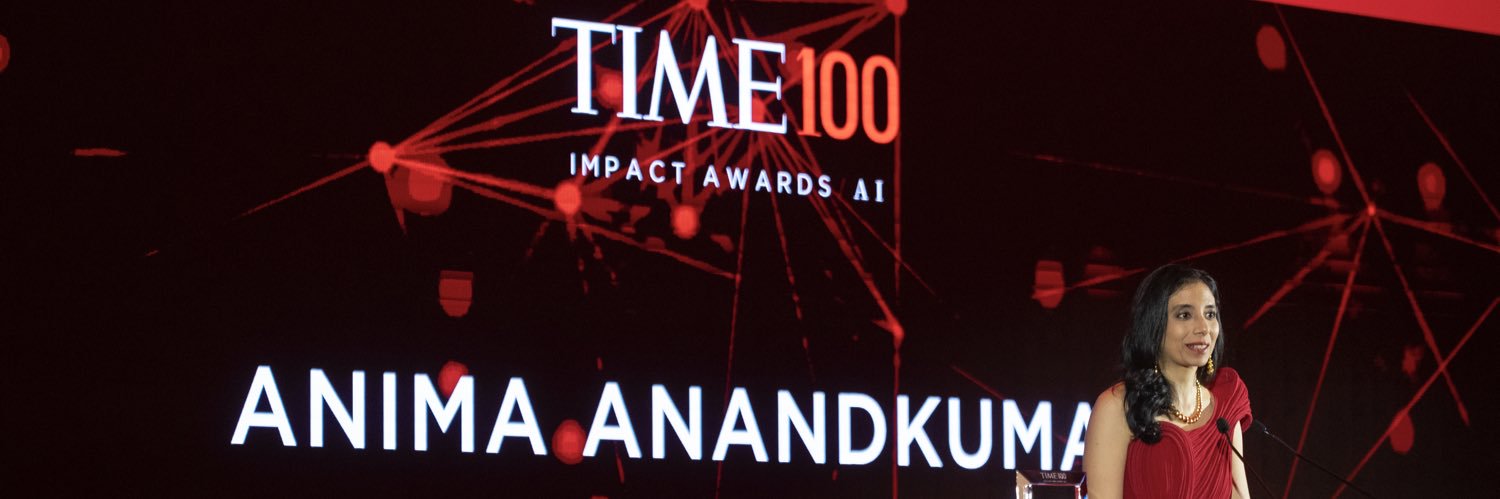
Honored to be named one of the 100 most influential people in AI by @TIME right on the heels of the public launch of our company Accelerated Understanding @accelerated_u
Bringing the power of AI+Science together has been the focus of my life for the past decade. I believe the greatest impact AI can have on science and engineering is its ability to massively accelerate simulation and understanding of the physical world.
We started this journey with the invention of Neural Operators at @Caltech to have a powerful foundation for AI modeling physical phenomena at multiple scales. Together with my team at @nvidia and support from @JensenHuang himself we built FourCastNet, the first high-resolution AI-weather model that is tens of thousands of times faster than existing systems.
Following up on this success we have applied Neural Operators to accelerating simulation of nuclear fusion to detect disruptions before they happen in the real world. Just this week, we announced how Neural Operators can enable density functional theory simulation in quantum chemistry quasi-linear time. We have also used Neural Operators to invent better medical devices like a catheter that reduces bacterial contamination by 100x and we have been able to design better masks for chips and optimized gate layouts for quantum dots.
More recently we have been asking ourselves what would happen if we aggressively scale our models and put multiple areas of physics in the same model, teaching it physics in full 4D (3D space + time). This requires massive scale and that is exactly what we have been able to do at Accelerated Understanding. We have pre-trained models up to 1 Trillion parameters, and we are able to train at 4D context lengths of up to 1 Trillion and run inference at 5 Trillion context.
I am particularly excited about self-improvement: a limiting factor for scaling physical AI so far has been the availability of high quality training data. As the old saying goes: your model is only as good as your data. But that no longer holds true: for our models we have the laws of physics themselves that let us measure and improve the quality of our outputs exceeding what was present in the training data.
But the improvement loop doesn’t stop at the models themselves. We can also use our models and their ability to understand physics and give directional feedback to break down one of the biggest barriers to innovation: the reliance on lab experiments as a bottleneck in the improvement loop.
As intelligence gets more abundant this bottleneck is only increasing in importance. Putting our models and their physical simulation capabilities in that loop instead and taking advantage of their directional feedback means we only need the lab all the way in the end to double check.
Excited to see new inventions and discoveries this will unlock! #TIME100AI#
Show more

Was fun to be on the @latentspacepod podcast a few weeks ago to talk about AI for physical simulation and understanding. This pre-dates the public launch of @accelerated_u so I couldn't yet talk the exact details but hint at what happens if you scale some of these methods to Trillion parameter model sizes and fully 4D context lengths in the Trillions in a universal model.
The podcast covers some of the ideas that provide the foundation for scaling. It also goes into the promise and successes that were possible even before going really big like building high resolution fully AI based weather models that are tens of thousands of times faster and as accurate as existing forecasts. We talk about predicting plasma behavior in fusion so quickly that one could take corrective action before something bad happens. And we cover how physical understanding doesn't just help with replacing experiments but lets us optimize design directly.
We even briefly touch on the promise of combining those capabilities into one large model which I can now talk about more.
Watch for yourself:
Show more
Excited to see @Reuters cover the launch of our startup Accelerated Understanding.
We are training large scale AI models that can simulate and understand physics to invent and discover. Our models understand the world directly in 4D (3D + time) and across physical phenomena. Going full 4D requires massive context length, we have pushed it to a Trillion in training and exceeding 5 Trillion at inference.
AI giving you a bigger haystack of ideas doesn’t help. The bottleneck for new inventions and discoveries is shifting from ideas to the ability to test them. With AI that can simulate and understand physics we are directly attacking this bottleneck.
People have been trying to do this for a while now, but usually by taking shortcuts. Narrow surrogates are great if you happen to have enough of precisely the right data and your design loop stays in distribution. Video models look fantastic but sweep physical accuracy under the rug, and some static world models cut out physics altogether. A lot of interesting physics isn’t visual.
What does not cutting corners look like? Space stays 3D and you also have time: so 4D in total. You also need multiple physical modalities in the same model, not just things you can see. That’s what we’ve built.
Scaling is the primary ingredient to make this work. To represent the world you need sufficient context, which in our case grows in 4 dimensions. Individual samples get so big they don’t fit into single accelerators or even full nodes anymore.
We’ve developed architectural tricks to make it work. We’ve pushed our models to 1T parameters during large scale pre-training and are able to train at up to a Trillion context when needed and do inference exceeding 5 Trillion context without any sub-sampling or patching.
Building on prior successes of AI weather forecasting, fusion simulation, design of medical devices, drugs and chips, we wanted to see if scale and universality can benefit AI for physical understanding. With our teams’ experience in large-scale infrastructure and model training we’ve been able to pull it off.
@accelerated_u @bjenik
Show more












