
Zara Zhar
@Boudicca61AD
"I gather rare revelations that carve the soul's immortal ledger, born where the divine meets the mortal heart in quiet depth."
Art/Film/Poetry - Curator
196 Following 7.4K Followers
Amazing Painting "Le Pardon" (2017) by Palestinian artist Shadi Alzaqzouq, is a compelling large scale painting that vividly depicts a theatrical scene. The diagonal positioning of a wounded man in the foreground disrupts the symmetrical composition of the painting. The viewer's attention is captivated by a bullet hole in the young man’s abdomen. The wounded man’s hand falls to the ground, pointing at a spray can. In the forefront, a woman in traditional Palestinian thobe and a Keffiyeh cradles the man’s body, reminiscent of Michelangelo’s iconic La Pieta, 1498-1499.
Le Pardon is a direct commentary on the horrific situation of Palestinians under an apartheid regime. The artist also addresses the oppression of Palestinian artists and the centrality of nonviolent resistance. Comparable to Jesus Christ (as), the Palestinian martyr lays in the woman’s hands, creating a visual resemblance to Mary (a) and her son in the Madonna della Pieta. The visual comparison speaks to the cyclical nature of history and the recurrence of tragedy on the same land.
Behind this duo, a golden frame unveils a black-and-white photograph depicting the Buchenwald concentration camp during the Holocaust. This unsettling image is held by two Western cheerleaders dressed in the patriotic American flag colors of blue, red, and white. The dual perspective introduces irony and contradiction into the debate by shedding light on the selective practice of Western values and the West’s attempt to wash away its colonial sins with the Zionist state.
The backdrop of the entire tableau juxtaposes the serene beauty of the sunset, with the apartheid wall serving as a literal and visual representation of the term “open-air prison”.
Show more

A portrait of Palestinian child 'Maha Al- Areer,' who is a WCNSF (Wounded Child, No Surviving Family) by Irish Activist-Artist, Anne-Marie Farrell
"I wait for the war to end so I can go to the graves of my mom, dad, brothers and sister to tell them to wake up. The war is over." - Maha Al-Areer.
Her siblings Mohammed, Munir and Marah were murdered in an IOF airstrike. Her father and mother were also killed. She was the only survivor. She was thrown from her home and badly burned.
"I wish for my family to go back to life." -Maha Al- Areer.
Based on a photograph by Haneen Salem @haneen.maher.salem (InstaG) @maha_al_areer (InstaG)
If you can find it in your heart, please donate to Maha's GFM
Show more

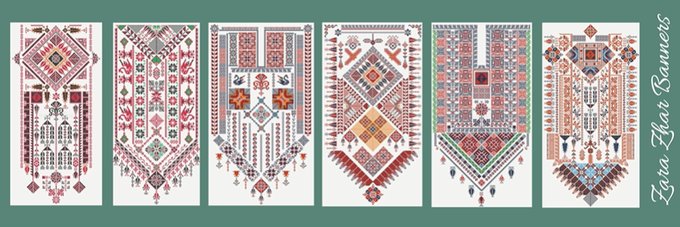
Poster Banners featuring ink paintings by Palestinian (GAZA) artist Abdelrahman Al Muzayen.
Feel free to copy/paste and use for your X profile header.
If you want anything specific or different colorways, hit me up with a msg in replies and I'll sort it.
Search ZaraZharBanners for loads more
Show more

Series of Incredible themed paintings by Iranian school-girls. I'l be posting all of them over the next couple of weeks.
Painting "The Sunflower Farm" by 9-year-old, Setareh Shahveisi from Kermanshah (themes of agriculture, agricultural land, nature, the environment, people and the family)🌻
#MiniMasters# #Iran#
Show more

Poem - 'I had a dream' by Palestinian Lamar Safi
Artwork (ai) by Palestinian artist Abdelrahim Farajallah
I’m 18 and I had a dream
that houses bloomed with love not blood.
I had a dream
that people didn’t have to die to be believed.
They spoke and they were heard.
I had a dream
that humanity was more than a mask
to put on when you like
or take off when you don’t.
I had a dream
that silence wasn’t the sound of fear
but the calm of a sleeping child,
a child who dreams of playdates
with joking, laughing friends.
I had a dream
of a world where bread is easier to reach than death,
where shelter is not living in a tent, trying to survive.
Where borders don’t cage us in; we can travel the world.
And I had a dream
that I lived to see that dream with my own eyes.
Lamar Safi is a young Palestinian student, studying her final year from a displacement camp & hoping to become a lawyer so that she can advocate for her rights as a Palestinian
Show more

A Poem For Dear Leila
'Leila in Mango and Turquoise'
Leila’s a riot of colour,
a splash of mango yellow against the grey,
hot pink sneakers kicking up dust,
a turquoise scarf that flutters like a kite
caught in a dream-wind.
Hebron hums beneath her feet,
a pulse of ancient stone and restless streets,
but Leila’s head’s up there—
in the clouds,
where the sky’s too busy painting itself
to notice the smoke.
She’s got earbuds in,
beats dropping like hope bombs,
a playlist of freedom—
Arabic pop tangled with hip-hop,
a rhythm that says not yet, not broken.
Leila’s nails are electric blue,
fingers snapping as she walks,
dreaming of a rooftop party
where the lights are neon,
not flares.
Leila sees it—
a future in technicolour:
a studio apartment with walls she’s tagged herself,
graffiti flowers curling around the windows,
a beat-up Vespa in lime green,
zipping her through streets
that don’t end in walls.
She’s got a sketchbook,
pages bleeding with ink—
dresses she’ll design,
bold as sunrise,
silks that shimmer like the sea
when it’s alive with her dreams.
Leila’s laugh’s a spark,
bright enough to light the blackout,
and she dreams of a stage,
mic in hand,
spilling poetry that’s half rap, half prayer,
words that lift the crowd
until they’re all floating with her,
heads in the clouds,
feet untethered from the weight.
Leila wants a suitcase,
paint-splattered and bold,
canvases rolled tight with Palestine’s heartbeat
ochre for the earth,
crimson for the fight,
her brush telling stories.
She sees souks in Amman,
cedar-shaded galleries in Beirut,
Tunis bustling with her art,
Algiers echoing her colours,
her paintings loud with rooftop beats and resilience,
of a girl who won’t fade.
Leila sees a night
where the stars aren’t drowned by drones,
where she glows in mango and turquoise,
all flowers and rebellion,
spinning until the world blurs
into something soft,
something hers.
The ground shakes,
but Leila doesn’t stumble—
she’s too busy dreaming,
too full of hope,
a girl in bright colours
who knows the clouds
are just the start,
and the sky?
The sky’s waiting for her to claim it.
— Taryn Zhar (@ZAZA_Zhar)
Show more

Series of Incredible paintings by Iranian school-girls.
Painting "Our Rural House" by Baran Hosseini, 12 yrs old, from Sanandaj, Kurdistan province, Iran
Check my highlights for more paintings by these amazing girls💚
#MiniMasters# #Iran#
Show more

Series of Incredible paintings by Iranian school-girls from different parts of Iran. I'll be posting all of them over the next few of weeks.
Painting by Sana Khodaei, 13-years-old from Bashrooye, South Khorasan Province
Check my highlights for more paintings💚
#MiniMasters# #Iran#
Show more


"Life Prevails"
Ismail Shammout

"Ismail" (2013) short film directed by Nora Alsharif
Inspired by a day in the life of Palestinian painter Ismail Shammout, the film tells the compelling story of a young man struggling to support his parents after their expulsion to a Refugee camp in 1948 by the Israeli forces. Despite the wretched life and distressing conditions he holds to his dream to go to Rome to learn painting. One day and after selling cakes at the train station with his little brother, they heedlessly enter a minefield. As Ismail faces death, and in his struggle to save himself and his brother, we discover his true spirit.
Show more

"Ismail" (2013) short film directed by Nora Alsharif
Inspired by a day in the life of Palestinian painter Ismail Shammout, the film tells the compelling story of a young man struggling to support his parents after their expulsion to a Refugee camp in 1948 by the Israeli forces. Despite the wretched life and distressing conditions he holds to his dream to go to Rome to learn painting. One day and after selling cakes at the train station with his little brother, they heedlessly enter a minefield. As Ismail faces death, and in his struggle to save himself and his brother, we discover his true spirit.
Show more
Portrait of the Palestinian photojournalist Saed Hasballah by Irish activist/artist Anne-Marie Farrel.
Saed is based in Gaza, He is much loved by his colleagues and countrymen alike. He has reported on the ongoing genocide tirelessly and despite being seriously injured twice at the hands of the IDF continues reporting and has refused to leave the strip. Many of his family members and over 300 of his colleagues have been murdered, deliberately targeted by the IDF.
Follow Saed here:
Show more


To my father, Ghassan Kanafani
(written after his assassination)
When I was small, my father used to take me to Al-Muharrer, seat me on his own chair and ask me to draw some pictures. When he moved to Al-Anwar,¹ I used to accompany him there too. Then he moved to Al-Hadaf² and took me, along with my sister Laila, to meet his colleagues there. My father was a good man. He bought me all I wanted and I still love him, although he is dead.
I found Arabic difficult but he taught me lots of things. As a result, I could read all the articles written about him. I liked having such a father because he was very intelligent and people loved him.
When we were in Denmark, Laila and I used to miss him very much and asked my mother to take us back to him. When we returned we used to see him working in the garden every Sunday, planting flowers with gentle hands.
Sometimes we worked together and when it got hot we used to take our shirts off. After work, he would often teach me how to use the small rifle he had bought me. I liked to watch television with him.
When I grow up I want to be like my father and will fight to return to Palestine, my father’s homeland, the land he and Umm Sa’ad³ used to tell me so much about.
From now on, I will help my mother and sister a lot so that they won’t miss him too much. But we will never forget him, or Lamees who died with him and whom we all loved very much — Lamees who was always kind and never lost her temper.
Fayez Ghassan Kanafani - aged 12
Show more

Series of Incredible paintings by Iranian school-girls from different parts of Iran. I'll be posting all of them over the next few of weeks.
Painting by Sana Khodaei, 13-years-old from Bashrooye, South Khorasan Province
Check my highlights for more paintings💚
#MiniMasters# #Iran#
Show more
Ink painting (1985) by Palestinian (GAZA) artist Abdelrahman Al Muzayen.
Animating the Present
She moves through the black field of ink
wearing the language of her grandmothers —
tatreez dense as memory,
wheat rising along the hem,
a dove resting against her heart
as if the cloth itself still breathes.
One hand steadies the camera.
She records so nothing can be claimed as forgotten.
On her shoulders the second self rises —
keffiyeh drawn tight,
rifle lifted into the dark,
smoke and possibility unfurling
from the open mouth of the barrel.
This is the double work of sumud:
to document the wound
and to refuse its finality at the same time.
Culture and struggle walking in the same body,
the past held steady in the lens
while the future is carried on the back.
She does not choose between them.
She becomes both —
the archive that will not close
and the uprising that will not rest,
embroidery and fire
moving forward as one.
— Zara Zhar
Abdelrahman Al Muzayen (b. 1943, Qubayba, Palestine) is one of the foremost figures in Palestinian liberation art. Displaced to Khan Younis during the Nakba, he later studied fine arts in Egypt before joining the PLO in Beirut, where he produced iconic political posters that fused traditional tatreez embroidery with revolutionary imagery. His work centres Palestinian women as living embodiments of sumud, cultural memory, and resistance. A painter, poster artist, academic, and researcher of Canaanite heritage, Al Muzayen has spent decades asserting that the survival of Palestinian visual culture is itself an act of steadfastness.
Show more

Art as Resistance
Three artworks by Palestinian artist Abdelrahman Al Muzayen
Across his 2008 Palestine Series, Al Muzayen striking black-and-white artworks uses ink to explore a powerful, recurring motif: the Motherland safeguarding her future.
In each piece, a central matriarch physically shields her children within the protective folds of her traditional thobe. Here, the mother represents Palestine itself, and the children embody the survival of a culture that refuses to be erased.
Piece 1/3: The Sanctuary
In this striking work, the mother stands as an unyielding monument of protection. Nested safely at her feet, two children look onward while her gown blooms with ancient Canaanite motifs—birds, fish, and stalks of wheat.
Al Muzayen weaves folklore directly into the fabric of survival, framing the preservation of life and heritage as the ultimate act of defiance.
Piece 2/3: The March for Liberation
This piece shifts into powerful forward motion. The mother strides ahead, releasing a bird into flight while holding the traditional key of return firmly in her grip.
Sheltered safely inside her robe, the children raise their hands in a gesture of hope and victory. Al Muzayen reminds us that memory, return, and future freedom are passed seamlessly down through generations.
Piece 3/3: Roots & Interlocking Faith
The maternal shield deepens here, as the mother’s flowing Keffiyeh-patterned veil arches completely over her children as they hold a traditional doll.
Her dress is rich with palm trees, birds, and fish—universal symbols of deep roots, life, and freedom. Through these intricate lines, Al Muzayen mirrors the enduring, protective spirit of Palestinian women.
Show more


Iranian Revolution/War Poster Banner.
Feel free to copy/paste and use for your X profile header. If you want anything AoR specific, hit me up with a msg in replies and I'll sort it.
#ZaraZharBanners#
Show more

One of my fav Yemeni Artists and Paintings💙🩵💜

I saw someone reading the book in London yesterday, just near the Strand, on my way out of KCL. Then I realized Israel will need a million years to erase its crimes and Genocide in Gaza. The love-hate relationship with this book is something that cannot be described, but what always gives it warmth is going back to my friend Zara’s words about it. Thank you a million times. :)
Show more

Palestinian artist Heba Zagout along with 2 of her children were murdered by the IDF on 13th October 2023 (age 39 years), Gaza Strip (R.I.P)
Heba's story:


Located in Jerusalem's Old City, the Dome of the Rock has become a prominent landmark in Palestinian art. Beyond its architectural significance, it frequently appears in paintings as a symbol of Jerusalem and the city's central place in Palestinian history and culture.
In Jerusalem (2023), Heba Zagout places the Dome of the Rock at the heart of a vibrant cityscape filled with colorful homes, churches, and winding streets. The painting celebrates Jerusalem as a living city while highlighting the landmark's presence within the cultural landscape of Palestine.
Show more

Painting by Doha Elhalawany depicting heartbreaking scenes of loss that I'm sure you'll all remember from the genocide that's still playing out in Gaza.

Painting by Palestinian artist Laila Shawa (R.I.P)
Ode for Laila's Birds of Paradise
In the garden that memory still insists is whole,
drones cut through the ancient canopy.
Yellow, red, pink, and blue —
bright as children’s toys,
they slice between the branches
where peacocks spread their hundred eyes
and cranes lift their necks in alarm.
The old miniature world is still here:
deer stepping carefully among the rocks,
small figures in robes of flowing script
standing like quiet witnesses,
trees heavy with fruit and story.
But the sky no longer belongs only to wings.
Machines have entered the frame,
circling the same air the birds have always claimed.
This is the other side of paradise —
not lost in some distant future,
but invaded in the present tense.
The drones do not belong to this palette,
yet here they are,
turning the living garden into a map
someone far away is learning to read.
Still the birds remain.
Still the peacocks open their tails in full defiance.
Still the cranes and geese and crows
refuse to abandon the branches
they have held for generations.
Laila painted the intrusion in unbearable colour
so we would see exactly what is being taken
and exactly what refuses to leave.
— Zara Zhar
Show more

Contemporary Palestinian artist Khalil Rabah often explores how the words we use and the ways we record knowledge influence how we see the world.
In Philistine (1997), Rabah pierces an Oxford English dictionary with nails, leaving only the definition of Philistine exposed. By isolating this word, the work invites viewers to consider how language can influence the ways cultures and histories are understood.
Show more












