
Barrett Linburg
@DallasAptGP
Co-Founder @ Savoy. We build, own & manage TX apartments, 8,000 units under management | I help people with capital gains invest in great Texas submarkets
1.2K Following 173.1K Followers
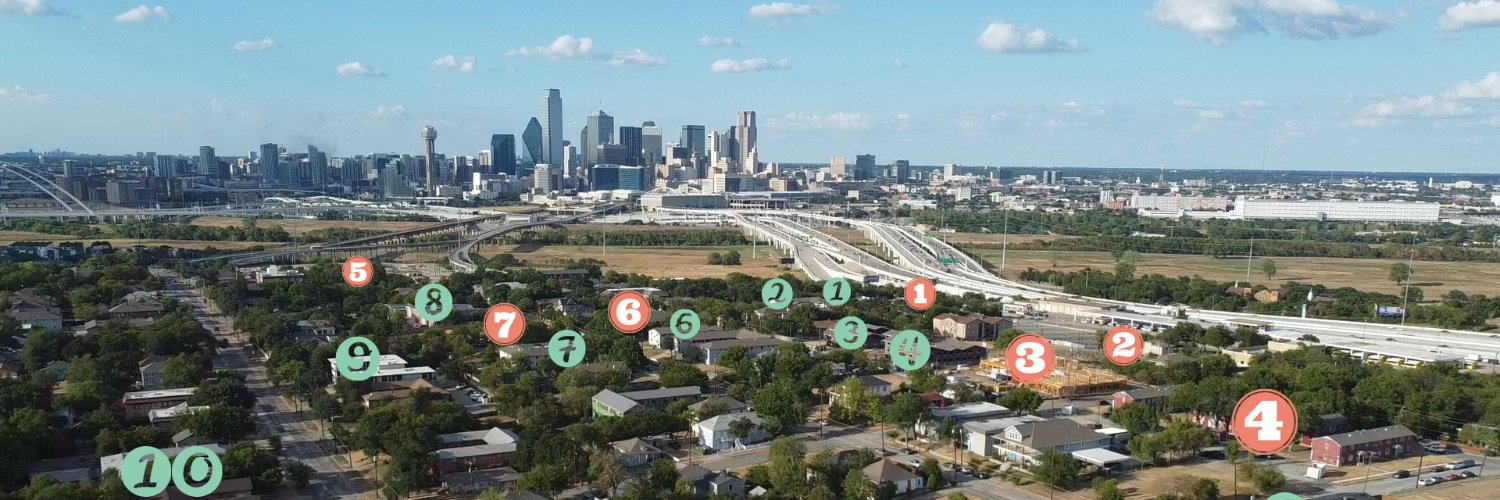
We have done a ton of work in the Dallas neighborhood over the past 6 years.
Started by buying vacant & blighted apartment buildings and gut renovating them (green dots)
Then we bought land and started building new buildings (orange dots)
Because it is all Opportunity Zone, when we sell our investors will not owe any capital gains tax on the appreciation or have to recapture the significant depreciation tax losses we have created for them
Proud of the difference that we have made in this corner of our city. Crime, blight, and vagrancy were real problems and now we see families and kids out walking
Show more

What car would you buy today if it had FSD?

Prediction: Tesla will keep FSD an in-house advantage for a couple years, and then once others start getting close will begin licensing it for other cars—just as they opened up the Supercharger network.
Show more
Imagine a podcast where a sunbelt multifamily broker has to read every page of the OM to @resetbasis

Tom Cruise reveals he never reads scripts himself, he has the writers read them to him out loud
"What I do with directors and writers is I don't read the scripts, I have them read it to me.”
“Because I don't want my ideas to invade it yet. I want to understand what is their communication, they've been working on it, they have things that are just there. So they come to me and I just sit there and I'm like, I want you to read it to me"
"And then we get to a place where I start to understand, and I'm like, I know how to contribute to that now. It sparks ideas. I have certain ideas, certain things I'd like to play with, and then I don't necessarily talk about it, I just do it.”
Show more

Love old maps
Dallas 1887 vs today

Nick is sick (literally) but just took 10 minutes to deep dive one of our apartment websites and gave me some great advice
Grateful to him

I offered to do free technical SEO audits for readers of my newsletter. I'm stuck at home with Covid so I have a lot of time on my hands
Over 100 people applied. Wow. Now I've done 73 audits and I learned some interesting things along the way
(1) A shockingly large number of people use Wix. I never think about Wix myself, do you? But I guess it is very popular
Wix has a market cap of $3.3B as a public company. I wonder how that compares to WordPress
(2) Domain authority - how important do you think this actually is? I'm seeing a lot of BEAUTIFUL new vibe coded websites with zero domain authority in Ahrefs or Moz
Then I saw today a website that looked like it hadn't been updated since 1997 for a vitamin supplement co-packing company and I bet it does like $5m/year
(3) I made a really neat pipeline to help me manage these. It works like this:
First, a user submits the newsletter form to get a free SEO audit
Then Claude Code scrapes all the URLs from that form and runs a basic technical SEO audit + checks DA + builds a simple nice visual HTML results page
Then Claude builds a dashboard for me, showing all the sites I have to audit
I click them one at a time doing Loom videos - like this one that I attached - and when I'm done I just paste the Loom back onto my Dashboard and click "Send"
Claude then rips the Loom transcript and helps me write a draft email to the person that I did the audit for
It's great! It takes me about 10 minutes to do each one
OK - that's all for now. I have about 15 or 20 more to finish up. This is definitely "doing the thing that doesn't scale" but I think it is quite fun
Show more

Anybody using these successfully?
We recently rebuilt all of our property management websites (agentic optimized) and getting a material number of renters inquiring directly from ChatGPT, but have not done any advertising on the platform yet
Curious to hear if anyone is using the ad platform
Show more

Two guys who love Opportunity Zones

Dallas may end up with more Opportunity Zone census tracts than any other city in the country
Dallas Eco Dev nominated 42 census tracts. The Governor's office accepted all of those and added two more!
To contrast, in 2018 the City asked for 62 and got 15.
Statewide, more than 1,200 tracts were proposed by more than 175 economic development organizations and county judges across 114 counties.
605 were ultimately designated using formal scoring criteria
Through 2024, Texas has received $7.84B of OZ equity investment and roughly 75% of that has been into urban areas.
With the combination of a permanent/improved program, a better map, and more thoughtfully chosen tracts...I think Dallas is going to receive several hundred million of equity investment per year going forward that it would not receive but for the OZ program
Show more

So you’re saying there’s a chance

The Texas triangle is lit up tonight. Big wins for four football programs all ranked in the top 25
UT
Texas A & M
SMU
University of Houston

This is the new Mercedes VLE. Electric van supposed to debut in the US next year with point to point self driving
If (big IF) they nail self driving then it could sell well
This is the type of luxurious people carrier that families want from Tesla and aren’t getting
Show more


Roadtrips were something I worried about before buying my Model Y
Now I can’t imagine a long drive in any other car
Stopping at a supercharger for 15-20 minutes is how long it takes for my family to make a bathroom stop anyway
Show more

@max_gagliardi You can’t go full EV yet unless you never roadtrip. Waiting to charge will always suck until it gets faster. We have a Model Y Peformance that I commute in and a gas SUV for longer trips.
Show more
Wealthy investors now have $170 billion in a strategy designed to generate tax losses.
Four years ago, it was $2 billion.
CNBC wrote about it this week. It's called tax-aware long-short investing, and if you're sitting on a big stock gain, your wealth manager may have already brought it up.
I read the article and thought about pairing it with Opportunity Zones. One generates capital losses. The other gives you five years before a capital gain becomes taxable.
And along the way, you move some of your wealth from a concentrated stock position into real estate.
🔷 What the account does
You've probably heard of tax-loss harvesting. Sell investments that are down and use the losses to offset gains on investments you sell at a profit.
The problem is that after years of rising markets, you may not have enough losers.
A tax-aware long-short account owns stocks and also shorts other stocks. When stocks rise, the shorts can produce losses. When stocks fall, the stocks it owns can produce losses.
The manager closes losing positions, books the losses, and replaces them while trying to maintain the account's intended stock-market exposure.
You can fund the account with appreciated shares without selling them first. As losses become available, the manager can use them to offset gains from selling down your concentrated position.
A dollar of capital loss offsets a dollar of capital gain. How much the account generates, and how quickly, depends on the strategy and the market.
🔷 Where Opportunity Zones fit
Normally, if you sell appreciated stock this year, you need losses available this year to offset the gain.
An Opportunity Zone investment changes the calendar.
Under current IRS guidance, you can sell stock in late 2026 and invest the gain in a Qualified Opportunity Fund in January 2027, provided you're within the 180-day window.
The gain stays deferred for five years. At the five-year mark, 10% is forgiven.
Now you have until 2032 to plan around that gain, while the money is invested in a real estate project.
I joke that if you ask 10 CPAs whether they'd rather have a client's tax bill coming due next April or five years to plan for it, all 10 will take the five years.
Give them a loss-generating account to work with during those five years and you can see why this pairing interests me.
🔷 The math
You own $10M of Nvidia with a $1M basis. You want to diversify into both other stocks and real estate.
Sell $2.5M of Nvidia in late 2026. Those shares have $250K of basis, leaving a $2.25M gain.
Invest the $2.25M gain in a QOF in January 2027. The $250K of basis is yours to keep. Recognition of the gain moves to 2032.
Contribute the remaining $7.5M of Nvidia to a tax-aware long-short account without selling it.
Over the next five years, the manager seeks to generate losses and uses some to offset gains as it sells down your remaining Nvidia. Unused capital losses can carry forward.
Then the OZ gain comes back.
After the 10% reduction, you have $2.025M of taxable gain. At a 23.8% federal rate, that's about $482K in tax before loss offsets.
If you have $1M of available capital losses, the bill falls to about $244K.
If you have $2.025M of available capital losses, the federal tax on that original sale is zero.
The actual tax bill will depend on how much capital loss you have available in 2032. And losses already used to sell Nvidia aren't available again in 2032.
🔷 The money wasn't sitting still
The $2.25M was invested in real estate. Hold the qualifying OZ investment ten years and its appreciation can be tax free too.
Meanwhile, the long-short account is working to diversify the remaining Nvidia into a broader stock portfolio.
You started with one company. You're moving toward ownership in many companies and a real estate investment.
🔷 The trade-offs
Long-short accounts charge fees, use leverage and short positions, and cannot promise a particular amount of losses. Your remaining Nvidia can fall while you're waiting to sell it.
Harvesting losses generally defers tax. Embedded gains remain in the account, and unwinding it can trigger a bill.
The OZ portion is a long real estate hold. You can't sell a quarter of an apartment building when you need cash. If the losses aren't there in 2032, you need another source of money to pay the tax.
And the tax benefit doesn't save a bad deal. Pick the building first.
If you're sitting on a large stock gain, ask your CPA and wealth manager to model the combination.
This is a tax post from a guy who builds apartments.
Show more
I remember that in the days after 9/11 every store sold out of American Flags
Has a Pulitzer prize ever been given out for Twitter posting?
Today's full day of posts by @25YearsAgoLive is worthy of nomination

Huge news out of Dallas this morning!
@EnergyTransfer, a global energy leader ranked #53# in the Fortune 500, and its full partnership of public entities — Sunoco, Sunoco Corp, and USA Compression — are moving their primary listings from the New York Stock Exchange to TXSE.
With a combined market capitalization of nearly $100 billion, these transfers mark a watershed moment for capital markets not just in Texas, but nationally.
The movement of primary listings out of New York and into Texas is just beginning, and TXSE is proud to have the complete Energy Transfer partnership among our first primary corporate listings.
Show more

I'm about to start a webinar on Opportunity Zones for 50+ Texas Economic Development directors.
These are the people in charge of bringing jobs, vibrancy, and tax base to towns big and small.
I'll teach them OZ. But that's one tool.
My real pitch: tell me the building that eats your police budget. The complex nobody will touch. The eyesore on Main Street.
Then tell me what you'll put on the table to make it pencil.
If it's in an Opportunity Zone, even better.
When the municipality is a partner & advocate for your project then everything (including the numbers) works better
Show more
Everyone is talking about what Cybercab and autonomous vehicles means for the future of transportation. I want to talk about what it means for real estate.
Here is a site plan of a 76 unit apartment project we just finished in Dallas. It is leasing up now. Look at the site plan. Half the land is surface parking.
That is how many small(ish) apartment buildings have been designed for decades.
Cities used to require it. Many, including Dallas, are now getting rid of parking minimums. But that does not change much on its own. We will keep building as much parking as our renters demand. So will every other developer. Renters bring cars (especially in Texas).
So the parking stays until the cars change.
Here is what we did differently. The building and the parking lot are two legally separate tax parcels. If the parking is no longer needed, we can build on the lot without touching the building. On this site that means another 70 to 80 apartments.
No new land. No acquisition cost. Same property, roughly double the units.
And you may not even need robotaxis to get there. You just need cars smart enough to park themselves. Door to door. Bumper to bumper. Drop me off under the porte cochere, then go park yourself in a parking structure in a cheaper part of town. Half the parking field disappears right there.
Now run that across a whole city.
Every surface lot. Every oversized parking field. Every empty corner of a multifamily site. Each one becomes a development opportunity if the need for parking change drastically.
More housing. Less asphalt. More housing where people want to live.
Waymo, Zoox, and Robotaxi arriving in Dallas matters more than most people think. Robot cars do not just change how people move. They may change what we build and where it is built.
Show more

Eighty years ago, my great-grandfather, Dick Burnett, acquired the Dallas Eagles baseball team
This included their stadium near Lake Cliff Park
Below are the now-demolished Burnett Field and the recently completed 86-unit Burnett Lofts 3 blocks away from the old ballpark site
Show more


How long until the dot gets to the middle of the Texas Triangle and just stays there for good?












