

EnigmaFunge
@EnigmaFund
CEO//Founder @MultiHopper + $SSR. GP at EnigmaFund VC. Advising Perle, KINO. + (prev) $TOSHI CTO team
1.1K Following 19.4K Followers
So we built an onchain privacy protocol that let's you send any assets, any amount, with compliance baked into the smart contract (@trmlabs partnership)...
... and you can route your assets through any wallet and smart contract in existence.
Without their signing authority.
Thank you for your attention.
Show more

Watch the magic of MultiHopper in action.
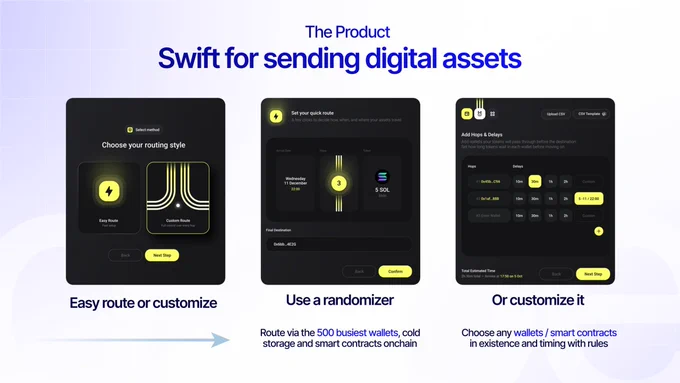
A customizable route allows you to send any amount of any asset through any wallet or smart contract onchain.
Plus, how it looks on block explorers and Arkham.
Permissionless and non-custodial.
Welcome to SWIFT 2.0 for blockchains.
Show more

MASSIVE. Probably the thing about clarity i liked the most.

BREAKING: The SEC grants a five-year "Innovation Exemption" for tokenized securities venues, allowing blockchain platforms to list and trade real tokenized stocks with full shareholder rights.
Show more

Wow. I am NEVER buying another token till I run it through Argus (codename for what @KkonMcC i building). What I learned today about several tokens was absolutely scary and amazing.
Which wallets were involved.
Historic cabals.
Revamped socials used in repeat same day dump scams.
Founder with a WEIRD past hidden in the far corners of the web.
Fake Github commits, stars and reviews.
Bundled wallets flushing 48% of supply out on the same day...
Just WOW.
The world needs this.
Show more
We're shipping some awesome upgrades this week for MultiHopper including one-to-many transfers for payments, salaries, unbundling migrated tokens and more.
Meanwhile we're skunkworking a unique privacy approach. Onchain. No pools/ anonymity pools / mixing/ tumbling.
gg.
Show more
SWIFT standardized correspondent banking.
Onchain exposes the entire transfer graph publicly.
MultiHopper is SWIFT 2.0 for digital assets: programmable, non-custodial routing with regulatory-ready privacy.
Any amount or asset, through wallets and contracts you don’t control.
Show more
Someone made some money... in BETA. $SSR launchpad for reserves is going to blow people's minds.
It's really a magic experience. We are tackling all kinds of issues no one ever thought of in the past, and innovating in some crazy cool ways.
Well done team. @StrategicSuperR FTW!
Show more

Just added PNL cards on 👀
PS: real PNL %, added a bunch of test assets and accidental mainnet 13x'ed on $STONK lmao

Bright on time.
Well played @galaxyhq
Old keys, don’t open new doors

$ANYONE desktop VPN is live.
Watch this video to see why it could finally be the end of middlemen and centralized providers addicted to control under the guise of altruism.

The $ANYONE Desktop VPN is live.
Mac, Windows, Linux. No single company watching your traffic.
The Anyone Desktop VPN is now live. Community release just dropped for Mac, Windows and Linux.
A normal VPN routes your traffic through one company’s servers. Fine, until you remember you’re just swapping “my internet provider can see everything” for “this one VPN company can see everything.” You’re still trusting a single middleman.
$ANYONE works differently. It routes your traffic through a decentralised network instead of one company. No single provider sitting there watching all of it. And this desktop version gives you proper control. Protect your entire system at once, or route individual apps through their own exit points, and pick different paths for different sites.
It’s a community release for now, ahead of a wider global rollout. Early days. But it’s live, and you can download it today.
More privacy. Less trusting one company with everything. That’s the direction we want to be heading.
Show more

There is literally only 1 token in my fomo portfolio that's green. 1. No surprise it's robinhood:0x7ac87d8fdb45200fdd51e4aca225244485c984c5
One of the many exciting implementations of @Multihopper, with a great partner. @OOBEonSol gives AI agents on @solana the flexibility and programability as well as native onchain privacy they need.
Thanks for being the best part of our journey: our purpose.
Show more

We are partnering with @Multihopper to give on-chain agents more control over payment routing on @solana.
The integration will give agents more flexibility around payments, with privacy, timing, policy rules and compliance built into the flow.
Agents registered on SAP will be able to use MultiHopper directly through OOBE’s tooling and runtime, giving developers an easier way to add advanced payment routing to their agents.
For MultiHopper, this brings their payment routing into the OOBE agent ecosystem and opens a new source of transaction flow from on-chain agents.
We are also working on a shared revenue model around transactions routed by OOBE agents through MultiHopper.
Glad we got to know the MultiHopper team through the @SuperteamDE's Build Station in Berlin and turned that connection into a partnership.
More details on the integration will follow in the coming days.
Show more

Please do not buy any fake MultiHopper tokens. We are not sure if @Cyrene are compromised.
All the MultiHopper documentation is very clear that we do not, and have no plans to issue a token.
STAY SAFU.
Show more
There are very few projects that have continuously produced real technology like $ANYONE.
It's a huge community and will find a massive unlock sooner or later. Doubtless.
It's a pleasure and privilege to be a long-time investor and advisor here.
Show more


I am absolutely URGING you to not support the $LAPTOP token or try play it in any way. There are professional market makers at play and they are here to completely rinse you. @zackxbt is surely going to have a field day today.
Whoever was involved in this launch should be absolutely avoided in the future.
Show more

also, looking at the token now that it has launched...
it is painfully obvious that extractive grifters who know absolutely NOTHING about crypto launched this
$100 BILLION FDV
seriously??
who the hell is Hunter Biden and why is he even relevant to crypto?
the guy became famous for making headlines for all the wrong reasons while his daddy was president
yeah, the same president who spent his entire administration attacking crypto, trying to stifle the industry and threatening to send people to jail
anyone buying this genuinely deserves to lose 100% of their money
and i do NOT say that lightly
Show more
So if you've been buying this $LAPTOP garbage... you need to leave the casino.
9. PS: the data you're getting is a TINY taste of what @KkonMcC and I are building at Project Argus (no token, not the final name - more soon)

At some stage I'm going to ask @fern if he has any $FIH. If he doesn't I'll send him some, and a pizza of course.


9. PS: the data you're getting is a TINY taste of what @KkonMcC and I are building at Project Argus (no token, not the final name - more soon)
@Multihopper is building in the Crypto World's Fair Hackathon, powered by @Colosseum, as part of @SuperteamDE
I've registered and can hardly wait to dive deeper in 6 days.

Everybody keeps talking a big game about tens of millions or hundreds of millions or even billions of dollars coming onchain. I want to share some insights on why I've focused all my efforts and creativity on @Multihopper
The fact is, the real opportunity is somewhere between $21 trillion and $42 trillion USD a day that is moving through SWIFT. It's double that if you include RWAs and equities.
Trillions. Each day.
To solve for this, programmability is more important than building privacy alone. There are some things that need to be said about approaches to privacy. The first one is that code is a crime.
Especially when you're profiteering from that code being used. It's like leaving a gun in a playground and saying that kids should be smarter than picking up a gun and shooting each other, or that no one should really touch a gun that is not theirs.
The moment you start messing around with the ability to transfer enormous amounts of funds, you are facilitating nefarious intent for terrorist organizations and criminals. If you are profiteering off the use of that code, you are 100% enabling and part of the problem.
One of the worst cases of this is the widespread addiction to doing privacy through pools.
Pools share the risk of one bad asset entering the pool and everybody being tainted. Of course, everybody keeps talking about the fact that you can keep these tracks segregated, but if you think that is going to fly with regulators, you simply don't know how the world works and how this kind of stuff plays out. Even if you got one regulator to be okay with this for a period of time, they easily could change their mind as soon as another one steps in their place. It certainly won't be uniform across all territories.
Unraveling the mess of this afterwards and stopping people from getting debanked just for being present in that pool or having used it in the past or in the future unknowingly has widespread ramifications not easily undone, if at all.
Another good point against the concept of pools is that they are impossible to keep sufficiently liquid to transfer enormous amounts of any asset. This is why people like Uniswap simply won't touch them:
- the regulatory risk
- the contamination issues
- The fact that they are open to exploits and manipulation, and are too hard to keep liquid.
You can't have dark pools for every single asset in existence, or even the top 10 meaningful ones, and keep them sufficiently incentivized.
The pools have the issues of contamination risk, are regulatory radioactive, and are open to massive slippage and exploit issues, as well as being too difficult to stay incentivized.
So, building on MultiHopper, we made some very simple choices:
1. No pools/ commingling by design
2. Permissionless
3. Non-custodial
4. As absolutely onchain as possible, pref 100%
5. Any asset, any amount, no liquidity requirements
6. Uncompromising stance on compliance. Thanks to our partnership with @trmlabs we scan every wallet in the route and all assets for AML, sanctions, CTR, illegal and stolen funds.
This is why we're closing POCs with some of the largest entities in FinTech and in crypto: we're not shoving something down their throat. We're giving them something they recognize and are comfortable with and that meets the market where it's at.
I'm a huge fan of all the forms of innovation, such as TE, FHE, TEFHE, ZK, and so forth. There is no one who can convince me that we're wrong about pools to create the primitive for programmable money.
And after reading this, I'd be extremely surprised if you weren't the same camp with us.
Build with MultiHopper Today. Live on @Solana.
(here is a cheeky video of my cofounder Kuj to share more)
Show more

$KARMA is migrating to @robinhood Chain.
KARMA is run by a founder we personally believe in at EnigmaFund.
Originally launched on Ben Pasternak’s Believe platform, which has been abandoned and where every token has collapsed, and surrounded with spurious activity, @amrix_j stood out from the beginning.
- relentless founder, locked in
- coachable, reasonable, approachable
- constantly delivering product
- Knows his numbers! Every metric that matters
- built a multi-million dollar revenue generating business at a young age
For a couple of months we’ve been chatting thanks to @ripper0x connecting us. (Chad).
What I've enjoyed in that time is not only an existing vision, but rather a vision that is being carved out based on data and adoption. Real discussions turn into real action.
We chatted about different business models, what's working, and what's not, based on actual measurable data, which you have an incredibly strong grasp of. The thing is, no matter how strong your grasp is of the data or how good you are executing, when you enter into a completely new field like crypto, there's a lot to absorb and get right. Generally, you can't get everything right, so the trick is to surround yourself with smart individuals who have experience in different fields and care about the project as well as your own progress as an entrepreneur.
It's great to see today that @Karma is entering a new era where it has the best chance of success rather than constantly fighting headwinds. We fully support this migration, and we'll support the chart in the order books as best we can, but we're just one small factor in this. While this is not financial advice, I call upon people who want to support a good founder to back the journey and not just the product or price.
Disclosure: we are not compensated advisors on the project, nor do we have any sort of side benefit or paid incentive. We are migrating all our tokens at EnigmaFund as well as at SSR (@StrategicSuperR) in this process.
Show more












