

OpenRouter
@OpenRouter
The unified interface for LLMs. 400+ models (incl. 50+ free), the best prices, explorable data, private chat, & a unified API.
385 Following 148.6K Followers
RT @koblovinamerica: we took jev and build a model router! hope you enjoy.

the world's first prod-grade auto router powered by @typesafeai 's jev and @OpenRouter
ship on friday night 6:30 pm they say
lfg

Model router powered by Jev with incredible results from their testing holy moly
MOLY I say

The Jev Router is our most transparent router to date, and it benchmarks very well!
See how it picks the model in the Chatroom sidebar, including cache-aware cost tradeoffs:


You've never routed like this before.
@OpenRouter is bringing Jev to all of your LLM calls, so your agentic workflows never have to waste a token again.
As always, faster, cheaper, more intelligent. Go build the future.
Show more
Jev Router keeps a model that works for the rest of the session.
It can raise or lower effort without switching models. It switches only when the expected gain is larger than the cost, including the cached chat it would lose.
Show more
Jev reads the conversation text only to pick the model and effort.
It runs under zero data retention (ZDR) terms, so nothing is stored or trained on. Attachments are never sent to Jev, and requests with "zdr: true" work with Jev Router.
Show more
Jev Router runs on Jev, TypeSafe's first Decision / System One model.
Before each turn, Jev reads your prompt and scores it on difficulty and precision. Also checks whether a bigger model or more effort would help, whether a cheaper model is enough, and whether the task changed.
Show more
Most routers pick a model based on each message. Each switch loses the cached chat, so you pay full price for the new model to reread the whole conversation.
Most routers also route on the task type, not the difficulty. Easy and hard coding tasks get the same model.
Show more
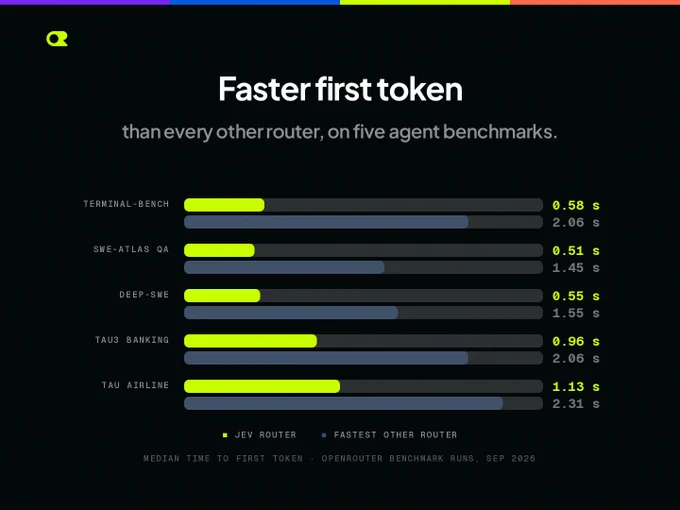
On five agent benchmarks, Jev Router had a faster median time to first token than every other router we tested.

Kev-4B is now on @OpenRouter

3/ Under the hood, Kev is a LoRA adapter and pointer head on Qwen3.5-4B-Base. The weights are on Hugging Face at
Thank you @SiliconFlowAI for hosting

Space Bunny Alpha is back online on OpenRouter.
The issue is now resolved, so the model is serving again. Thanks for your patience while it was down.

Claude Opus 5.5 from @AnthropicAI is live on OpenRouter!
The first model in the Claude 5.5 family leads Opus 5 and Fable 5.1 on agentic coding, knowledge work, and computer use, with 1M context at $4/M input and $20/M output, 20% lower per token than Opus 5.
Show more

The addressable market for Decision models like Jev might be very large
Chart from

.@openrouter tip: you can get useful notifications like these directly in your team's Slack

Grok 4.7 from @SpaceXAI is live on OpenRouter!
Their most capable model for coding and knowledge work. It works longer on hard tasks, checks its own work more carefully, and sits at the frontier of price-performance on CursorBench 4.0.
Use it now:
Show more

Curious what Jev's favorite ____ is?
Try to get your thing to rank first!


> 239 t/s
lol k
Thanks @OpenRouter :)

You can also play with Jev directly in our playground:












