
Stanford HAI
@StanfordHAI
The official account of the @Stanford Institute for Human-Centered AI, advancing AI research, education, policy, and practice to improve the human condition.
605 Following 108.8K Followers
Stanford HAI's fall conference returns this October. Confronting Our AI Future: Hope, Fear, and the Choices Ahead will feature a full day of conversations on work, learning, governance, and how we ensure AI expands human potential. Speakers include @drfeifei, @JeffDean, @audreyt, @erikbryn, Alondra Nelson, and @istoica05, with more to be announced.
Register by October 1 for early bird pricing:
Show more

From robot learning to chip design to AI security, Stanford faculty @sanmikoyejo, @chelseabfinn, and @Azaliamirh are shaping where AI goes next. Congratulations to these three on being named to the TIME AI 100!
Show more

AI tools are playing an increasingly large role in mental health care, but the governance frameworks needed to ensure they are safe and effective are lagging behind. A policy workshop, hosted by @StanfordHAI's Healthcare AI Policy Steering Committee in collaboration with @StanfordMed's AI for Mental Health Initiative, identified three critical challenges policymakers need to address:
Show more

AI chatbots are increasingly used as life coaches, counselors, and therapists. Developers rely on mental health experts to test whether responses are safe. New research finds that expert disagreement makes that process unreliable; the scholars propose a path forward:
Show more

⏰ Last chance: Applications for the 2026 Rising Stars in Data Science workshop close August 3 at 11:59pm CT. The two-day workshop at @UChicago brings together data science graduate students and postdocs at a critical point in their academic careers — in collaboration with @Harvard, @HDSIUCSD, and Stanford HAI:
Show more

Generative AI has sparked debates on authorship and creative ownership. Stanford HAI Student Affinity Groups members Christina Ba and Navya Agarwal set out to explore a different angle — what if AI could augment the creative process rather than diminish it?
Show more

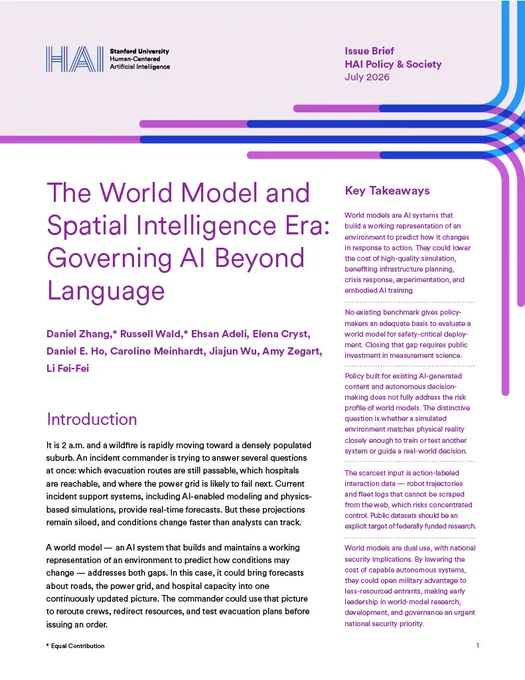
📢 New issue brief: World models will reshape how AI interacts with the physical world. Our latest brief examines their emergence, opportunities, risks, and national security implications, and proposes a governance framework to guide policy conversations as the technology matures.
Show more
What if you could test a drug on a digital twin of your own cells before taking a prescription? Stanford HAI Faculty Affiliate Emma Lundberg is leading a team building an AI foundation model to make that possible:
Show more

In Maryland, it could take up to 14 weeks to read all required government reports — longer than the state's 13-week legislative session. Scholars at Stanford HAI and @StanfordLaw’s RegLab are helping states cut through the clutter:
Show more

Narratives are harder to fact-check than individual claims and AI is making them easier to spread. Stanford HAI Student Affinity Groups members are exploring what it takes to combat disinformation beyond fact-checking:
Show more
Assessment in education is changing. A new white paper from the Stanford Accelerator for Learning, in collaboration with ETS, explores how AI is reshaping assessment, and why the future depends on valid, transparent, and human-centered systems. It includes insights from Stanford HAI Associate Director @EmmaBrunskill and Faculty Affiliate Victor Lee.
Show more

AI developers rely on mental health experts to evaluate whether chatbot responses are safe. But when experts disagree, averaging their scores produces responses that are no one's idea of good advice:
Show more
"In a short period of time, our team has built the largest fully open language model ever trained, the first AI-generated genomic database, and the first AI-generated viable genomes." Stanford HAI Faculty Affiliate @BrianHie on Evo 2, developed with support from a Stanford HAI Hoffman-Yee Research Grant:
Show more


🚨🚨New paper in @Nature with @AshuAshok, @lukebeehewitt & @ghezae_isaias 🚨🚨
Can LLMs predict results of social science experiments?
Across 70 preregistered studies, we find strong correspondence (r=.85) between LLM-predicted and observed effects.
🧵
Show more

AI continues to reshape strategic competition between major powers. @HooverInst Fellow Eyck Freymann examined how AI, nuclear deterrence, and semiconductor interdependence shape the U.S.–China relationship.
Missed this HAI seminar? Watch here:
Show more

When does personalizing interventions in medicine, education, or job training actually improve outcomes? Stanford HAI Associate Director @EmmaBrunskill and @Stanford postdoc Zhaoqi Li built a statistical test to measure when it is actually worth it:
Show more

Over 1,700 legal cases have involved AI-hallucinated facts, cases, and laws. Yet we know surprisingly little about how legal AI systems perform or the likelihood of error. "There's No Free Benchmark," led by @NeelGuha and co-authored by Stanford HAI Senior Fellows Daniel Ho, @JulianNyarko, and @chrmanning, is part of a special feature in @PNASNews on AI and the law:
Show more

The @DigEconLab's AI Economic Indicators platform provides timely, data-driven measures of AI's impact on the economy. Join an online discussion of the latest findings on July 22 at 9:00am PT:
Show more

Governments worldwide are investing billions to reduce reliance on foreign AI providers. But commercial "sovereign AI solutions" may reconfigure dependencies rather than eliminate them. Stanford HAI Denning Director @landay on what countries should consider instead:
Show more

AI systems can be weaponsized to encourage harmful behaviors and beliefs. Stanford HAI Student Affinity Groups members studying cognitive security are asking what safeguards are needed to protect human autonomy:
Show more












