

Thomas Roedl
@TomSolidPM
AI doesn't fix broken systems. It amplifies them.
I help professionals build the system first.
Creator of @myICOR
182 Following 4K Followers
Thank you Claude Opus 5.5.
What a leap forward compared to just a month ago.

That's why I started building my own applications with Claude Code.
Software like Zoom, which was initially just a video meeting app, is now completely bloated with features.
It tries to be the all-in-one solution for teams, and yet it fails to quickly give me a transcript of my meeting.
I still have to go through loops to find the recording and transcript.
Clicking on many things ends in dead ends.
And Zoom's AI has no clue what a meeting is or why I would need a transcript at all.
Tools like Granola and Wispr Flow give me instant transcripts after the call, including a summary, and they are not even part of the meeting app in the first place.
This shows that when too many people get involved, things get too complicated to use.
Anyone who has tried to use Microsoft's or Google's software suites for teams knows that too.
I'm not saying it's a bad thing to evolve a tool and try to make it an all-in-one solution, as long as you ensure that the original value proposition of the tool, the foundation everything else is built on, remains priority number one.
Show more


My Claude Shorts Factory is growing!
The problem:
My usage is being consumed rapidly
The solution:
A new Mac Mini that runs it 24/7
Meanwhile, I made 3 new skills for 3 new categories.
Each skill produces a full production kit with an editable project, upload resources (thumbnails, titles, descriptions, etc.), script, manifest, storyboard, narration, cover, prompts, etc.
These are incredibly fun to make. Now comes the upload process and channel management.
Show more

In the age of digitization, people held on to paper to stay connected to the physical world. In the age of AI, we will hold on to people for the same reason.
Humans become more and more the bottleneck...


How time flies with Sonnet 5.5 🤯

The moment I realized AI can now build fully fledge productivity tools end-to-end with Sonnet 5.5 in under 30 min.


Introducing Gemini 4 Argon – our new frontier model.
It’s built for complex workflows across coding, enterprise knowledge work, and cybersecurity defense – rolling out today to a set of trusted testers through our Fairwind Program.
Show more
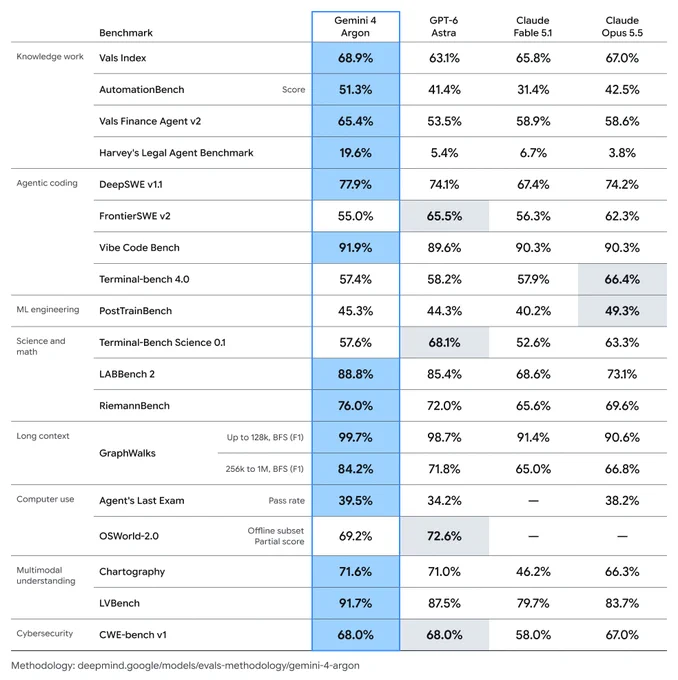
Pretty smart for Anthropic to drop Opus and Sonnet 5.5 first. Then let OpenAI unleash whatever this is, and then drop Fable 5.5. What year this is 🤯



Next week, a new alpha chapter starts. This is always so exciting as a builder 🔊✨

Life is complicated. It's up to you to make it simple.
Opus 5.5 = Fail / Jev = Fail
Jev + Opus 5.5 = secret to make the self driving car simulation a reality.

What I found out about Grokbot vs Claude so far:
⚪ Its own computer, awake when mine is not
work continues after I close the lid
⚪ Keeps logged-in sessions in the cloud Chrome dies when my session ends
⚪ Learns a workflow by watching me once then re-runs it as a saved routine (but this is available in Claude Desktop too)
⚪ Bots message each other, hand off work my specialists answer once and end. (That's an interesting part to look deeper into)
⚪ Drives an app with no API, by clicking it in the cloud, not on your machine
💡 The gap is one thing: a machine that stays
awake.
The rest of its list I already have using Claude and one local folder:
⚪ Multi-agent teams · 30+ specialists parallel dispatch inside one session
⚪ Persistent memory via the myPKA scaffold local folder · markdown + mypka.db tasks, session logs, journals, CRM
⚪ Real tool access · MCP, not screen-poking Supabase, Lexware, MoneyMoney, YouTube, email, calendar
⚪ Browser control · Claude in Chrome my Chrome, my logins, my Mac
⚪ Scheduled runs · cron and cloud agents but no live desktop kept signed in
💡 The edge is the venue, not the model.
Show more

Same apps. Different Tuesday.
(people with ICOR)

“we sandboxed the agent”
meanwhile the agent:

If you think you have an ADHD brain, read this before you get it diagnosed.
Half of X has decided they have ADHD. 🧠
And maybe they're right. But before you book that appointment, there are a few things nobody tells you.
1. ADHD is a diagnosis of exclusion.
Anxiety, depression, sleep disorders, burnout, and even thyroid issues can look identical to ADHD. A good clinician rules all of those out first. A bad one doesn't.
2. Symptoms must have started before age 12.
Not "I got stressed at 34 and started losing focus." The pattern has to trace back to childhood. Dig out old report cards. Ask your parents. The evidence matters.
3. There is no test.
No blood panel. No brain scan. No app. It's a structured clinical interview, rating scales, and a professional's judgment. Anyone selling you a 5-minute online quiz is selling you something else.
4. A label can liberate you, or it can limit you.
Many adults describe their diagnosis as life-changing clarity. Others report grief, stigma, and a new ceiling they didn't have before. Both outcomes are real.
5. The system is under pressure.
Overdiagnosis concerns are rising alongside underdiagnosis. Telehealth platforms have financial incentives to diagnose. That doesn't mean your symptoms aren't real, it means the quality of the evaluation matters enormously.
Here's the uncomfortable truth:
A lot of what gets called ADHD in high-performing adults is a system problem, not a brain problem.
❌ No structure.
❌ No process.
❌ Constant context-switching.
❌ Infinite notifications.
A broken environment will make any brain look broken.
🔶 Fix the environment first.
🔶 Build the system.
Then, if the struggle persists across every context, then get the proper evaluation.
Know the difference between a brain that needs support and a workflow that needs redesign👇
Show more

Building dashboards with AI gets you to 90% in five minutes, then eats hours on the last 10%.
That last 10% isn't a coding problem. It's the system you skipped.
Don't let AI "build a dashboard".
Let it:
1. Build the design system.
2. Build a well established data structure that feeds it.
3. Build the definition of what actually matters to you on screen.
Then hand that over to AI and the dashboard comes out right 9 times out of 10.
🚨 BUT DON'T STOP HERE!
After you're happy with the result, let AI write the conclusions, insights and rules down.
Every decision you made once becomes a guideline your AI team reads before it touches anything again.
That's where the compounding starts. Session 20 builds on the conclusions of sessions 1 through 19 instead of rediscovering them.
💠 THE CRAZY PART
And none of this needs a platform.
A folder of markdown files on your own machine does it.
Show more
A true doctrine for working with AI:
Code owns what is checkable, the model owns what is judgeable.
...and gates enforce it so no agent can self-certify.
Creating more than $2 billion in value is framed as a failure, with the company cast as an “unfortunate victim”
A great example of playing stupid games and winning stupid prizes. I’m so glad Todoist isn’t part of this!
Play your own infinite game. Set your own rules. It’s far more rewarding than running on the VC hamster wheel.
Show more