

Category Labs
@category_xyz
We build high-performance decentralized systems.
21 Following 11K Followers
Today we are releasing Quantum Cadence, a post-quantum version of Cadence, our consensus protocol with multiple concurrent proposers. Quantum Cadence uses no quorum certificates, and its safety and liveness do not depend on signatures.
Most modern consensus protocols, Cadence included, rely heavily on signatures and quorum certificates, which a large-scale quantum computer could forge. Simply replacing today's signatures with post-quantum ones would make certificates too large for every validator to send around in a high-performance blockchain. Quantum Cadence instead draws on Forget-IT, a recent signature-free consensus protocol co-developed by researchers at Category Labs.
Quantum Cadence still keeps the overall architecture and core guarantees of Cadence, so our Cadence prototype was easy to carry over: an AI was able to adapt it to Quantum Cadence in a few hours, and an early prototype now runs on an internal test network.
We designed Quantum Cadence to be practical for a high-performance blockchain. In our simulations, its latency is similar to Cadence's, and it scales better with the number of proposers.
Interactive explainer:
Full paper:
Joint work by @MohammadMJalal1, @TobiasKlenze, and @komasito55
Show more

Check out Tree-BTE 🌳, our new tree-based approach to designing batched threshold encryption (BTE), the cryptographic tool for encrypted mempools.
Tree-BTE can be instantiated with different cryptographic hardness assumptions to yield different properties. For example, with a lattice-based hardness assumption, we get a post-quantum secure BTE scheme with >100x faster decryption than prior lattice-based schemes.
Instantiations based on other assumptions (such as DDH, DCR, LWR) are also possible. Check out our paper on eprint.
Show more
Monad Private Settlement enables an onchain financial ecosystem where enterprises can run entire business processes onchain and interact with each other on the open Monad network.
Read the design specifications here:
Show more
We're at Open in Singapore tomorrow, presenting on the main stage and in the builder room. Schedule below.
Come say hi!

PropAMMs beat passive LPs by leveraging capabilities like active repricing and pricing by counterparty. That edge lets them quote retail tighter. But propAMMs also spoof quotes.
On-chain routing fixes that, and MRC-17 makes it simpler with one shared routing interface for propAMMs.
Show more

🚨 New paper alert 🚨
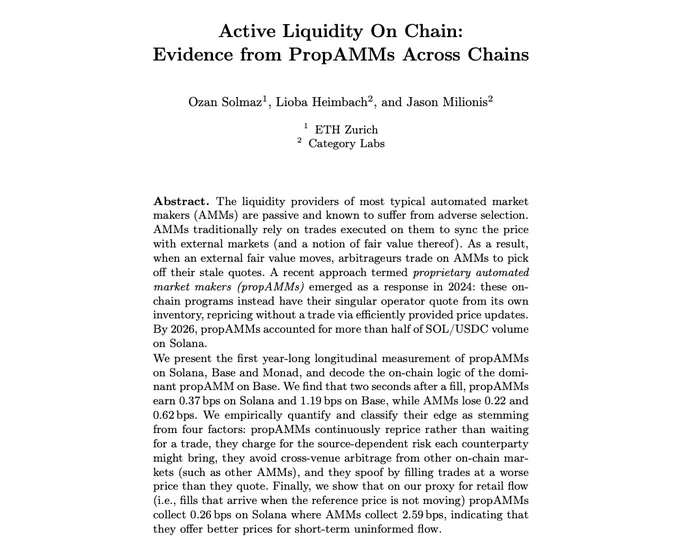
Active Liquidity On Chain: Evidence from PropAMMs Across Chains
w/ Ozan Solmaz @jason_of_cs
Liquidity providers on traditional AMMs such as Uniswap are passive and suffer from adverse selection. As a result, their price only moves through trades. When an external market moves, these LPs get picked off on their stale quotes. PropAMMs, a new design, emerged in 2024 attempting to combat this. In them, a single operator quotes from its own inventory and reprices actively. By 2026, propAMMs carried more than half of SOL/USDC volume on Solana and had been found, among other chains, on Base and Monad.
Our work seeks to elucidate the benefits of this new design both for LPs and for retail users. Do propAMM operators really have an edge over passive LPs, and if so, where does this edge come from? Can propAMMs offer tighter quotes to retail users? We measured a full year of propAMMs on Solana, Base and Monad, and decoded the closed-source on-chain logic of Tessera, the largest propAMM on Base.
The result: propAMMs have a measurable edge over passive LPs: two seconds after a fill, propAMMs earn 0.37 bps on Solana, 1.19 bps on Base and 1.69 bps on Monad, while passive LPs on AMMs comparatively lose 0.22, 0.62 and 2.06 bps. We trace the edge to four sources:
🟠 Cheap, frequent repricing: updates use at least 25 times less resources than swaps on Solana, and 5 to 15 times less on Base and Monad. Generally, the default block order on all three chains is by priority fee per unit of computation. Thus, an update pays far less than a swap for the same priority placement.
🟠 Pricing by counterparty: five of the six largest Solana propAMMs offer tighter spreads to aggregator flow than to non-aggregator flow. For Tessera on Base, we show that it whitelists, penalizes or blacklists individual addresses.
🟠 Arbitrage against AMMs: when a reference price moves, propAMMs reprice while AMMs do not, and arbitrageurs trade the two. A propAMM fills at its updated quote, so it may break even on these legs on Solana and Base and even earn 1.55 bps on Monad.
🟠 Spoofing: aggregators route on the quote from the end of the previous block. For Tessera on Base, we show that the operator consistently raises its default fee early in the block and lowers it again late in the block, so aggregators read stale state that carries the lower fee. As a result, only 39% of swaps execute at the quoted price, and the average swap receives 1.08 bps less.
The second question we ask is: can propAMMs offer users tighter quotes as a result of their edge? The answer is yes: on fills that arrive while the price is not moving (our proxy for retail flow) propAMMs take 0.26 bps on Solana, 1.26 bps on Base and 1.62 bps on Monad, where AMMs take 2.59, 1.38 and 8.60 bps respectively. Retail also makes up a larger share of propAMM volume: 32%, 43% and 17% on Solana, Base and Monad, against 9%, 16% and 8% on AMMs.
What did we learn? PropAMMs avoid the losses of passive liquidity provision, yet still manage to give retail tighter quotes. However, users also have to bear the cost of spoofing, which we expect to change as aggregators move to an on-chain methodology.
Link:
Show more
Users whose trades are meant to be protected from front-running still get sandwiched as a result of exposure along their transaction's path.
Encrypted mempools help limit that exposure significantly, but privacy also needs to reach beyond the mempool. That's what we're building toward!
Show more
🚨 New paper alert 🚨
No Place to Hide: An Analysis on Protected Order Flow Sandwich Attacks
w/ Ozan Solmaz @boez95 @ChristofTorres
Bots watch every pending trade in Ethereum's public mempool and sandwich the ones worth attacking. Hence the nickname: the dark forest. In response, Ethereum and other chains built protections, from private RPCs to mechanisms native to the chain, that shield trades from these bots. We call this protected order flow.
How well are these users actually protected? We measured it in a three-year study of sandwich attacks by persistent bots against protected order flow on Ethereum, Solana, Tron, Base, Arbitrum, and Monad. The protections on these chains range from private RPCs on Ethereum and private submission to a centralized sequencer on Base and Arbitrum, to first-come-first-served ordering in Tron's public mempool and local mempools on Solana and Monad. Local mempools were never meant as a full front-running prevention, but they do limit who sees a trade before it lands.
On four of the six chains, we observe protected order flow sandwich attacks: 28.0M attacks on Solana, 38,567 on Tron, 30,607 on Ethereum plus 2,576 more through reorged blocks, and 1,889 on Base.
We trace each chain's exposure and find that it sits in various places along a transaction’s path.
🟠 Ethereum: OFAs can expose enough information to make private trades sandwichable, especially when the same transaction reaches multiple OFAs or when searchers receive full transaction details. Reorged blocks also expose private transactions. We find transactions that were private and untouched in a block that got reorged, and then sandwiched on the canonical chain.
🟠 Solana: transactions are sent to the upcoming leaders, and early on we find that a few leaders carry far more attacks in their blocks than their share of blocks, i.e., they are likely the exposure source for these transactions. From 2025 that fades, but we see that victims concentrate around a few apps.
🟠 Tron: we presume that bots win latency races in the public mempool, so the first-come-first-served ordering in block building does not fully prevent sandwiches.
🟠 Base: we see two different kind of exposure. One lines up with a documented RPC bug that exposed pending transactions. The other has attackers preying on victims who trade on a predictable schedule, if the vicim does the same trade every couple of blocks, the attacker can front-run them without observing the pending trade.
Protected order flow sandwiches look very different from public mempool sandwiches. The attacker's transactions often land in a different block than the victim's, and unlike in the public mempool, their success is not guaranteed. These attackers simply don't act with the same certainty.
The dark forest may have shrunk, but we show there's an even darker corner of it, where users who think they're protected still get front-run. Protection has to hold at every layer, from the app to the RPC to the block producer. Encrypted mempools and TEE-based designs can help, by keeping transaction contents out of attackers' reach until inclusion. But even they might not be enough on their own without privacy, for example if the victim is too predictable.
Link:
Show more

Check out our latest cryptography paper, Batched and Weighted Threshold Encryption with Silent Setup. Building on BTX, this scheme supports many desirable properties of an encrypted mempool:
⚡ Weighted decryption (ideal for Proof-of-Stake blockchains)
⚡ Silent setup (key generation no longer requires interaction between parties)
⚡ Batch and index independence (more user friendly and fewer constraints on decryption)
We’re excited about the future of encrypted mempools!
Paper link:
Authors: Amit Agarwal, Champ Chairattana-Apirom (Category Labs intern ‘26), @sourav1547, Babak Poorebrahim Gilkalaye
Show more


A public ledger doesn't need to be an open book
Institutions that need privacy currently have one option: move activity into closed systems, sacrificing liquidity and composability
At Open, @category_xyz will unveil a new way to keep sensitive activity private on Monad
Show more


Broke 25 Year Old Buys Billion-Dollar Founder a Beer @_jhunsaker

Our latest paper, EVM Workloads in the Wild, has been accepted at AFT '26 in London. Gas metering assumes that execution conditions are stable. We measure the extent to which that assumption fails, on Ethereum and Base.
More details below 👇
Show more


Happy to appear on the Fault Tolerant Frenz podcast next week to present our new Cadence protocol! Let me know if you have any topics/questions you'd like to hear discussed (or ask them live during the session). Sign up here:
Show more

At the MEV SBC workshop today to talk about EVM workloads in the wild. The current EVM pricing model assumes execution conditions are stable. We show they are not.

Ever wondered how big blockchain peer-to-peer networks are and where the nodes are running from? Check out our paper at SBC. We conducted the largest measurements of peer-to-peer networks, measuring 36 networks since December 2024.
Show more











