
Jennifer Doleac
@jenniferdoleac
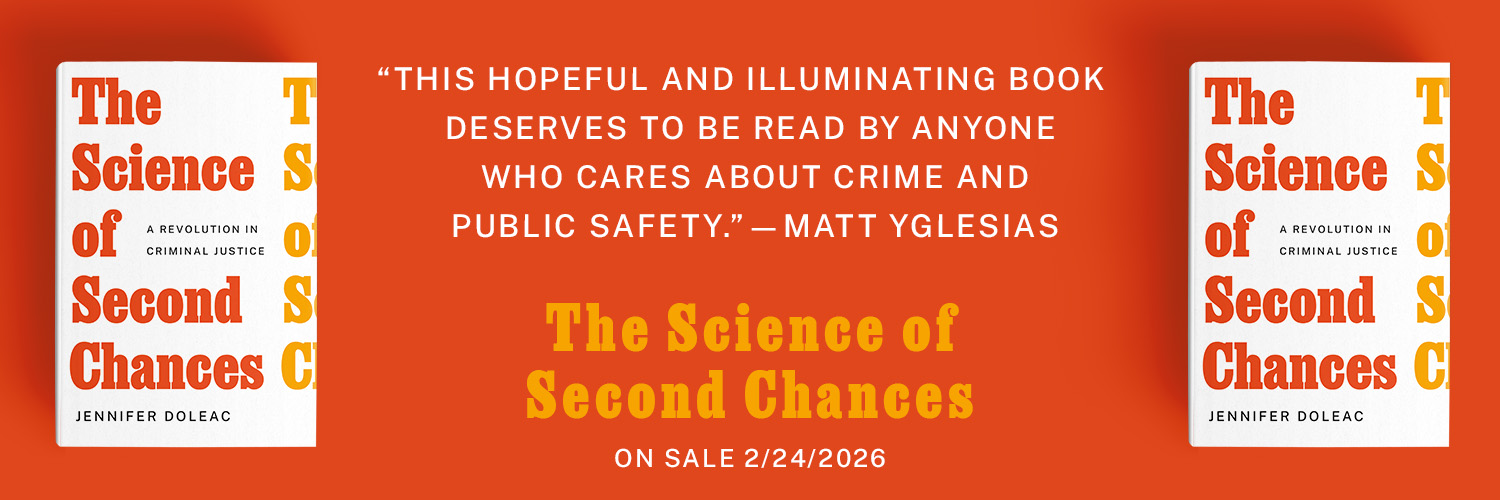
Economist & public safety expert. Author, The Science of Second Chances. Host/author, @ProbCausation podcast & substack. Passionate about ROI.
3.3K Following 64.5K Followers

How do researchers study crimes that people may be unwilling to admit?
@cristinatquinn talks to Kennedy Johnston about a survey method designed to encourage more honest reporting and what it may reveal about sexual violence.
Listen: [
Show more


Episode 60 of Probable Causation featured professor Elisa Jácome. She talked about the how losing access to Medicaid at age 19 (once they're classified as adults) affected young men's criminal justice involvement.
Originally published: November 9, 2021.
Show more


Academic feuds should only be conducted in the traditional way: weirdly passive aggressive footnotes in competing monographs over a period of multiple decades (whoever dies first loses).

Good op-ed from @jenniferdoleac bringing together the various perspectives and find the evidence to anchor the debate to.
If interested, our working paper on the Flock effect is at
Show more


Hi Friends! We finally have a podcast website!
If you ever have wonder if we've covered a topic, Alex Hollingsworth has created a website that will have all the transcripts, and an easy way to search the topics and who we've talked to. Hope y'all enjoy!
Show more

The Society of Labor Economists is piloting a new mentoring program intended to provide small group mentoring! We are seeking both mentors and mentees--apply here!
In this bonus episode, David Eil interviewed professor Hannah Walker about her book, Mobilized by Injustice: Criminal Justice Contact, Political Participation, and Race.
Originally published: July 27, 2021.
Show more

Episode 64 of Probable Causation featured professor Jason Baron. He talked about how foster care affects criminal justice involvement.
Originally published: January 4, 2022.

Episode 84 of Probable Causation featured economist Alex Albright. She talked about an automatic pretrial release program for low-risk defendants in Kentucky.
Originally published: December 6, 2022.
Show more

Episode 68 of Probable Causation featured professor Andrew Barr. He talked about how access to SNAP (food stamps) in early childhood affects later criminal justice involvement.
Originally published: March 1, 2022.
Show more

Episode 88 of Probable Causation featured professors Sara Heller and Max Kapustin. They talked about the impacts of READI, an innovative program targeting men at high risk of gun violence in Chicago.
Originally published: February 28, 2023.
Show more

Episode 75 of Probable Causation featured professor Panka Bencsik. She talked about the effects of diversion for drug possession arrests.
Originally published: July 5, 2022.

Awesome episode of Field Notes, featuring Ashley Spence from @DNAJusticePRJ. If you're interested in what it takes to make the best use of modern DNA technology to solve crimes, check it out.
Show more
Flu vaccine ✅
Covid vaccine ✅
Go get yours!

As DA, I will continue to build on this progress by prosecuting cases, holding offenders accountable, and pursuing justice at every turn. But at the same time, we must recognize that if we are serious about making these declines sustainable, there must be generational investments in treatment, mental health services, violence prevention, and the economic opportunities that give people a reason to choose a different path.
Show more
I would like everyone to respond this quickly when I ask for something. 😂

@CharlesFLehman @smourtgos @ian_t_adams Whoa! This is excellent. I think I remember @jenniferdoleac calling for such a study recently and this evidently must have already been underway. Sweet!
You guys. I’ve spent the last couple weeks learning how to use AI productively. It has been *so fun.* I feel like a kid (read: early-career researcher) again, not wanting to waste time eating or sleeping because I wanted to get back to my Stata code.
Show more













