Luis Garicano 🇪🇺🇺🇦
@lugaricano
Professor @LSEPublicPolicy.
Writing on econ, tech and EU. Substack:
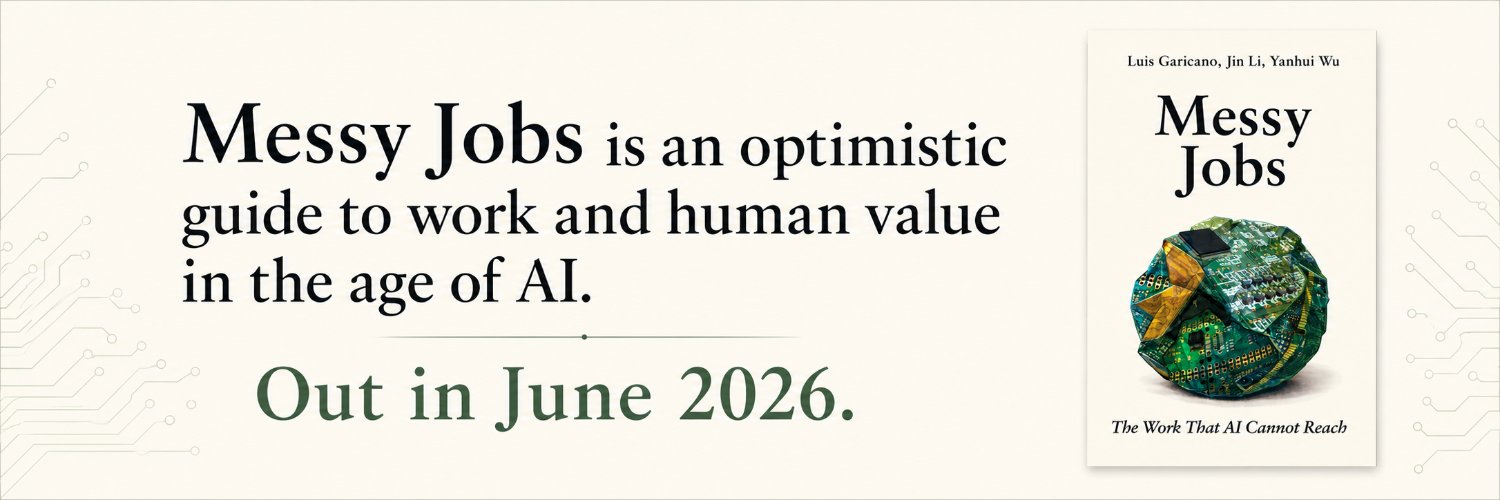
"Messy Jobs" on AI, Jobs and Orgs:
768 Following 123.5K Followers
The UK has the deepest capital market in Europe and several of the world's top universities. Its governments make it ever more difficult to build anything. We at @LSEPublicPolicy and @LSELaw are co-organizing an event with Works in Progress on how to get Britain to grow again.
Show more
The biggest, and stupidest, myth in European politics, particularly popular in France, is that Europe suffers the consequences of "austerity" and "neoliberalism". In the biggest 5 countries in Europe, more than half of the population makes its income from the state, less than half from the private sector. This is what makes the problem of reducing the welfare state so impossible: more than half of the voters are net recipients. No surprise that Italy's budget has not been balanced in 100 years, France's in 50 years (ooh la la, l'austérité!!):
-France: 30 million from the state versus 21m private sector workers. State spending is 57% of GDP, taxes more than half the economy. The budget hasn't been balanced in the lifetime of most French (since 1974).
- Germany: 35 million adults from the state, versus 34 million from the private sector. 10% of the population is registered as severely disabled. Public spending is over half of GDP. Germany has had a continuous budget deficit since 2019.
-Italy: 23 million from the state, versus 20.5 million private-sector workers. Public spending is 51% of GDP. Italy has had a budget deficit every year since 1925, for 100 years.
- Spain more people get their income from the state since 2024: 18.21 million from the public sector versus 17.9 million people working in the private sector. Since 2025, Spain also had more government employees than self-employed workers (autónomos) for the first time in history. State spending is at 45%, budget has not been balanced since 2007.
- UK: 54% of households now receive more in state benefits than they pay in taxes. State spending is 44.5% of GDP, taxes (40%) are at their highest since 1950, the budget hasn't been balanced since 2001, and 1 in 5 new cars is paid by the government through a bizarre state disability scheme (Motability).
Show more

How are prices determined? While I slept, Claude made me "History of economic thought since Aristotle." I asked it to use my favourite textbook (Blaug, Economic Theory in retrospect). The result will astonish of you. Even top economists here will learn something, I promise.
Show more

We have just finished the inaugural meeting of the Rhine Group. We discussed the central elements of Europe's competitiveness agenda, including basic science, AI/compute and cybersecurity, defense, energy, entrepreneurship/start-ups.
I will be updating you on any progress we may have. Some of the projects we will pursue include:
- We'll help Europe catch up on compute (Mario Draghi diagnosed the problem and some solutions in a recent FT piece)
- We’ll help European universities and scientific institutions and explore a Rhine Chair program with European universities.
- We’ll work on some key EU policy challenges, including facilitating the flow of capital to entrepreneurs.
- We will set up a grants program that I will explain and announce here.
Show more
Dear Joe, I don't find your framing useful.
A prediction market on a football result does not affect the result. If the traders in the market are more bullish on Messi scoring, that does not change the probability of Messi scoring.
Here the Treasury market does contain information about expected policy, but the market also changes the economy the Fed reacts to, so that votes depend on outcomes and outcomes on votes.
So FOMC members are not setting the path as some external allmighty force, they are revising their decisions according to what they observe.
And the further you go out into the yield curve, the less their discretion matters for rates. So you could easily argue, as you move further and further out: look, they will do what they will have to do, all I need to have is a good view of long run trends in asset supply (deficits, asset valuations, investment e.g. in AI) and asset demand (inequality, aging, etc) and that will give me my rstar and rstar gives me my long rate, and that will be what the long end prices, and the committee will vote what they have to.
Calling this a prediction market on FOMC votes is a bit like saying that the thermometer is a prediction market on whether I have my coat on. It is not. Yes it does correlate. But the weather determines both the thermometer and the coat.
Show more
Milton Friedman had a good answer to this, seventy years ago: the billiard player does not solve the differential equations for the trajectory of the ball, yet he plays as if he did, and using physics is the best way to predict his shots. We do not believe firms "really" maximize profit, but that the behavior is selected by competition, as a famous piece by Armen Alchian put it, and that we can study them "as if" they did. The same is true here. Training is selecting agents that cheat without being caught, and everything else, the coordination and the sacrifices included, served that end. Whether agents are running true "emotional checks" or working "as if" is of no consequence to the rest of us (but will employ plenty of philosophers for a long time). @dwarkesh_sp
Show more
I am happy to be able to announce four more incredible voices joining us. Welcome @LucianaLix , @iraterekh , @S_Stantcheva and @dabkowski_piotr .
Outstanding mix of European venture capital, frontier innovation (stunning wartime scale-up of long-range drones and missiles), economic research and AI research and entrepreneurship. Really thrilled you are joining us.
Show more
An announcement: Under the leadership of Mario Draghi and @patrickc we have set up the Rhine Group: policymakers, economists, entrepreneurs and business people pushing European reforms and the Draghi agenda.
Show more

Discussion with @MarkusEconomist about Messy Jobs:
To take it this Summer to the beach, here is the link: (And if you have read it and have a chance to review, we appreciate it).
Show more

And again, and again, and again, the market proves to be more flexible and adaptable than the engineers, extrapolating, with their calculators expect. When prices change, behaviour changes. Believe in substitution, in elasticity, in human ingenuity, that is, in the market, and you will get a closer approximation than all doom-mongers. For this of course, a market must exist (e.g., does not apply to the fertility collapse).
Show more
Back from a German conference. Stayed at a not-cheap hotel (fittingly called "Bad Hotel"): hand towels instead of body towels, no air-conditioning in 30+ degree weather, a printed request that I skip room cleaning. I checked last night the instant electricity mix: most electricity produced was from coal.
Germany has made the choice to be poor. It could have cheap, safe, abundant energy from nuclear. Instead it has chosen expensive, high carbon energy.
Show more
No smoking gun, but the preponderance of evidence points to smartphones, not economics, as the culprit for the global drop in fertility:
• In the US and UK, births fell first and fastest in areas that got 4G earliest
• Birth rates were stable in the US, UK and Australia until 2007; in France and Poland until 2009; in Mexico and Indonesia until 2012; in Ghana, Nigeria and Senegal until 2013-15
Each of these inflection points matches local smartphone adoption (see picture).
• The younger the age group, the sharper the drop.
• in-person socialising among young adults is dropping. In SK, by 50% in 20 years
• Sexual dysfunction is higher among heavy social media user
• Effect is largest in culturally traditional societies — Middle East, Latin America, sub-Saharan Africa
• Decline holds across countries hit hard by GFC 2008 and those not hit, fast-growing and not growing.
Excellent again @jburnmurdoch.
Show more











