

Orthodox Christian
@orthodox_33ad
ICXC ☦️ NIKA | Lives of the Saints ~ Sayings of the Holy Fathers ~ To the Glory of the Holy Triune God
33 Following 28.7K Followers
🔸 November 2 - Saint Gabriel the Fool for Christ 🔥🔸
Today, we commemorate Saint Gabriel the Fool for Christ. He was a wonderworking Georgian monk during the era of Soviet persecution. St Gabriel was born in Tbilisi in 1929 with the name Goderdzi. When his father Vasili was murdered, the 2 year old Goderdzi was renamed Vasiko in his honour. Vasiko first heard the name of God at age 7 when he overheard his neighbours arguing, and one shouted, “You have crucified me like Christ”. The curious boy asked the men Whom Christ was, and they told him to read the story of His life.
The boy rushed to the book market and purchased a copy of the New Testament which soon illuminated his soul. His heart aflame with a love of Christ, Vasiko would build small churches from pebbles in the yard. While many Georgians were discarding their icons for fear of persecution from the Communists, Vasiko went door to door collecting these icons which he cherished. Concerned over her child’s obsessions with God, Vasiko’s mother threw away his New Testament.
At this point, the boy left home and took shelter in many monasteries including the Samtavro monastery. While completing his mandatory service in the Soviet army, Vasiko would often secretly attend liturgies. His comrades alerted the authorities, and they sent him to a medical commission where they declared him mentally insane. Discharged from the military, Vasiko committed himself to monasticism. He attended services at the Sioni Cathedral in Tbilisi, and formed a close spiritual bond with Patriarch Melchizedek III who tonsured him a monk in 1954 with the name Gabriel.
In 1965, thousands gathered in Tbilisi for the annual Soviet celebration of international workers day. St Gabriel was so disturbed by this communist cult that he set fire to the giant portrait of Lenin for which he was beaten and arrested. Banned from the priesthood by the Soviets, St Gabriel later constructed a hermitage behind his family home where he spent many years living in asceticism. He was later restored to the priesthood in his beloved monastery of Samtavro where he reposed in 1995, a smile still etched on his face.
Show more

It is impossible to recall peace without dissolving the cause of the schism, the primacy of the Pope exalting himself equal to God.
— St. Mark of Ephesus

🔸 November 1 - Saint Helen of Sinope 🔸
Today, we also commemorate the Holy Virgin-Martyr Saint Helen of Sinope. St Helen was the daughter of the pious Bekiary family and lived in the 18th century in Sinope, the oldest city of Pontus. Her parents raised her in the fear of God, and implanted in her heart a pure love for Christ. She was especially influenced by her uncle who taught in a secret Greek school. She was graced with great beauty and distinguished for her obedience to her parents. When she was 15, her mother sent her one day to buy embroidery thread from the shop.
On her way, she passed the house of Ukuzoglu Pasha, the Turkish Governor of Sinope, who saw Helen from his window. Her beauty attracted his licentious soul and he thought to defile her. The Pasha ordered that she be brought to him, but each time he tried to defile her, an invisible force pushed him back. An invisible wall was protecting the girl - a wall forged by her prayers. The Pasha had her imprisoned in his house, but Helen managed to escape and return home.
The Pasha flew into rage upon discovering this, and summoned the Sinope council of elders, demanding that they bring Helen to him or otherwise a massacre of all Greeks in the city would follow. The elders pressured Helen’s father to hand over his daughter, and after much pain and tears, he eventually submitted. The despicable Pasha received the beautiful Helen with delight, hoping to fully satisfy his lustful desires. But again, an unforeseen force prevented him from defiling the Saint as she sang the Six Psalms which she had learned from her uncle.
After many more failed attempts to assault the gir, the Pasha ordered for her to be tortured and put to death, after which her body was put in a sack and thrown into the Black Sea. But instead of sinking, the Martyr’s relics floated, while a heavenly light beamed down upon them. When her holy relics were retrieved by Greek sailors who saw that a nail had been driven through her skull. In 1924 during the Greece-Turkey population exchange, her hold head was taken to the Church of the Great Martyr Marina in Ano Touba, Thessaloniki, where it is kept to this day.
Show more

🔸 November 1 - Saint David of Evia 🔸
St David was born in the late 15th century and was the son of a priest. At age 3, he beheld a vision of John the Forerunner who led him to a nearby church dedicated in his honor. There, the child remained barefoot for 6 days before the Saint’s icon. At 15, David left home and was ordained a monk by his spiritual father Hieromonk Akakios, later Bishop of Arta.
David showed perfect obedience; once, after being reprimanded for accepting shoes from a Christian without a blessing, he walked barefoot back to Arta to return them. He became Abbot of the Monastery of the Mother of God in Varnakova where he founded a secret school to teach Orthodoxy during Ottoman rule. Due to the monks’ disobedience, he reluctantly left the monastery.
The Lord led him to Mt Steiris where he continued his ascetic struggles. Accused of sheltering a runaway slave, David was arrested and tortured by the Turks. The Saint patiently endured his trials, and Christians paid a bribe for his release. When a sailor refused to take him across to the island of Evia, the Saint placed his robe on the sea, made the Sign of the Cross, and miraculously sailed across. Seeing this, the sailor begged for forgiveness, and David blessed him from afar. In Evia he built a small church to the Transfiguration of the Savior.
His holiness drew many monks, so he journeyed to Russia seeking funds for a new monastery. With the help of the Greek community in Russia, he gathered a large sum of money. Sealing the tunds inside a hollowed log, he cast into the river. When he returned to Evia, he saw that the log had been found by fishermen in Rovies, but their axes broke when they stuck it. David revealed to them that it held the monastery funds, and would open only by God’s will.
Builders ignored St David’s instruction to construct the monastery atop the mountain, and instead built it near the Transfiguration church because there was no water up high. The Saint went up the mountain and prayed to the Mother of God, and miraculously a spring gushed forth. Thus, the Monastery of St David was founded in 1540. He guided the monks here until his repose in 1589.
Show more

pray without ceasing, in everything give thanks; for this is the will of God in Christ Jesus for you.
1 Thessalonians 5: 17-18

Moses’ vision of God began with light; afterwards God spoke to him in a cloud. But when Moses rose higher and became more perfect, he saw God in the darkness.
Gregory of Nyssa, The Life of Moses
Show more

Christ reins! We stand firm in the Holy Orthodox Faith and do not participate in Halloween.

"You cannot drink the cup of the Lord and the cup of demons."
1 Corinthians 10:21

"If a man does not cut off his own desires and the thoughts that cause him to stumble, he will never find rest. Just as a fire burns up wood, so does the recollection of offenses burn up the heart."
— Saint Anthony the Great
Show more

We can know Scripture, defend doctrine, and speak eloquently about Christ, yet remain unchanged by Him.
Saint Paisios reminds us that the most powerful witness is a life transformed through repentance, humility, prayer, and love.
This is the heart of the Orthodox Christian life. Not merely knowing about Christ, but participating in His divine life through the lifelong journey and through the stages of purification, illumination, and theosis.
Show more

Two towering figures of uncompromising Orthodoxy met on Saturday 24 October 2026, at the Holy Monastery of Agia Skepi in Serres: Hieromonk Fr Savvas the Athonite and Monk Fr Dositheos.
Their spiritual circles will fight the battle for Faith as the end times intensify and the signs advance.
Join the struggle. Attend the Divine Liturgy, go to confession, live a spiritual life, resist injustice and blasphemy. The time for confession of the Faith and for joining forces with the powers of the Triune God in the great spiritual war that lies ahead has already come!
Show more

"When the army returns to Kosovo."


"The criterion for the validity of the Mysteries for us Orthodox is Orthodox dogma, whereas for non-Orthodox it is the apostolic succession. In the Orthodox tradition it is not enough to trace back ordination to the Apostles; we must have Orthodox dogma. Piety and dogma are one and the same thing and cannot be separated. Where teaching is correct, praxis is correct. Orthodoxy means right belief and right praxis."
Protopresbyter John Romanides
Empirical Dogmatics Vol. II (p. 247)
Show more

“But Jesus said, 'Let the little children come to Me, and do not forbid them; for of such is the kingdom of heaven.” – Matthew 19:14.
Reel from Raisa Serban

Everything is in God's hands. All our hopes are in Him.
— Saint Tsar Nicholas II Romanov

The Bolsheviks killed him and his family, but they could not destroy their faith.
In the early hours of July 17, 1918, Tsar Nicholas II, Tsarina Alexandra, their five children Olga, Tatiana, Maria, Anastasia, and Alexei and their loyal attendants were led into a basement in Yekaterinburg under the false promise of safety. Instead, they were mercilessly executed. During their imprisonment, the Holy Royal Family endured suffering, humiliation, and uncertainty with unwavering faith in Christ.
They devoted themselves to prayer, forgave their enemies, and accepted their cross with humility, becoming shining examples of Christian endurance. The Orthodox Church venerates them not because they ruled an empire, but because they bore their suffering and death as faithful servants of Christ. Today, we commemorate the Holy Royal Martyrs Tsar Nicholas II, Tsarina Alexandra, the Tsarevich Alexei, the Grand Duchesses Olga, Tatiana, Maria, and Anastasia.
Holy Royal Passion Bearers, pray to God for us! ☦️
Show more

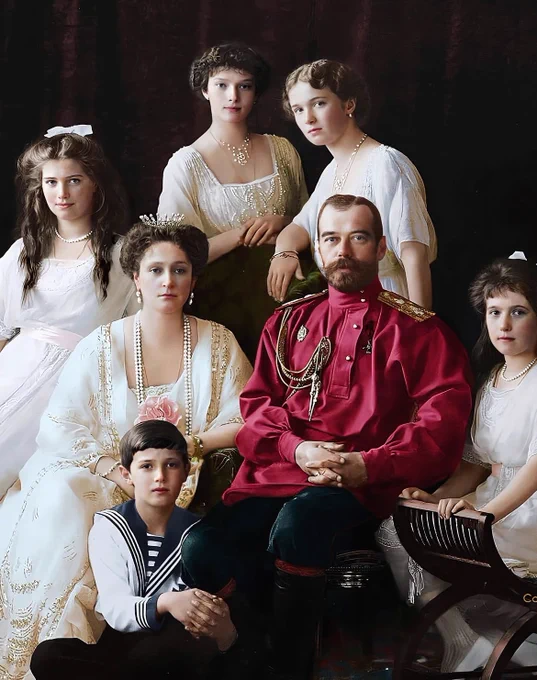
17 July 1918: The Martyrdom of the Holy Imperial Family of Russia
Around midnight, between 16 and 17 July 1918, they were awakened and taken, together with four other members of their household, to the basement of the house, supposedly in order to be moved to a safer location. After a long wait, they were ordered to stand in a line so that a photograph could be taken of them.
Suddenly, instead of a photographer, eleven Bolsheviks entered the small room, led by Yakov Yurovsky, and began shooting their victims. The death of some was slow and agonizing, such as that of the young heir, Alexei, who was finished off with blows to the head, and Princess Anastasia, who was killed with bayonets.
They then took from the dead whatever valuables they had on them and hurriedly transported the bodies by truck to a nearby forest, where they threw them naked into a mine shaft. Fearing, however, that the bodies might be discovered, the following night they pulled them out and, after dismembering them, burned them, pouring 300 liters of gasoline over them. To destroy the remaining traces of the martyrs, they poured 190 kilograms of vitriol over them. Finally, whatever remained was hastily covered with soil and branches.
This entire horrific process lasted three days and nights from the moment of their murder.
The eleven martyrs of 17 July 1918:
• Tsar Nicholas II Alexandrovich Romanov, age 50
• Tsarina Alexandra Feodorovna, age 46
• Grand Duchess Olga, age 23
• Grand Duchess Tatiana, age 21
• Grand Duchess Maria, age 19
• Grand Duchess Anastasia, age 17
• Tsarevich Alexei, age 14
• Physician Eugene Botkin
• Cook Ivan Kharitonov
• Lady-in-waiting Anna Demidova
• Valet Alexei Trupp
Saint Nectarius of Optina had prophesied in 1917:
“Difficult times are coming soon! The year 1918 will be even worse. The Tsar and his entire family will be tortured and murdered… If we do not repent and return to God, then not only Russia, but all of Europe will collapse. The hour of prayer has come!”
Holy Royal Martyrs, intercede for us. ☦️🇷🇺
Show more











