

Warp
@warpdotdev
The open platform for automating development. Infrastructure to build, measure, and interact with agents across the SDLC
3 Following 58.9K Followers

In a fully humming factory, the key characteristic is that it’s a closed loop, measurable, improvable system. This should be the goal.
In such a system everyone is working from the same context, in public, in a fully-audited, observed way. Agents themselves are observing the skills and config that drive the system and suggesting improvements. Platform engineers are able to extend the system to integrate it into all internal systems. Engineering leaders can see productivity metrics and understand what changes are being made to improve them. The whole thing is running empirically, not on vibes.
Show more
It may be time to start automating some of those Claude Code tabs you have running...
The software factory approach is getting pretty popular, but it can be daunting to adopt all at once.
Let's go through “crawl, walk, run” steps for making the transition from local, interactive agents to automated cloud development.
Show more

Skill GitHub has been achieved internally


/remote-control with Grok Build CLI is my favorite feature of this launch.
Run `grok` in the Warp Terminal and click `/remote-control` to copy a session sharing link to your keyboard. With this, you can:
> paste it in your browser and continue the same exact session from there
> send the link to a friend to work on (v helpful for hackathons, etc), your phone, or another device
> embed the link in an iFrame anywhere (lots of cool project i'd love to see doing this)
and did i mention... this + all of Warp is open source? 🙂
Show more

Model selection is a huge driver for AI spend; we just reduced our cost-per-PR from $80 to $30 by switching from Opus 5 to GPT 5.6. We made this decision not by guessing, but by benchmarking. I want to show you how you can do this too!
Join me for a live session on building custom model benchmarks:
Thursday, September 17th 2pm ET
We'll build a custom benchmark that replays your past agent conversations against a set of different models to find the best cost/performance pick. I'll whiteboard the entire setup so you can do this yourself, and we'll walk through the batteries-included version with Warp Factories.
RSVP: 📅
Show more

Warp now has built-in support for the Grok Build CLI.
- Use Warp's rich input for agent prompts, with support for longer pasted prompts and multi-cursor
- Use /remote-control to share your agent session to another device
- Access the file explorer and code review panels
Show more

Software factories should be built on an infrastructure stack that is open, composable, and defined-in-code.
This article lays out the principles that apply to anyone who is looking to move to a factory model.
Show more
Our cost-per-PR keeps trending down. Now we're at $30.
The biggest drivers:
- Benchmarking models on our own data to find the most efficient cost/performance pick. GPT 5.6 Sol (high) today
- Letting agents review past conversations and PR skill patches for bad instructions and adjusting our skills accordingly
$30 still seems expensive on average though. I think we can get this to $10 or lower, and we are still figuring out what good looks like here. Obviously not all PRs are equal.
Show more

Excited to support!

I’m excited to finally announce the newest edition my Stanford course 𝗧𝗵𝗲 𝗠𝗼𝗱𝗲𝗿𝗻 𝗦𝗼𝗳𝘁𝘄𝗮𝗿𝗲 𝗗𝗲𝘃𝗲𝗹𝗼𝗽𝗲𝗿. It has been 9 months in the making.
Last November, with the release of Claude Opus 4.5, coding agents experienced a step function improvement in capability. We all felt it. The LLMs were more powerful, could reason for longer, solve harder tasks.
This year’s iteration of my course reflects the 2026 metamorphosis of software engineering.
My core belief is simple: AI-native developers of the LLM era are going to become the most important members of any software organization. I have designed my course to train this next generation of engineers.
𝗪𝗵𝗮𝘁’𝘀 𝗱𝗶𝗳𝗳𝗲𝗿𝗲𝗻𝘁 𝘁𝗵𝗶𝘀 𝘁𝗶𝗺𝗲 𝗮𝗿𝗼𝘂𝗻𝗱
First, 85% of my Fall 2025 class material is being thrown out. The Fall 2026 syllabus reflects the core capabilities AI-native engineers must have: agent skills, advanced context engineering, MCP portals, agent-ready codebase principles, agentic code review, security, parallelizing background agents, software factories, and more.
Second, I am going to teach my students how to have software taste. Every student will be required to ship pull requests to production-grade, real-world codebases. The course is collaborating with the top open-source AI repos who will offer support and mentorship to students on how to meaningfully contribute to their projects.
This has never been done before in any university course so I am incredibly grateful to our OSS Partners: @browserbase, @HeyGen, @CopilotKit, @semgrep, @OpenHandsDev, @milvusio, @marimo_io, Pi, @crewAIInc, @warpdotdev, @vercel, @cmux, @arizeai, @UnslothAI, and @anyscalecompute.
𝗪𝗵𝗮𝘁’𝘀 𝘀𝘁𝗮𝘆𝗶𝗻𝗴 𝘁𝗵𝗲 𝘀𝗮𝗺𝗲
I’m fortunate to again have AI software engineering leaders and founders as guest speakers to share their learnings from building top coding agent products. Thank you to @leerob from @cursor_ai, @bcherny of @claudeai code, @EnoReyes of @FactoryAI, @silasalberti of @cognition, @0xine of @semgrep, Rajesh Bhatia of @Cloudflare , @amasad of @Replit, and @eladgil.
All resources will be available online. All classes will be available to the public.
9/22 on Stanford campus. See you in class.
Show more

We used a Factory Benchmark to reduce cost-per-PR from $80 to $30.
Benchmarking on your own data is a seriously powerful pattern.

We benchmarked the top models on our own coding tasks. The results:
- GPT 5.6 Sol (high) won on performance
- Grok 4.6 (high) was the runner-up
- GLM 5.3 Flash won on cost at comparable quality
All 50%+ cheaper than our previous default (Opus 5)
Show more

Public benchmarks are easy to game. The best solution: benchmark on your own data
RSVP so you don't miss it!
I'm hosting a workshop next Thursday, Sept 3rd on how to build self improvement loops for agents. The idea is simple, yet super powerful: build agents that review past conversations, score the quality, and suggest skill improvements to fix inefficiencies.
You'll walk away with a workflow you can apply to any setup, and an understanding of how this fits into a wider approach for software development with Warp Factories. Hope to see you there!
RSVP: 📅
Show more

Uses the skills backing our Warp Factories self improvement loop 👀
Introducing /skill-doctor v1
Skill doctor is a skill that improves your skills:
- Crawls your past CC, Codex, or Warp convos
- Scores them for efficiency and code quality
- Proposes diffs to your skills that you'd actually merge (STE-100 approved)
🔖
Show more

Been seriously impressed adding self-improvement to our agent conversations so far.
We've merged 5 self-improvement PRs in the past few days, including this one that caught token burn in our message passing system for orchestration
Show more

We're building a debugger for agents internally.
Breaks down costs by agent + subagent tasks, shows agent processes on a timeline, tracks the exact dollar amount spent.
Would you use it?
Show more

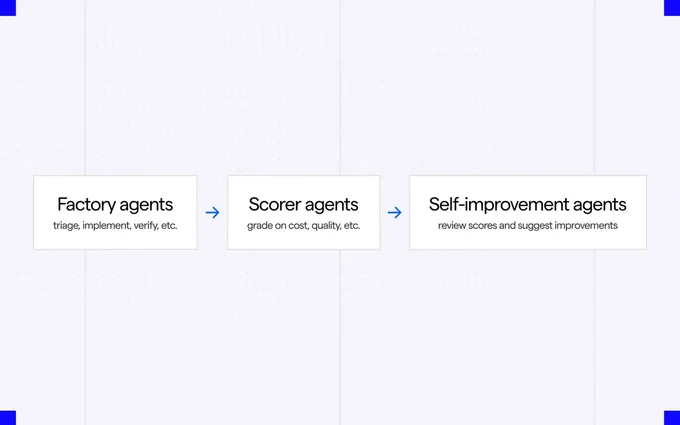
Introducing self-improvement loops.
The concept is simple: what if agents could improve Skills by reviewing past conversations?
Here's the three step loop:
- Score conversations from criteria you define
- Isolate failures
- Generate skill improvements
Show more

We're experimenting with hosting Warp Factories on So far, the DX has been incredibly clean!












