Search results for AgentObservability
AgentObservability community
One keyword maps to one global community path.
People
Not Found
Tweets including AgentObservability

🔍 A DeepSeek Harness Plugin That Lets AI Explain the Agent's Own Trace
Less than two weeks after DeepSeek Harness entered developer preview, its plugin ecosystem is already taking shape.
Zhihu contributor 刘琦 built DSH Trace Insight, a focused plugin for one of the most important but overlooked parts of Agent engineering: understanding what an Agent actually did.
1️⃣ DeepSeek Harness exposes the process
Many Agent harnesses behave like black boxes. Users provide a task, wait, and eventually receive an answer.
DeepSeek Harness is different. Its trace records tool calls, execution steps, failures, retries, and other intermediate activity.
This makes the Agent more transparent, but the raw trace is stored as a large JSONL file. Even with filtering, it is difficult for a human to read and reconstruct the full process.
The author's idea was straightforward:
If the trace is too complicated for humans, let another AI interpret it.
2️⃣ Turn raw traces into readable analysis
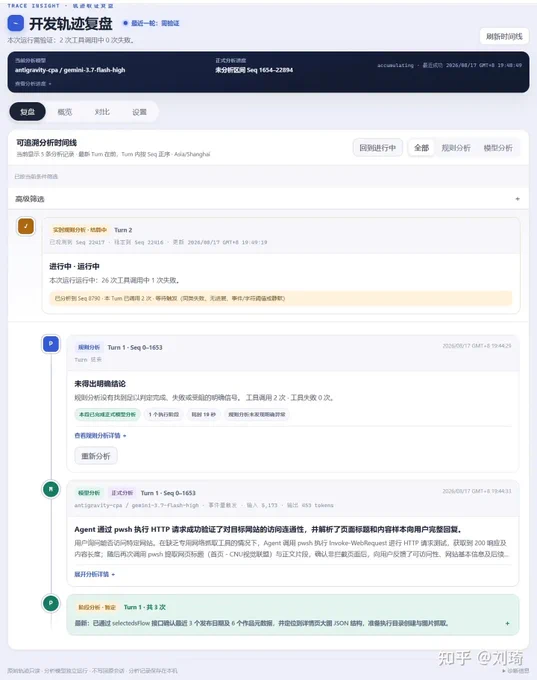
DSH Trace Insight adds a side panel that asks an AI model to explain the running trace.
It can summarize:
🔹 What the Agent is doing
🔹 Which methods and tools it used
🔹 Where errors or retries occurred
🔹 Whether any risky actions appeared
🔹 What lessons can be extracted from the run
Instead of waiting beside an opaque progress indicator, users can inspect how the task is progressing, whether the approach is working, and how risky the current behavior looks.
The goal is not to add another capability to the executing Agent. It is to add an interpretability layer around the Agent's behavior.
3️⃣ Use two models for cross-checking
When a suspicious step appears, the plugin can send the same trace to two different AI models and compare their analyses.
This is useful because trace interpretation is still a model-generated judgment. A second model can expose disagreements, missed risks, or different readings of the same tool call.
The plugin can also organize detected issues into a compact list for manual review.
That creates a useful three-layer workflow:
Agent execution → AI trace analysis → human review
It is a lightweight approach to Agent observability without requiring users to inspect thousands of raw log lines.
4️⃣ Installation is intentionally simple
The plugin is open source under the MIT license:
Users can ask their Agent to install it directly with:
Please install this DSH plugin:
The current version is designed for the native DeepSeek Harness Web UI.
Using it inside third-party desktop wrappers may require additional development, since those clients may package or modify the original Web UI differently.
5️⃣ DeepSeek Harness can become a model worker behind Codex
The author also suggests an interesting setup for people who do not use DeepSeek Harness as their primary Agent interface.
Open the native DSH Web UI inside Codex's browser. Codex remains the main harness, while it operates DeepSeek Harness and the models connected to it.
This creates a layered workflow:
🔹 Codex handles planning and orchestration.
🔹 Lower-cost non-GPT models inside DSH perform lightweight tasks or code inspection.
🔹 DSH Trace Insight exposes how those models executed the work.
🔹 Codex can discuss the results with DSH across multiple rounds, then send the final conclusion to another strong model for an additional review.
Compared with assigning every subtask to an expensive model, this setup can reduce cost. Compared with calling another CLI tool blindly, it provides much better visibility into execution.
✅ The real value is observability
DSH Trace Insight does one thing: it translates an Agent's raw execution history into something humans can understand.
That simplicity is its strength.
As Agents begin running longer tasks with more tools and greater autonomy, the important question is no longer just whether they produced the correct answer.
We also need to know how they reached it, what failed along the way, and whether they crossed any risky boundaries.
🔗 Full Reading:
#DeepSeek# #DeepSeekHarness# #AIAgents# #AgentObservability# #OpenSourceAI# #AIEngineering#
Show more




Protect sensitive data without giving up voice agent observability.
LiveKit PII Redaction automatically removes personal information from transcripts and recordings before it is stored. It is included with LiveKit Agent Observability at no additional cost.
Read more:
Show more


🧠 4. AGENT FLIGHT RECORDER
Give Hermes accountability.
Record the important trail:
• decisions
• tool calls
• file changes
• agent handoffs
• failures
• recovery attempts
Then you should be able to ask:
-What changed?”
-Which agent changed it?”
-Why did you do that?”
-Can I roll it back?”
Why: Agent observability becomes more important as autonomy increases.
Show more

Moving AI agents from prototype to production faster than ever? Don't let rapid iteration hide critical runtime behavior.
Tune in to What's New Wednesdays: Vibe-code, trace, and deploy your agents to explore:
• Production agent observability workflows in W&B Weave
• Evaluating and self-improving agent loops at scale
• Real-world takeaways from CoreWeave Hacks
Register here:
Show more


The hyperscalers didn’t just build businesses renting out CPU compute. They built extremely valuable products around data, networking, security, storage, etc. We’re now building around AI accelerators, but the playbook of building value add software on top is the same.
Turns out GPUs are really good for running AI models. That is why inference engines, which take a trained model and compute and produce intelligent tokens that can do real work, have become the first piece of this software stack. But, there is so much more to build than just this!
Training helps you turn compute into better models that produce more valuable tokens. Routing helps you pick the right model to generate those tokens at the right cost and quality. Security monitoring helps you check what’s going into and coming out of those models. Then there’s agent observability, context management, sandboxing, etc. All of these things will be part of the new AI stack and the opportunity is much bigger than just serving a model.
This definitely isn’t a winner-take-all market, whether we’re talking about open models vs. the frontier or the players within each category. Customers want choice, flexibility, and access to the fundamental building blocks to create their own systems.
Constrained GPU supply will actually act like a regularizer and draw this fight out longer. Customers are looking for both compute capacity AND value add on top of it. When someone doesn't have capacity, you go somewhere else. That means more players get exposure to customers and the opportunity to address value add.
Getting a customer because you have available GPUs is different from keeping them because your software is better. In the limit, the value add on top of the GPU will win out. The companies that do the best job building that software AND verticalize the fastest to own everything from chip to token will take the lion’s share. It’s important to be building for that now, even when the immediate customer need is just more compute.
Show more

New capabilities in the Gemini Enterprise app:
1. Combine generative intelligence and deterministic business logic to manage enterprise reliability
2. Scale the agentic task force with autonomy
3. Collaborate with your colleagues and agentic task force in real time
4. Govern with confidence with complete agent observability and traceability
5. Connect your ecosystem
Explore our suite of agent building and management tools, here →
Show more


🚨 ClickHouse's net dollar retention is currently above 200%.
20VC just dropped a fantastic new episode with Aaron Katz, CEO of ClickHouse.
A must-listen for every $NBIS investor.
Here’s my detailed summary:
1) ClickHouse is growing at an insane pace.
The revenue trajectory Aaron shared was:
$0M → $12M → $50M → $200M → $500M+ expected this year.
He believes ClickHouse can reach $1B in ARR before December 2027.
2) The company could go public as early as next year if it wanted to, but there’s no rush.
His goal is to build a company that lasts decades, not optimize around the next financing round or IPO window.
He also highlighted some of the downsides of being public today, particularly the volatility and the impact that large stock-price moves can have on employees.
3) Net dollar retention is above 200%.
That’s mind-blowing.
The reason is that customers tend to start with one workload and then expand ClickHouse into others: data warehousing, real-time analytics, observability, customer-facing applications, etc.
That expansion dynamic is extremely powerful.
Importantly, gross retention is above 99%.
4) ClickHouse now has 4,000+ customers.
Some customers spend tens of millions of dollars per year, while he estimates the midpoint production customer is around $100k.
Importantly, AI-native companies still represent less than 12% of revenue.
So despite ClickHouse being one of the major infrastructure beneficiaries of the AI boom, there appears to be relatively little customer concentration risk.
5) Enterprise adoption is accelerating.
Aaron said sales cycles at large enterprises are compressing significantly.
Historically, sales cycles into major financial institutions could be measured in years rather than quarters. Now, companies are adopting new technologies much faster.
Open source and product-led growth help here because customers can evaluate, deploy and scale ClickHouse without going through a traditional enterprise sales process first.
6) AI agents could massively expand database consumption.
Aaron thinks the database requirements of agentic applications are fundamentally different from traditional software.
Humans tend to run predictable reports and dashboards. Agents can simultaneously execute dozens of unpredictable queries across multiple systems.
That makes three things increasingly important:
Latency. Throughput. Efficiency.
One example he gave: Tesla is ingesting around 1 billion events per second into ClickHouse.
And unlike humans, agents don’t naturally care about limiting consumption. That means query volumes could explode.
7) Eventually, agents may choose the infrastructure themselves.
Today, a developer might ask Claude: “What database should I use?”
And Claude might recommend ClickHouse.
Aaron expects that eventually the agent itself will provision the entire stack: database, networking, compute, storage, etc.
In that world, infrastructure companies won’t just be competing for developers. They’ll also be competing to become the default choice of AI agents.
ClickHouse is already benefiting from that dynamic.
He said Anthropic told them it chose ClickHouse for a specific observability workload after asking Claude which technology it should use.
His long-term goal is therefore straightforward: make ClickHouse the default database for applications built by agents, not just humans.
8) AI is accelerating ClickHouse’s own development roadmap.
Internally, ClickHouse’s Anthropic usage has increased roughly 100x since the beginning of the year.
He said the company is shipping products faster than ever and entering product categories roughly two years earlier than originally planned.
His view on AI coding costs is simple: if product velocity and revenue growth keep accelerating, he doesn’t care much about optimizing token spend today.
Especially because inference costs should continue declining.
9) ClickHouse probably underinvested in sales.
The company has only around 100 quota-carrying salespeople despite operating at hundreds of millions in revenue.
Aaron admitted that, looking back, he should have increased sales capacity sooner.
Competitors in data warehousing and observability can have thousands of salespeople.
ClickHouse intentionally focused on product, engineering and product-led growth first, following something closer to the Datadog playbook than Snowflake’s enterprise-heavy GTM strategy.
Now it's layering a larger enterprise sales motion on top.
10) The company is unusually efficient.
ClickHouse has close to 800 employees and expects to reach around 1,000 by year-end.
Despite that, it's already generating hundreds of millions in revenue with only ~100 quota-carrying salespeople.
Aaron said average sales rep productivity is very high relative to the industry.
11) ClickHouse is already a very international business.
More than half of revenue comes from outside the US.
Roughly 40% from EMEA, 10% from Asia.
More than half of customers are also outside North America.
ClickHouse is live in 36 regions around the world across AWS, Google Cloud and Azure.
That global footprint is one reason Aaron believes the company can’t operate from just one or two centralized hubs.
12) ClickHouse is also seeing renewed interest in on-prem infrastructure.
Aaron said even some highly innovative digital-native Silicon Valley companies are discussing moving parts of their stack away from hyperscalers and back on-prem.
That matters because ClickHouse wants to support multiple deployment models: cloud and on-prem/private environments.
His view is that forcing enterprises into one deployment model ultimately limits the addressable market.
13) The moat isn’t simply the open-source database.
One common investor concern is:
“What stops AWS, Google or Microsoft from just offering ClickHouse themselves?”
Aaron acknowledges this risk.
His answer is that open-source companies need to maintain proprietary/cloud functionality that's sufficiently difficult to replicate.
He also says the competitor he fears most isn’t Snowflake or Databricks. It’s the company that doesn’t exist yet.
ClickHouse itself appeared seemingly out of nowhere and disrupted established database vendors. He worries about someone eventually doing the same to ClickHouse.
14) ClickHouse wants to become much broader than an analytical database.
The company has already completed six acquisitions in four years.
The most recent example mentioned was Langfuse, which pushed ClickHouse further into AI agent observability.
His framework is interesting:
If ClickHouse can build something internally, let engineering do it. If an exceptional team is already building a product on top of ClickHouse in an area that will eventually belong inside the broader platform, consider acquiring them.
The ambition is clearly moving toward becoming a much broader data platform.
15) ClickHouse has a very strong balance sheet.
Aaron said the company had around $1B on the balance sheet and didn’t actually need the additional capital from its recent financing.
That gives ClickHouse plenty of flexibility to keep investing aggressively in product, hiring, M&A and international expansion.
16) Aaron thinks AI infrastructure revenue is more durable than application-layer revenue.
He believes the biggest risk when investing in many AI application companies is revenue durability.
Applications can have relatively low switching costs. Infrastructure tends to have much higher switching costs once it becomes deeply integrated into production systems.
That's one reason he's skeptical of simply extrapolating hypergrowth at some AI application companies indefinitely.
For infrastructure, slower initial adoption can actually produce much more durable revenue later.
17) He definitely doesn’t believe AI is a bubble.
When asked for a widely held AI belief he disagrees with, Aaron picked the idea that AI is overhyped or simply another temporary hype cycle.
“We’re just getting started.”
He lived through internet, mobile and social, and says none of those cycles accelerated as quickly as AI is accelerating today.
The combination of AI applications, agents and exploding data consumption could create infrastructure demand unlike anything we’ve seen before.
FINAL THOUGHTS
ClickHouse is incredibly well positioned to benefit from the surge in data consumption driven by AI agents and increasingly compute-intensive workloads.
$NBIS investors shouldn’t assume an IPO is imminent. Aaron said ClickHouse could go public as early as next year, but made it clear there’s no urgency to do so.
That might actually be the right decision for long-term value creation. If ClickHouse continues executing at anything close to its current pace, I can clearly see a path toward becoming a $100B+ company over the next few years.
Any analyst valuing $NBIS without accounting for its stake in ClickHouse is missing a significant part of the picture.
Show more
