Search results for AIEngineering
AIEngineering community
One keyword maps to one global community path.
People
Not Found
Tweets including AIEngineering

🔍 A DeepSeek Harness Plugin That Lets AI Explain the Agent's Own Trace
Less than two weeks after DeepSeek Harness entered developer preview, its plugin ecosystem is already taking shape.
Zhihu contributor 刘琦 built DSH Trace Insight, a focused plugin for one of the most important but overlooked parts of Agent engineering: understanding what an Agent actually did.
1️⃣ DeepSeek Harness exposes the process
Many Agent harnesses behave like black boxes. Users provide a task, wait, and eventually receive an answer.
DeepSeek Harness is different. Its trace records tool calls, execution steps, failures, retries, and other intermediate activity.
This makes the Agent more transparent, but the raw trace is stored as a large JSONL file. Even with filtering, it is difficult for a human to read and reconstruct the full process.
The author's idea was straightforward:
If the trace is too complicated for humans, let another AI interpret it.
2️⃣ Turn raw traces into readable analysis
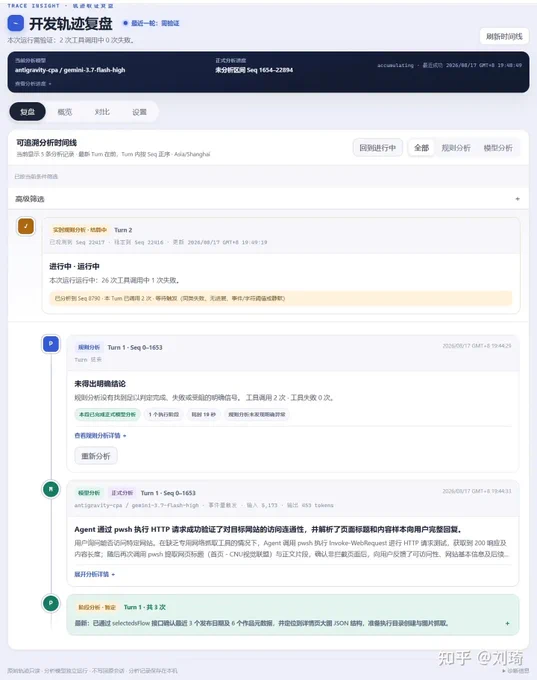
DSH Trace Insight adds a side panel that asks an AI model to explain the running trace.
It can summarize:
🔹 What the Agent is doing
🔹 Which methods and tools it used
🔹 Where errors or retries occurred
🔹 Whether any risky actions appeared
🔹 What lessons can be extracted from the run
Instead of waiting beside an opaque progress indicator, users can inspect how the task is progressing, whether the approach is working, and how risky the current behavior looks.
The goal is not to add another capability to the executing Agent. It is to add an interpretability layer around the Agent's behavior.
3️⃣ Use two models for cross-checking
When a suspicious step appears, the plugin can send the same trace to two different AI models and compare their analyses.
This is useful because trace interpretation is still a model-generated judgment. A second model can expose disagreements, missed risks, or different readings of the same tool call.
The plugin can also organize detected issues into a compact list for manual review.
That creates a useful three-layer workflow:
Agent execution → AI trace analysis → human review
It is a lightweight approach to Agent observability without requiring users to inspect thousands of raw log lines.
4️⃣ Installation is intentionally simple
The plugin is open source under the MIT license:
Users can ask their Agent to install it directly with:
Please install this DSH plugin:
The current version is designed for the native DeepSeek Harness Web UI.
Using it inside third-party desktop wrappers may require additional development, since those clients may package or modify the original Web UI differently.
5️⃣ DeepSeek Harness can become a model worker behind Codex
The author also suggests an interesting setup for people who do not use DeepSeek Harness as their primary Agent interface.
Open the native DSH Web UI inside Codex's browser. Codex remains the main harness, while it operates DeepSeek Harness and the models connected to it.
This creates a layered workflow:
🔹 Codex handles planning and orchestration.
🔹 Lower-cost non-GPT models inside DSH perform lightweight tasks or code inspection.
🔹 DSH Trace Insight exposes how those models executed the work.
🔹 Codex can discuss the results with DSH across multiple rounds, then send the final conclusion to another strong model for an additional review.
Compared with assigning every subtask to an expensive model, this setup can reduce cost. Compared with calling another CLI tool blindly, it provides much better visibility into execution.
✅ The real value is observability
DSH Trace Insight does one thing: it translates an Agent's raw execution history into something humans can understand.
That simplicity is its strength.
As Agents begin running longer tasks with more tools and greater autonomy, the important question is no longer just whether they produced the correct answer.
We also need to know how they reached it, what failed along the way, and whether they crossed any risky boundaries.
🔗 Full Reading:
#DeepSeek# #DeepSeekHarness# #AIAgents# #AgentObservability# #OpenSourceAI# #AIEngineering#
Show more




TL;DR: Same Claude Opus, no harness → $9 outcome in 20 minutes. Same model, full harness → $200 working product in 6 hours. This open-source curriculum teaches why — systematically.
learn-harness-engineering
"The model is smart. The harness makes it reliable." — 14 lectures and 8 projects covering harness engineering for AI coding agents. ⭐️ 13.7k
Key points
🔧 5 subsystems form the harness skeleton
· Instructions: AGENTS.md and structured guidance make the repo the single source of truth
· State: claude-progress.md + git history enable multi-session continuity
· Verification: tests, lint, E2E pipelines prevent false completion claims
· Scope: explicit completion criteria enforce one-feature-at-a-time progress
· Session Lifecycle: init → implement → verify → commit → handoff as a structured protocol
📚 Progressive learning path
From fundamentals (seeing the problem, structuring repos) to advanced patterns (automated loops, graph-based workflows, Human-in-the-Loop). A shared Electron knowledge-base app provides hands-on practice at every stage.
⚡ Instantly applicable to existing projects
Copy AGENTS.md, and feature_list.json from the template library into any project root for immediate structured context and scope constraints. The zero-dependency diagnoses harness quality on the spot.
🌐 Current frontier harness designs included
Breakdowns of Pi, Claude Code, Codex, and DeepSeek harness architectures (added August 2026), plus loop and graph engineering lectures with templates (July 2026) — the course continuously reflects real-world practice.
The shift from "prompt the agent better" to "design the environment for reliability" is what 13.7k engineers are endorsing here.
#CodingAgent# #AIEngineering#
Show more

✍️ Now that AI can write hundreds of syntactically valid lines per second, the developer's job has shifted from "writing" to "reading and verifying." That shift changes what we should want from a programming language.
Why Go is an Ideal Language for AI-Assisted Software Engineering
🔍 Overview
Google's Go team makes the case for Go as the ideal language for the AI-assisted development era. As the bottleneck moves from code generation to review and verification, the language properties that matter most have flipped — readability and maintainability win over writability and expressiveness.
⚠️ The Problems Being Solved
・LLMs frequently hallucinate type mismatches and non-existent properties
・Dynamically typed languages (e.g. Python) only catch these errors at runtime
・AI-generated code often pulls in stale packages or vulnerable dependencies
・Repeated refactoring passes degrade accuracy (~95% first-pass, declining)
🛠 How Go Addresses Each
・gofmt enforces uniform formatting — AI output is always syntactically predictable
・Static typing + fast compilation: rejects errors instantly, orders of magnitude faster than Java, C#, or Rust
・govulncheck: low-noise vulnerability scanning targeted only at invoked symbols
・Native fuzz testing: continuous discovery of boundary-condition bugs
・15 years of strict backward compatibility: Go 1.0 code runs unchanged today
📌 The Counterintuitive Conclusion
"As developers write less code, language choice becomes more critical." Absorbing AI's high-velocity output safely requires deterministic guardrails — and Go was designed for exactly that.
#Golang# #AIEngineering#
Show more

🚀 An ebook that takes FastAPI from your first endpoint all the way to production-scale AI systems — going deep on LLM/RAG serving, with interview questions at the end of every chapter.
Title: FastAPI for AI Engineers: From First Endpoint to Production-Scale AI Systems
URL:
🚀 Overview
A practical guide (First Edition, 2026, by AI Engineering Insider) for AI engineers serving ML models and LLM/RAG systems in production with Python. It spans 10 chapters and 100 interview questions, woven with real-incident case studies and cost-model sidebars.
❓ Challenges Solved
・Building a model is one skill; serving it safely as a scalable production API is another
・LLM/RAG serving has its own hard parts — streaming, guardrails, cost control
The book reframes FastAPI as "the de facto serving layer for AI and ML systems."
💡 Structure & Tech Covered
・Foundations: ASGI/WSGI, Uvicorn, OpenAPI, and Pydantic v2 schema separation and validation
・Implementation: idempotency, meaningful status codes, pagination, and the Router→Service→Repository clean architecture
・DB/Security: SQLAlchemy/SQLModel/Alembic, N+1, pool sizing, JWT, BOLA defense, OWASP API Top 10
・Async: "never block the event loop," def vs async def, and httpx retries/circuit breakers
🎯 The Core (Ch.9: AI/RAG/LLM)
・Load model weights once in lifespan; offload CPU inference to a thread
・An LLM gateway centralizing auth, prompts, guardrails, and cost metering, with SSE token streaming
・Build RAG with embeddings + a vector DB (start with pgvector); validate output with Pydantic, then retry on failure
・Enforce max_tokens as a "spending limit" via the type system
📊 Highlights
・Practice-first, learning from real incidents (Netflix, Stripe, GitLab, Optus, Air Canada)
・Ch.10 covers Gunicorn+Uvicorn, K8s liveness/readiness, the three pillars of observability (p99 vs p50), and SLO-based alerting
#FastAPI# #AIEngineering#
Show more

With AI Engineering skills, you actively shape the build: You influence what gets built, and drive the build loop. Here're key skills to do this.

Anthropic AI engineer just showed how to give AI agents real memory in 4 steps - and it changes everything
in 28 minutes he shows exactly how agents can remember across sessions, completely free
worth more than any $500 AI engineering course
here's what he covers:
• why agents forget everything between sessions
• memory stores - agents read, write across sessions
• dreaming - agents that improve their own memory
• 95% cache hit rate, so it stays cheap
most people are still copy-pasting context into every new chat - while the people who figured this out are building agents that get smarter every single night
watch full video then read article below
Show more


The worst part about AI engineering is how often does everyone think their weird esoteric bullshit actually matters.
I think it's a combination of sycophancy + non-determinism + models getting better so fast that you can associate model improvements with random changes you made to your environment. The result is that everyone's brains fall out as they overthink things that don't matter.
Show more

Behind the scenes at AI Infra Summit!
@MattKimball_MIS and @BrendanBurkeX sat down with leaders from @Ambarella_Inc, @wd_corporation, @Synopsys, and @MiTACcomputing to explore edge AI, storage, AI engineering, and scalable systems.
Full interviews coming soon!
Show more


Everyone wants to build AI agents. Almost nobody has a reading list.
They watch one YouTube video, skim a Twitter thread, then wonder why their agent falls apart the moment it needs to plan, use a tool, or remember anything.
Here's the resource list I wish someone had handed me on day one. Every link, organized by what it actually teaches. Save this one.
**VIDEOS**
1. LLM Introduction:
2. LLMs from Scratch:
3. Agentic AI Overview (Stanford):
4. Building and Evaluating Agents:
5. Building Effective Agents:
6. Building Agents with MCP:
7. Building an Agent from Scratch:
8. Philo Agents (playlist):
**REPOS**
1. GenAI Agents:
2. Microsoft's AI Agents for Beginners:
3. Prompt Engineering Guide:
4. Hands-On Large Language Models:
5. GenAI Agents (alt link):
6. Made with ML:
7. Hands-On AI Engineering:
8. Awesome Generative AI Guide:
9. Designing Machine Learning Systems:
10. Machine Learning for Beginners (Microsoft):
11. LLM Course:
**GUIDES**
1. Google's Agent Whitepaper:
2. Google's Agent Companion:
3. Building Effective Agents (Anthropic):
4. Claude Code Best Agentic Coding Practices:
5. OpenAI's Practical Guide to Building Agents:
**BOOKS**
1. Understanding Deep Learning:
2. Building an LLM from Scratch:
3. The LLM Engineering Handbook:
4. AI Agents: The Definitive Guide — Nicole Koenigstein:
5. Building Applications with AI Agents — Michael Albada:
6. AI Agents with MCP — Kyle Stratis:
7. AI Engineering (O'Reilly):
**PAPERS**
1. ReAct:
2. Generative Agents:
3. Toolformer:
4. Chain-of-Thought Prompting:
5. Tree of Thoughts:
6. Reflexion:
7. Retrieval-Augmented Generation Survey:
**COURSES**
1. HuggingFace's Agent Course:
2. Build with Anthropic:
I'm not telling you to go through all 39 links this weekend.
Start with the Stanford overview, then Anthropic's "Building Effective Agents" guide, then ReAct. That sequence alone will teach you more about how agents actually work than most paid courses.
Save this post. You'll want it back in three weeks when you're stuck debugging why your agent keeps calling the wrong tool.
Repost if this saved you an afternoon of searching.
P.S. Which one are you starting with?
Show more

There will be no AI jobpocalypse.
The story that AI will lead to massive unemployment is stoking unnecessary fear. AI — like any other technology — does affect jobs, but telling overblown stories of large-scale unemployment is irresponsible and damaging. Let’s put a stop to it.
I’ve expressed skepticism about the jobpocalypse in previous posts. I’m glad to see that the popular press is now pushing back on this narrative. The image below features some recent headlines.
Software engineering is the sector most affected by AI tools, as coding agents race ahead. Yet hiring of software engineers remains strong! So while there are examples of AI taking away jobs, the trends strongly suggest the net job creation is vastly greater than the job destruction — just like earlier waves of technology. Further, despite all the exciting progress in AI, the U.S. unemployment rate remains a healthy 4.3%.
Why is the AI jobpocalypse narrative so popular? For one thing, frontier AI labs have a strong incentive to tell stories that make AI technology sound more powerful. At their most extreme, they promote science-fiction scenarios of AI “taking over” and causing human extinction. If a technology can replace many employees, surely that technology must be very valuable!
Also, a lot of SaaS software companies charge around $100-$1000 per user/year. But if an AI company can replace an employee who makes $100,000 — or make them 50% more productive — then charging even $10,000 starts to look reasonable. By anchoring not to typical SaaS prices but to salaries of employees, AI companies can charge a lot more.
Additionally, businesses have a strong incentive to talk about layoffs as if they were caused by AI. After all, talking about how they’re using AI to be far more productive with fewer staff makes them look smart. This is a better message than admitting they overhired during the pandemic when capital was abundant due to low interest rates and a massive government financial stimulus.
To be clear, I recognize that AI is causing a lot of people’s work to change. This is hard. This is stressful. (And to some, it can be fun.) I empathize with everyone affected. At the same time, this is very different from predicting a collapse of the job market.
Societies are capable of telling themselves stories for years that have little basis in reality and lead to poor society-wide decision making. For example, fears over nuclear plant safety led to under-investment in nuclear power. Fears of the “population bomb” in the 1960s led countries to implement harsh policies to reduce their populations. And worries about dietary fat led governments to promote unhealthy high-sugar diets for decades.
Now that mainstream media is openly skeptical about the jobpocalypse, I hope these stories will start to lose their teeth (much like fears of AI-driven human extinction have).
Contrary to the predictions of an AI jobpocalypse, I predict the opposite: There will be an AI jobapalooza! AI will lead to a lot more good AI engineering jobs, and I’m also optimistic about the future of the overall job market. What AI engineers do will be different from traditional software engineering, and many of these jobs will be in businesses other than traditional large employers of developers. In non-AI roles, too, the skills needed will change because of AI. That makes this a good time to encourage more people to become proficient in AI, and make sure they’re ready for the different but plentiful jobs of the future!
[Original text in The Batch newsletter.]
Show more
